

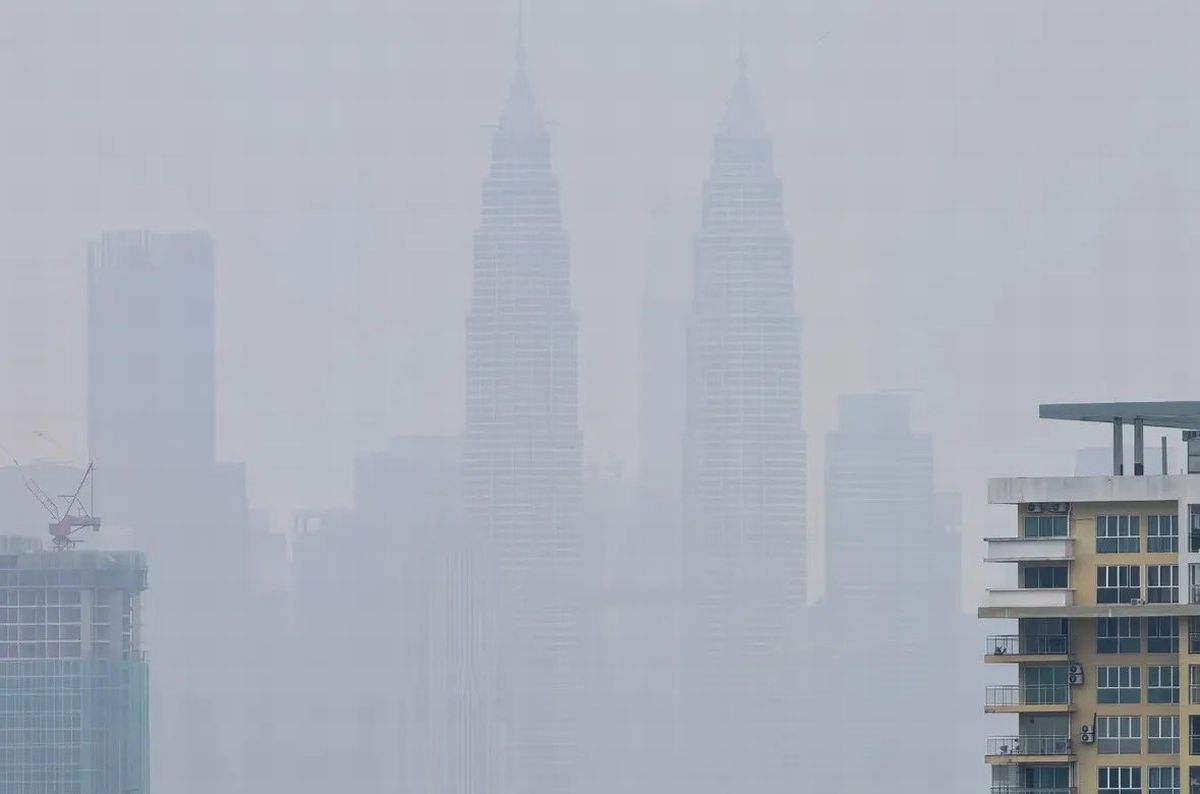
KUALA LUMPUR, Oct 13 — Bandar Kuching MP Dr Kelvin Yii proposed today that Malaysia impose haze-related sanctions on Indonesia via trade tariffs, amid prolonged forest and land fires in the neighbouring country.
The Sarawakian lawmaker pointed out that the Air Pollutant Index (API) reading in the state capital of Kuching reached 357 last September 1, followed by an emergency declaration in the district of Serian after its API reading surpassed 500 on September 4.
Haze affected air quality for 41 days in Sarawak until September 14. Under the API classification, readings of 201 to 300 are very unhealthy, whereas readings above 300 are classified as hazardous.
Haze in Malaysia is expected to persist until next year.
“Mr Speaker, the principle is simple: the polluter must pay,” said Dr Yii during a debate on an emergency motion on haze in the Dewan Rakyat’s Special Chambers today.
He said for Malaysian companies, a proposed Transboundary Haze Pollution Act must allow fines to be imposed directly on parent companies and directors proven to be responsible for the fires and haze, even when their operations are overseas.
“For foreign companies beyond our jurisdiction, Malaysia must be prepared to exercise its own trade powers. If international law cannot impose fines, I propose that the government study the introduction of a Haze Tariff or targeted trade restrictions on products from concessions proven to be involved in burning,” said Dr Yii.
“This is not about punishing the Indonesian people, who are also victims of the haze. We do not want to jeopardise our good relations with our neighbours.
“But companies that burn forests for profit must understand that their products will not enjoy easy access to the Malaysian market. The health of Malaysians must not continue to be sacrificed.”
Natural Resources and Environmental Sustainability Minister Arthur Joseph Kurup told Dr Yii in a written parliamentary reply last Tuesday that a proposed transboundary haze law must take into account various factors because enforcement will be challenging.
Trade tariffs, however, do not require legislation and can be imposed by any country on any trading partner on any goods.
Dr Yii urged the government to table a Transboundary Haze Pollution Bill and refer it to a parliamentary special select committee, so that MPs from both sides of the House can look at how a version of Singapore’s Transboundary Haze Pollution Act can be adopted in Malaysia, together with input from experts and civil society.
“I also support Greenpeace Malaysia’s proposal to make air quality standards legally binding and aligned with World Health Organization (WHO) guidelines,” he added.
The DAP lawmaker further told Malaysia to take the lead at the Asean level to ensure full compliance with the Asean Agreement on Transboundary Haze Pollution (AATHP). Malaysia was the first country to ratify the regional treaty in 2002.
“Between August 1 and 11, the ASEAN Specialised Meteorological Centre (ASMC) detected 75 hotspots in Sarawak, compared with 3,853 in Kalimantan. On the morning of October 7, Central Kalimantan recorded an API reading of 4,250, more than 14 times the hazardous threshold. Even last Saturday, the reading remained at 1,392,” said Dr Yii.
“As long as those fires continue, the smoke will continue to reach us.”
The most dangerous component of haze is PM2.5, fine particulate matter that penetrates the lungs and enters the bloodstream. It exacerbates asthma, triggers heart attacks and strokes, and disproportionately affects children, the elderly, and pregnant women.
Breathing in PM2.5 at a concentration of 22 micrograms per cubic metre throughout the day carries roughly the same health risk as smoking one cigarette, noted Dr Yii, citing Berkeley Earth scientists.
“When the API reading exceeds 300, that is equivalent to smoking approximately 11 cigarettes a day. On September 4, every resident of Serian, from newborn babies to the elderly, was breathing air equivalent to smoking approximately 23 cigarettes a day. That is more than an entire pack. In Kuching, at an API reading of 357, the equivalent was approximately 14 cigarettes a day,” said Dr Yii.
“We ban smoking in restaurants to protect non-smokers. Yet during the haze season, we force our children to ‘smoke’ more than half a pack of cigarettes a day against their will.”
Haze is also an economic crisis, noted Dr Yii.
“Clinics are crowded with patients, workers take sick leave, and productivity declines. Food delivery riders, farmers, construction workers, and hawkers have no choice but to continue working in the smoke. Tourism and small businesses are also affected.”
At a meeting yesterday, Indonesia President Prabowo Subianto reportedly ordered firefighting efforts in his country to be stepped up. Indonesia is currently focusing firefighting in Central Kalimantan and South Sumatra provinces.
However, Coordinating Political and Security Minister Dudung Abdurachman reportedly said that the Indonesian government’s meeting didn’t discuss offers from Malaysia and Singapore to help in suppressing the haze-causing fires, Channel News Asia reported.

