

KUALA LUMPUR, Sept 15 — Reports on terrible conditions of assets and staff quarters in the national health service have emerged beyond Flying Doctor Service (FDS) helicopters after the Long Lellang tragedy.
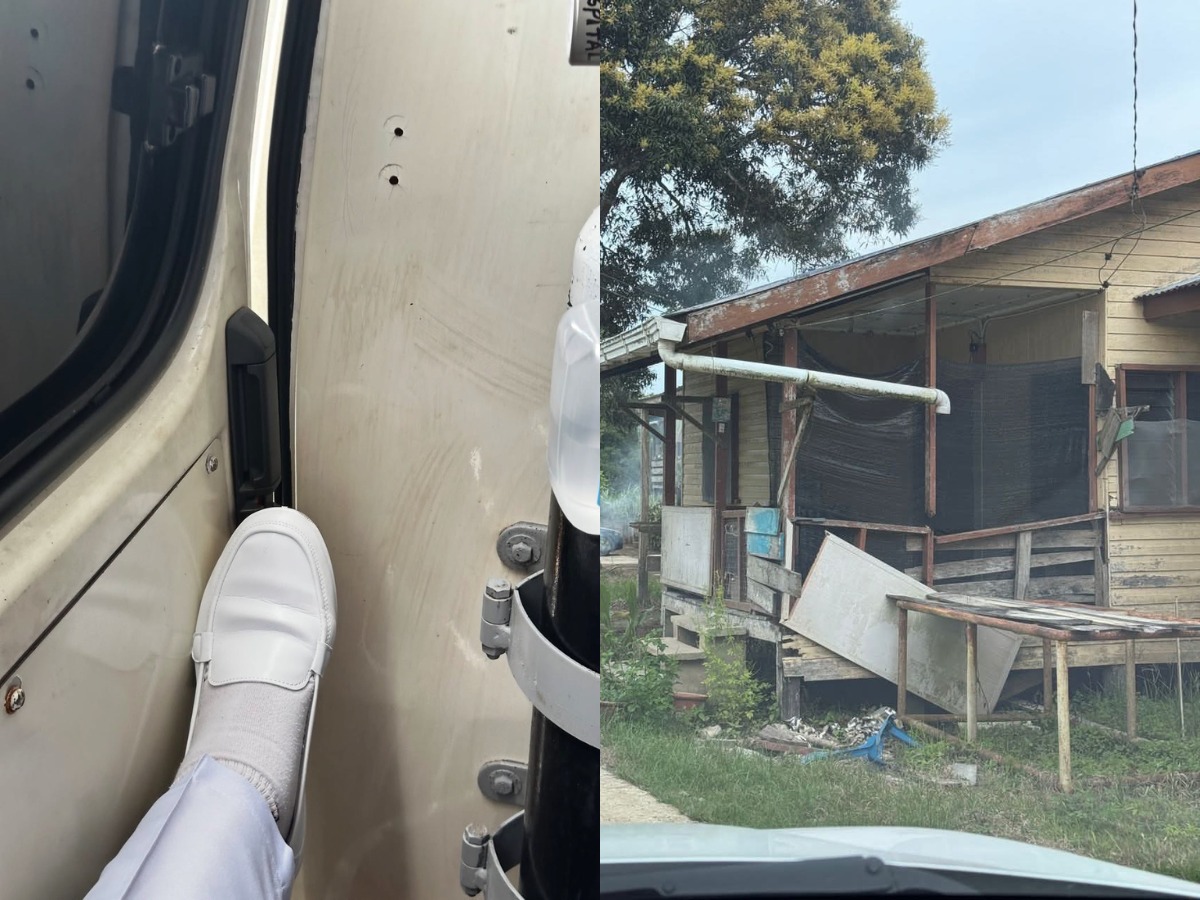
Public Health Malaysia (PHM), a pro-health Facebook page with 1.5 million followers, highlighted a nurse’s Threads post last Thursday that showed a video of her holding an ambulance door shut with her foot.
“Perhaps to others, it may look funny,” wrote PHM.
“But for the health care worker sitting at the back with the patient, this is no laughing matter. In that small space is a patient who may be struggling to breathe, in severe pain, or in need of monitoring. There is an oxygen cylinder, medical equipment and health care workers who need to ensure that the patient arrives safely.”
PHM stressed that an ambulance wasn’t merely a vehicle, but part of emergency care.
“A vehicle that is too old and worn out does not only affect comfort; it can compromise the safety of patients and staff, cause delays, and add to the stress of health care workers who are already working in challenging conditions,” it said.
“And this issue is not about blaming any driver or facility. They are using what they have. The bigger question is: have they been given assets that are good enough for them to carry out their duties safely?”

A doctor posted on Threads last Thursday a picture of a Ministry of Health (MOH) ambulance in Tuaran, Sabah, which appeared to be a remodelled pick-up truck, that she said she had used the last time she referred a patient to a hospital.
“The health minister who came to Tuaran recently should be escorted on this, then he can feel the pulse of the people and health care workers on the ground. My friends in the peninsula can compare to ambulances in their respective states – can you beat the dilapidation of our ambulances here?” she wrote.
A medical officer replied that in the interiors of Kudat, Sabah, health workers don’t even have 4×4 “ambulances”, but only vans to transport patients.
“When it’s raining and we need to transfer a patient, we get on mobile Hilux clinics and use a seatbelt to secure the oxygen tank. If the patient needs to lie down, they can only lie down in the backseat. We can’t put a stretcher on the back of the truck because then we can’t close the tailgate,” he wrote on Threads.
“Just pray that no one needs intubation in the clinic during rainy seasons.”

A nurse in public service claimed that her office would tell staff to continue using ambulances with bald tyres waiting to “burst any time” because of insufficient budget to replace the tyres.
“Ambulances from other KKs (public health clinics) are the same. Whenever we go to and fro sending cases on the ambulance, we recite two ‘kalimah syahadah’ first and call our mother and children before getting on the ambulance to make our apologies and pray for the afterlife.”
Another person posted a photo of an ambulance, which she said was from Kudat Hospital in Sabah, with the door’s rubber lining coming off. “The door flew open because the road condition wasn’t very good, but even the rubber came off. Luckily we weren’t thrown out of the ambulance.”
Yet another person posting on Threads claimed that ambulances in the peninsula had a mileage of 700,000 to 900,000.
“We in the peninsula may not travel as far as you in Sabah and Sarawak, but in the state where I’m serving, many Orang Asli still live in the jungle that can’t be accessed by any vehicle. We need to walk to their homes,” said the health worker.
“In the district, we borrow ambulances between KKs and hospitals. I don’t know what to say about their dilapidated status. The air-conditioning is broken. I was once drenched sitting in an ambulance transferring a patient.”

CodeBlue previously reported the case of an ambulance from Slim River Hospital in Perak that got into a fatal accident in August 2019 due to a burst tyre, killing a 66-year-old female patient and a 37-year-old male driver.
Then-Health director-general Dr Noor Hisham Abdullah claimed that the government ambulance’s tyres were well maintained and serviced. In September 2019, Health Minister Dzulkefly Ahmad, who is now in his second stint in office, pledged action then.
CodeBlue also previously reported that Medivest Sdn Bhd had provided Sultanah Aminah Johor Bahru Hospital (HSAJB) a fire extinguisher that malfunctioned during an October 2016 fire in its south intensive care unit that killed six patients, according to an independent inquiry.
A decade after the country’s biggest fire tragedy in a public hospital, Dzulkefly has yet to publish the report by the independent committee chaired by former Court of Appeal judge Hishamudin Yunus, which was handed to the health minister in June 2018.
Extremely Dilapidated Staff Quarters, Unusable Boats In Sabah

Other doctors highlighted the dilapidated condition of staff quarters.
A person, who previously served as a medical officer (MO) at Sungai Sungai Klinik Kesihatan in Beluran, Sabah, posted on Threads that the quarters gazetted for health care workers were very dilapidated and “inappropriate for living”.
“Therefore, we had to rent a villager’s dilapidated house in order to provide our services there. This was the dilapidated house that we lived in,” said the person, posting a video that showed a run-down house with peeling floors and walls.
The doctor also said their clinic was a visiting clinic that required going to the facility by boat. However, MOH boats couldn’t be used. So the health workers had to use private boats with an engine horsepower of below 200cc to transfer patients from the clinic to the hospital.
Basic necessities like clean water weren’t available either, forcing the doctor to collect rainwater using bottles. During terrible droughts, water had to be taken from a moldy pond.
“I went there to serve my beloved people and country, with the hope that I would become a specialist later. I served for 10 months before choosing my mother over my permanent post there,” said the former medical officer.
Another doctor, replying to that ex-medical officer’s post, showed a video of the staff quarters when he was posted to Sungai Sungai Klinik Kesihatan, due to previous resignations of two medical officers at the same time, one of whom was the person whose post he responded to.
The house looked really run-down, with broken pieces of wood on the porch and mattresses on the floor without beds.
“Now you understand why the previous MOs quit. We only had water during rainy seasons; if there’s a drought, there’s no water,” said the doctor, whose posting at the Sungai Sungai public health clinic was two weeks’ long.
“These quarters aren’t safe for living,” replied the MO who had resigned.
A person commented, “I thought the quarters for teachers were bad, but it’s even worse for doctors”.
Plain Bread, Biscuits For Staff Meals

A doctor posted on Threads last Friday a picture of a staff meal in the operating theatre (OT), supposedly given to his friend working at a public hospital in Kuala Lumpur. The breakfast was four slices of white bread with a small packet of jam that coworkers had to share.
“Why can’t they provide food at least similar to patients?” the doctor quoted his friend as saying. Another friend of his working overseas sent him a photo of their staff meal in a clinic that comprised two croissants and a cup of coffee.
Another medical officer, in response, posted a photo of biscuits as a meal for on-call doctors at Bukit Mertajam Hospital in Penang.
A person, however, said their hospital provided five meals for on-call doctors. Others said their hospitals provided only dinner for on-call doctors.
Another doctor posted a picture of their on-call meal, showing macaroni, a chicken drumstick, and two slices of papaya. “But I only eat a bit because Red Zone calls non-stop to refer cases.”
FDS Workers Recall Turbulent Flights, Difficult Patient Transfers

The Long Lellang crash has also prompted former and current health care workers who had participated in FDS missions to share stories of turbulent flights, critically ill patients, and the challenges of providing care in the air.
Medical doctor @dr_watson_7 recalled serving in Sarawak from 2008 to 2011, when he escorted patients by air several times between hospitals.
Among them was an elderly man with chronic heart disease who needed a coronary angiogram, a patient with retained placenta who was transferred from Lawas Hospital to Miri Hospital in a Twin Otter, and a woman with complications following delivery who was flown from Limbang Hospital to Miri.
He also remembered his first helicopter transfer from Sibu to Kuching, when strong winds caused the aircraft to sway from “left to right, then up and down”.
When he asked a senior medical officer what would happen if the helicopter engine stopped, he was told: “Just pray that you survive the crash.”
“But I still got on that helicopter. Because there was a patient who needed to get to Kuching,” he wrote on Threads.
Another health care worker @naz_zbr recalled joining an FDS team in Sarawak’s interior to provide services to the Penan community, including a return flight during heavy rain when the helicopter became unstable.
The pilot had warned that if the weather became too bad, they would have to land wherever suitable, but the dense forest along the route made that difficult.
Threads user @syasya.eida91 also recalled transferring an intensive care patient from Sibu to Kuching by helicopter in 2019 as a junior anaesthesiology medical officer.
“I remembered how scary it was… sitting in the heli with our intubated, difficult to ventilate patient, lying on the heli’s tail. I was praying for a safe journey the whole time!!!” she wrote.
Rehabilitation physician @drchoongjt described the difficulty of treating patients inside the helicopter, where space is limited and medical equipment is basic.
“Patient on a stretcher, in a tight, warm and stuffy compartment. Reaching the patient’s trunk can be difficult, let alone performing CPR if needed,” he wrote. “Monitoring is quite basic. And if anything happens halfway… limited can be done.”
He said the concern for FDS teams was often whether the patient would make it safely to hospital.
Four MOH staff and a pilot were killed in the crash of an FDS helicopter in Long Lellang, Ulu Baram, Sarawak on September 8.
Pilot Captain Zainol Afiq Bee Sham, medical officer Dr Ainul Baraah Kamaruddin, assistant medical officer Alexson Adit Henry, as well as staff nurses Debra Moset and Jessie Paya Jok perished in the line of duty in their 30s and 40s.


