


As the trend of delayed childbearing continues to rise in Singapore, more women are turning to in-vitro fertilisation (IVF) to build their families.
With advancing maternal age comes an increased risk of chromosomal abnormalities in embryos, such as Down syndrome. In response, a controversial embryo screening technique known as Preimplantation Genetic Testing for Aneuploidy (PGT-A) has gained traction, often marketed as an “insurance policy” for older mothers.
However, as Singapore evaluates whether to approve PGT-A as a mainstream and routine clinical procedure, a closer look at the data, scientific limitations, and ethical concerns suggests that extreme caution is warranted.
The Pilot Trial: Promising Data, Hidden Nuances
Recently, Singapore’s Ministry of Health (MOH) reported the latest data from a pilot trial evaluating PGT-A at public IVF centres. According to a parliamentary reply on August 4, 2026, the pilot trial involved 303 women and resulted in 119 pregnancies and 92 live births, demonstrating that PGT-A improved live birth rates.
While these results seem encouraging, they must be viewed in context. The pilot trial had a relatively small sample size and strict eligibility criteria. It specifically targeted women aged 35 and above who had clear medical indications, such as experiencing two or more recurrent IVF implantation failures, suffering two or more miscarriages, or having a history of pregnancies with chromosomal abnormalities.
Hence, these positive results should not be viewed as a “green light” for the broad application of PGT-A on all older women who do not have such medical indications. The success seen in a highly selected group of patients with poor reproductive histories does not automatically translate to all older female IVF patients, despite the increasing local demand driven by fears and anxiety about Down syndrome.
The Global Evidence: A Lack of Broad Benefit
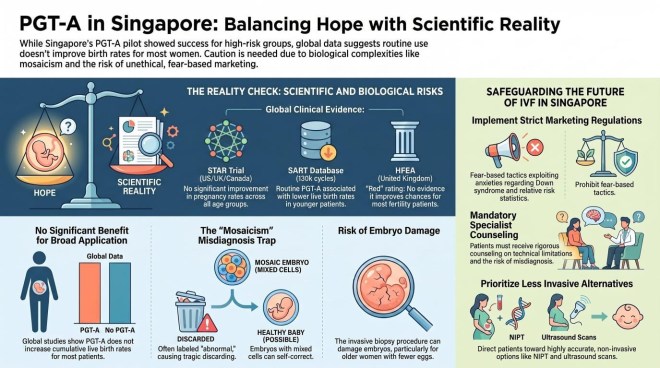
When looking beyond the local pilot study to large, multi-centre randomized trials conducted overseas, the narrative shifts significantly. Studies involving thousands of patients have repeatedly shown that the general, broad application of PGT-A on older women does not significantly improve cumulative live birth rates.
For instance, the STAR trial, a large and prominent multi-centre study involving 34 IVF clinics across the United States, Canada, the United Kingdom, and Australia, found no significant overall improvement in ongoing pregnancy rates across all age groups.
Similarly, a massive study conducted in China involving over 1,200 patients, published in the New England Journal of Medicine, concluded that IVF with PGT-A did not yield better cumulative live birth outcomes than conventional IVF.
Furthermore, a retrospective analysis of more than 130,000 IVF cycles from the Society for Assisted Reproductive Technology (SART) database found that the routine application of PGT-A was actually associated with a lower cumulative live birth rate compared to routine IVF, particularly in younger patients.
In light of this mounting evidence, reputable professional bodies have urged restraint. The American Society for Reproductive Medicine (ASRM) and SART have stated that the routine broad application of PGT-A on all older women should not be recommended.
In the UK, the Human Fertilisation and Embryology Authority (HFEA) traffic light system on IVF add-ons has assigned a red rating for PGT-A, indicating that there is no evidence it improves the chances of having a baby for most fertility patients, and warning that it may actually reduce the number of embryos available for transfer.
The Human Cost: Misdiagnosis And Lawsuits
The limitations of PGT-A are not merely academic; they have profound, real-world consequences. The technique is highly invasive, requiring a biopsy that extracts cells from the outer layer of the embryo. This procedure risks damaging the embryo, a danger that is greater for older women who often have fewer, lower-quality embryos.
More alarmingly, PGT-A is prone to misdiagnosis due to “mosaicism” — a condition where an embryo contains a mixture of normal and abnormal cells. Because the biopsy only samples the outer layer (which forms the placenta), it may not accurately reflect the inner cell mass that develops into the baby.
Emerging research shows that mosaic embryos have a remarkable capacity for self-correction, pushing abnormal cells to the outer layer and allowing healthy cells to form the fetus. By rigidly classifying these embryos as “abnormal,” PGT-A often leads to the tragic discarding of potentially viable, healthy embryos.
This high error rate has sparked ongoing class-action lawsuits in the United States against major genetic testing companies, alleging consumer fraud and deceptive marketing.
In Australia, fertility giant Monash IVF recently agreed to a A$56 million legal settlement with 700 former patients after allegedly discarding potentially viable embryos due to flawed genetic testing. These legal battles highlight the devastating emotional toll on patients who have been robbed of their chances of parenthood by a test driven more by marketing than definitive medical science.
The Danger Of Exploitation In Singapore
If PGT-A is normalized as a mainstream clinical procedure in Singapore, there are serious pitfalls to consider. Singapore is a hypercompetitive, status-conscious society that places immense value on academic achievement. In this environment, the birth of a child with a disability like Down syndrome carries a heavy psychological burden and faces harsh social stigmatization.
Private IVF clinics could easily exploit these sociocultural factors and patients’ anxieties over Down syndrome risks. Through unethical, fear-based marketing, clinics might exaggerate the risks of Down syndrome and other chromosomal abnormalities to hard-sell the expensive PGT-A procedure to vulnerable and desperate patients.
In other countries, there have even been unauthorised use of photographs of Down syndrome children by IVF clinics for the unethical advertising of PGT-A as a safeguard against such “tragic” outcomes. Fertility clinics often utilise “fear-based messaging,” exploiting the vulnerability of older women by presenting the relative risk of Down syndrome in a misleading manner.
For example, presenting a risk increase from 0.1 per cent at age 25 to 1 per cent at age 40 as a “ten-fold increase” rather than a 0.9 per cent absolute increase can effectively trigger panic. Such exploitation of patients’ ignorance regarding the concept of relative versus absolute risk is one of the IVF industry’s unethical sales tactic, marketing PGT-A as an essential “insurance policy” for responsible parenting.
Safeguarding Desperate And Vulnerable Patients
To prevent the exploitation of desperate and vulnerable patients, stringent and robust safeguards must be put in place before any transition of PGT-A to a mainstream procedure.
First, there must be strict regulations to curtail the unethical marketing of PGT-A. Clinics must be prohibited from using fear-based tactics or misleading relative risk statistics to push the procedure on older women without medical indications.
Second, mandatory, rigorous, and comprehensive counselling by certified genetic counselors must be implemented. Patients must be fully informed of the technical limitations of PGT-A. They need to understand the risks of biopsy damage, the high potential for misdiagnosis of mosaic embryos, the reality of mosaic embryo self-correction, and the fact that broad application of PGT-A does not significantly improve cumulative live birth rates.
Finally, patients must be made aware of and directed towards cheaper, less invasive, and highly accurate diagnostic options for detecting Down syndrome during pregnancy.
Alternatives like Non-Invasive Prenatal Testing (NIPT) and advanced ultrasound scans offer robust and accurate screening without the invasive risks associated with embryo biopsy in PGT-A. Furthermore, new non-invasive AI-based assessments of embryo chromosomal normality based on time-lapse imaging are currently being developed, offering a safer alternative for the future.
As Singapore navigates its demographic challenges, the pursuit of parenthood should not come at the cost of unnecessary anxiety, financial exploitation, and the tragic loss of potentially viable “mosaic” embryos than can self-correct. Evidence-based restraint, transparent counseling, and the protection of vulnerable patients must be the cornerstones of any newly-formulated policy regarding PGT-A.
The author is an associate professor at Peking University, China.
- This is the personal opinion of the writer or publication and does not necessarily represent the views of CodeBlue.


