

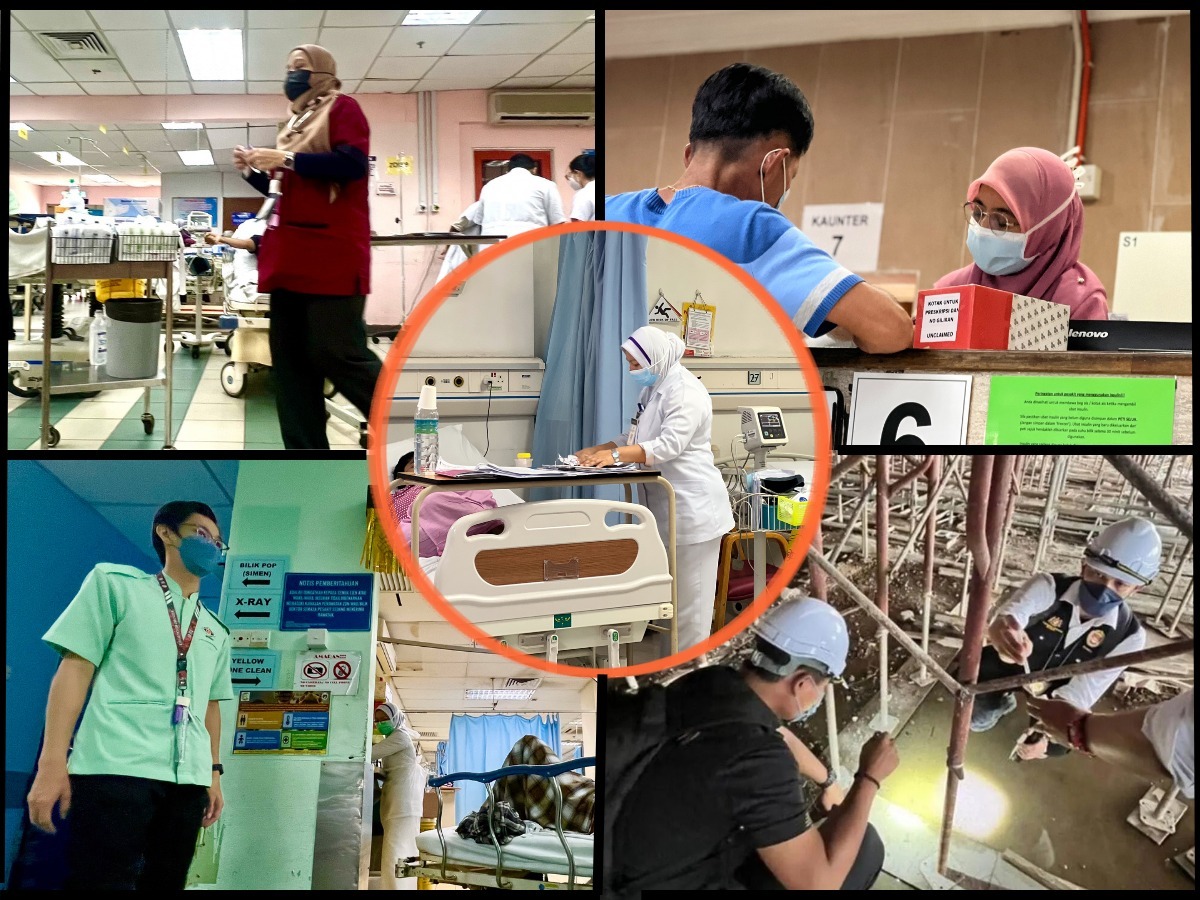
KUALA LUMPUR, July 31 — Doctors, pharmacists, nurses, medical assistants, and public health assistants prefer salary increments, clear career pathways, and better work environments to a Ministry of Health (MOH) pension.
Five associations representing various health care workers were commenting on a CodeBlue proposal for the establishment of an MOH pension for all 83 service schemes in the ministry, similar to the United Kingdom’s NHS Pension Scheme.
According to the NHS, its pension scheme plays a valuable role in the recruitment and retention of NHS staff.
The Madani government is currently fine-tuning a new retirement scheme for civil servants to curb a ballooning pension bill that is estimated to exceed RM46 billion by 2030.
The Edge reported that since February 1, 2024, newly appointed civil servants were no longer pensionable and were hired on three-year contracts, pending the finalisation of a permanent contributory appointment scheme. These three-year contracts will end on January 31, 2027, subject to extension or transition to the new scheme.
All civil servants in the implementation group and management and professional (P&P) group received a 15 per cent salary increment under the Public Service Remuneration System (SSPA) by January 2026.
However, health care workers in the MOH did not receive additional pay hikes or retention benefits specifically for the health service, despite severe attrition that led to a contraction of the doctor and nursing workforces over the past two three years.
Hartal: Retirement Benefits Less Crucial For Doctors Than Lower-Income Health Workers

Hartal Doktor Kontrak (HDK) suggested differentiating retirement benefits according to staff groups, saying pension-style protection could be considered for lower-income or lower-grade health workers, whereas higher-paid staff could contribute to the Employees Provident Fund (EPF).
“The choice would ultimately depend on the objectives of the scheme, its fiscal implications, and how retirement benefits are prioritised across different categories of MOH staff,” HDK spokesman Dr Muhammad Yassin told CodeBlue.
“For doctors, retirement benefits may have a relatively smaller influence where there is a substantial income gap between the public and private sectors. For nurses, retirement security may have a greater influence because the difference in earnings between the two sectors is generally less pronounced.”
The contract doctors’ group also stressed that a pension scheme was unlikely to be the only factor influencing the retention of health care workers, citing other factors like salary, workload, career progression, workplace environment, flexibility, and professional development opportunities.
“An MOH-specific pension scheme would involve balancing workforce objectives with long-term fiscal considerations,” said Dr Yassin.
“Any expansion of retirement benefits would have financial implications and would need to be assessed alongside other potential investments in the health system, including staffing, infrastructure, training, medicines, and equipment.”
MNU: Pension Not Sole Retention Tool For Nurses

The Malayan Nurses Union (MNU) said if the objective is to create a pension for health care workers similar to the NHS pension scheme, a more practical approach isn’t to create a separate pension for the MOH, but to retain pensions for the entire Malaysian civil service while introducing additional benefits specifically for MOH staff.
These include flexible retirement options, incentives for critical professions, additional retirement benefits for high-risk or shift work, as well as health programmes and long-term care for MOH retirees.
However, the nurses’ union stressed that retirement benefits weren’t the sole retention tool for nurses, highlighting multiple factors driving the attrition of nurses from public service: big salary differential, high workload, unequal nurse-to-patient ratio, shift work, promotion opportunities, and work-life balance.
“If nurses can get much higher income in the private sector or overseas, a pension may not be enough to change their decision,” MNU president Noor Aini Abu Hashim told CodeBlue.
“Besides a strong pension scheme, the government also needs to offer other measures, such as a special allowance, clear career pathway, more flexible working hours, mental health support, and opportunities for professional development.”
She also suggested retention incentives for critical years of service, like after five, 10, and 15 years.
MNU said a proposed MOH pension scheme shouldn’t solely be framed in terms of whether this will increase the government’s pension bill, but that policymakers should also question the costs if MOH fails to retain health care workers.
When an experienced nurse or health worker leaves MOH, the government loses its investment in that person’s pre-service training, clinical training, orientation, competency development, and years of experience.
MOH is then forced to recruit new staff, train them, bear the period of vacancy, and redistribute workloads to remaining staff.
“All of these incur financial costs and costs to the quality of service,” said Noor Aini.
She also highlighted the economic value of continuation of patient care, pointing out that experienced health workers usually make clinical decisions more efficiently, reduce mistakes, guide new staff, and increase team productivity.
“If the attrition rate is high, hospitals must regularly train new staff, which can affect operational efficiency and patient experience.”
MNU said a pension should be seen as a retention incentive, not merely a retirement benefit. In that sense, part of the rising costs of a pension scheme can be balanced with a reduction in the costs of hiring and training, fewer vacancies, and an increase in workforce productivity, although Noor Aini also acknowledged the need for a new retirement scheme to be financially sustainable.
“Such an evidence-based approach is more effective in convincing policymakers than arguing solely on welfare grounds. It shifts the narrative from ‘adding to the pension burden’ to ‘investing in the sustainability of the country’s public health care system’.”
MPS: Pension Can’t Fully Compensate Job Uncertainty For Pharmacists

Malaysian Pharmacists Society (MPS) said a pension wasn’t a standalone solution to health workforce attrition, citing immediate concerns like uncompetitive salaries and allowances; excessive workloads and inadequate staffing; uncertainty over permanent appointments; limited or unclear career progression; inflexible placement, and transfer policies; insufficient training and specialist opportunities; and challenging work conditions in rural, remote, and high-need facilities.
“This concern also applies to pharmacists. Recent uncertainty and delays involving permanent appointments have resulted in trained pharmacists leaving MOH while awaiting a clear career pathway. This indicates that job security and timely career decisions are at least as important as eventual retirement benefits,” MPS president Prof Amrahi Buang told CodeBlue.
“An MOH pension scheme may therefore reduce attrition, but its effect should not be overstated. It should be introduced, if feasible, as one component of a comprehensive total-reward strategy that addresses both the immediate and long-term reasons employees leave public service.”
MPS said eligibility for an MOH pension scheme should generally be based on qualifying service within the ministry, rather than being restricted to selected professions.
Shared service schemes shouldn’t be automatically excluded; a fairer approach would be to allow benefits to accrue according to the officer’s qualifying years of service within MOH, with suitable portability or pro-rating when the officer transfers elsewhere.
“The scheme should also avoid creating another divide between different generations of employees performing the same responsibilities. Personnel appointed under the interim contract and forthcoming contributory permanent appointment arrangements should therefore be considered within its eligibility framework,” said Amrahi.
“Since the government is finalising a defined-contribution retirement arrangement for newly appointed public servants, an MOH scheme could potentially operate as a supplementary occupational benefit for qualifying MOH service, rather than as an entirely separate replacement for the national arrangement. The appropriate structure should be determined through actuarial and workforce modelling.”
MPS described the retention of a capable and experienced public health care workforce as a strategic national investment.
“If independent actuarial and workforce modelling demonstrates that a contributory MOH retirement scheme—or a supplementary occupational benefit—can improve retention at a sustainable cost, the proposal deserves serious consideration.”
PPPM: Advanced Training, Higher Wages More Important For Medical Assistants

The Malaysian Association of Medical Assistants (PPPM) said an EPF scheme for medical assistants in public service, or assistant medical officers, was sufficient, dismissing the need for an MOH pension scheme.
PPPM president Mustafa Abd Majid attributed the attrition of nurses, doctors, and possibly medical assistants, primarily to low salaries, as he called for a more attractive salary scale for medical assistants by taking into account their workload, responsibilities, long working hours with insufficient rest on shift work, and mental stress.
“The government should also provide better career advancement opportunities, recognising that medical assistants need to pursue advanced training to ensure competency and quality of work, so that the health care services delivered are more effective, leading to fewer complications, improved disease recovery, and more complete patient rehabilitation,” Mustafa told CodeBlue.
“To achieve the above aspirations, the medical assistant service scheme should be upgraded to degree level (in line with current international practice for comparable professions such as physician assistant/associate, clinical officer, etc.), given that the fields of medical and health sciences have become highly complex and require advanced knowledge and skills.
“Furthermore, medical assistants should be provided with opportunities for continuous education at the master’s level and beyond to acquire greater knowledge and expertise. At present, many medical assistants are already pursuing further studies at their own initiative and expense.”
PPPM urged the government to improve on-call allowance payments and allowances for work performed outside normal working hours to reduce attrition of medical assistants from the health service.
Public Health Assistants Union Wants Career Development, Fair Remuneration, Conducive Working Environment

The Public Health Assistants Union of Peninsular Malaysia (KPKASM) said a pension guarantee was one of the factors that made public service a more attractive career choice.
“Retirement security not only gives employees confidence to build long-term careers, but also has the potential to help the health sector attract and retain a high-quality workforce,” KPKASM president Elmy Quttaibah Samsuorial told CodeBlue.
However, the union stressed that a pension wasn’t the only factor influencing an individual’s decision to remain in service.
“Career pathway development, recognition of competencies, fair remuneration, opportunities for professional advancement, and a conducive working environment also play important roles in improving workforce retention,” said Elmy Quttaibah.
“Therefore, KPKASM believes that efforts to address attrition should be implemented comprehensively through an approach that encompasses employee welfare, career development, and future security.”
In response to how CodeBlue’s proposal for an MOH-specific pension scheme ran contrary to the government’s aim of reducing pension liabilities, Elmy Quttaibah described investments in the welfare and stability of the health workforce as a “strategic investment for the nation”.
“For KPKASM, the key issue is not merely whether a dedicated pension scheme should be established, but how the country can ensure that the health sector remains an attractive career choice and is able to retain a high-quality workforce.”

