

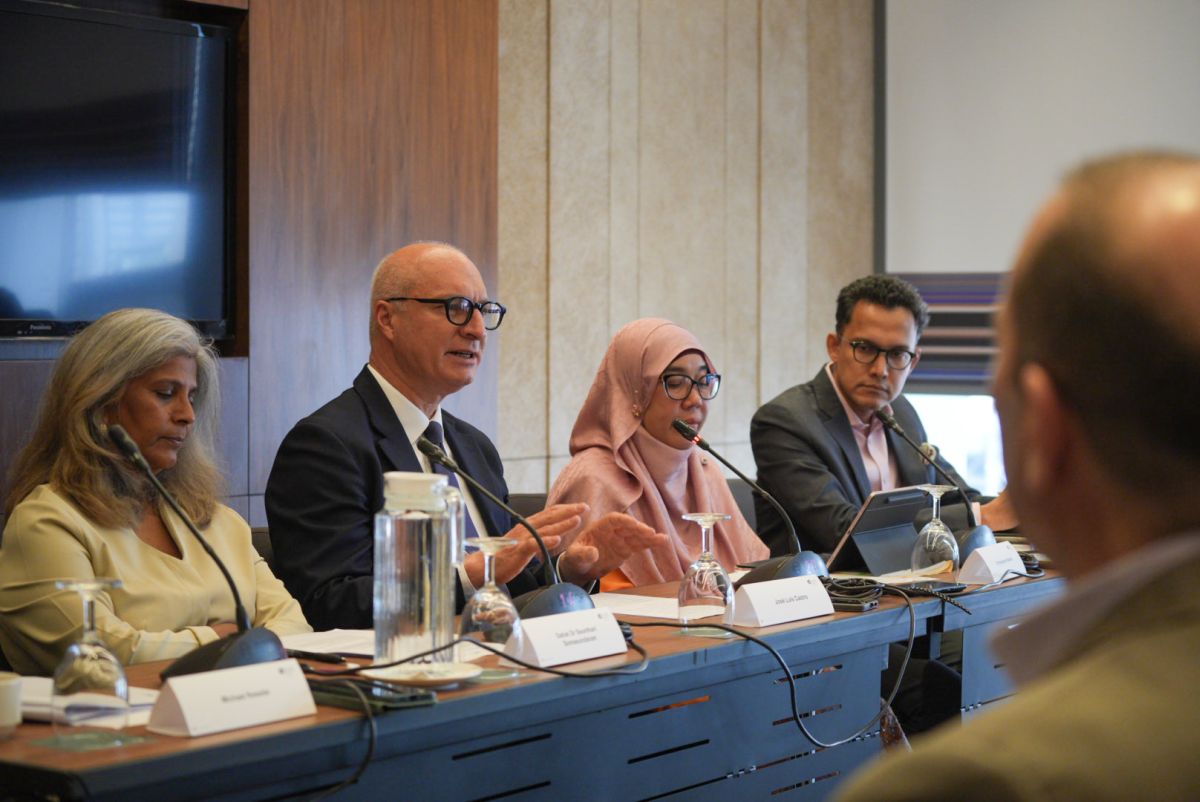
KUALA LUMPUR, Nov 19 — Governments gain little from courting tobacco or vape manufacturers because the long-term costs of treating smoking-related illnesses far outweigh any economic benefits, a senior World Health Organization (WHO) official said last week.
José Luis Castro, WHO director-general special envoy for chronic respiratory diseases, said countries are often enticed by promises of jobs, foreign investment, or export potential. But, he argued, those projections overlook the “substantial and avoidable” medical and economic burden associated with nicotine products.
“Tobacco is a product that kills and makes people sick,” Castro told CodeBlue on the sidelines of the “Unpacking the Chronic Respiratory Disease Epidemic” media workshop, held in partnership with the WHO and Pace University Center for Global Health here last Wednesday (November 12). “There is no investment made there that will not cost the government a tremendous amount of money later on in terms of incapacitation, lifelong medical treatment, and health care costs.”
Castro pointed to patients who require treatment for life after developing diseases tied to smoking or vaping. “That is not a return on investment,” he said. “We have economic studies showing the real cost to the economy. Beyond the financial burden, there is the pain and suffering inflicted on families and society.”
WHO Envoy Warns Against Expanding Nicotine Manufacturing
Malaysia’s decision earlier this year to issue its first federal licence to manufacture nicotine vaping devices has attracted attention among public health advocates. In May, Ispire Technology Inc., a Nasdaq-listed company based in California, received an interim licence to begin producing vape hardware at a facility in Johor.
The approval came just three days after Health Minister Dzulkefly Ahmad and other officials accepted the WHO’s World No Tobacco Day 2025 award in Geneva – a timing that drew criticism from anti-tobacco groups.
An opposition lawmaker, who leads on health issues, said the licence undercut the government’s enactment of the Control of Smoking Products for Public Health Act 2024 (Act 852), which only took effect in October last year.
Ispire has said that the devices assembled in Malaysia contain no nicotine or cannabis liquids and are intended solely for export. The company is shifting some assembly operations from China to Malaysia to avoid United States tariffs.
Across Asia, the tobacco market is led by five multinational companies – China National Tobacco Corporation (CNTC), Philip Morris International (PMI), British American Tobacco (BAT), Japan Tobacco International (JTI), and Imperial Tobacco Group (ITG).
Many Asean countries continue to offer duty-free privileges or industrial incentives, according to the Southeast Asia Tobacco Control Alliance’s (SEATCA) Asian Tobacco Industry Interference Index 2023. Several of these companies have expanded into electronic nicotine delivery systems, including e-cigarettes and heated tobacco products.
Castro said the region’s willingness to host these manufacturers raises a “moral dilemma.” He likened it to a family that serves nutritious meals at home while offering harmful food to neighbours. “No country would want to be labelled as exporting a product that kills people,” he said.
‘COPD Is A Medical Condition, Not A Moral Failure’
Castro urged governments to further confront the stigma surrounding chronic obstructive pulmonary disease, or COPD, a progressive and irreversible lung condition linked to smoking and polluted air.
“COPD is a medical condition. It is not something brought willingly by a patient,” he said. “It is not only caused by smoking. Millions exposed to polluted air will develop weak lungs and eventually lung disease.”
COPD is a progressive, irreversible lung disease marked by chronic breathlessness, cough, and airflow obstruction that does not fully improve with treatment, unlike asthma, where airflow obstruction is typically reversible.
Chronic respiratory diseases caused 7,832 deaths in Malaysia in 2019, nearly eight times the number attributed to asthma (1,031 deaths) that same year, according to WHO data.
But experts say the disease remains underdiagnosed, partly because patients fear being blamed for their symptoms. “This disease can turn a person into a prisoner,” Castro said. “Eventually they cannot even leave the bed. That is not life.”
He added that even smokers should not be blamed when seeking care. “They are people fighting an addiction,” Castro said. “They need help, not punishment.”
Castro also warned that recurring haze and industrial pollution in Southeast Asia contribute significantly to chronic respiratory illness. Addressing the problem, he said, requires cooperation across governments and ministries.
“This cannot be solved by the environment ministry alone,” he said. “It requires a whole-of-government response – health, finance, education, foreign affairs. Actions taken in one country affect its neighbours. We live in an interconnected region.”
The WHO envoy called for Asean-level collaboration to address industrial pollution and the cross-border impacts of haze, saying respiratory health must be treated as a shared regional priority, not just a domestic environmental issue.


