

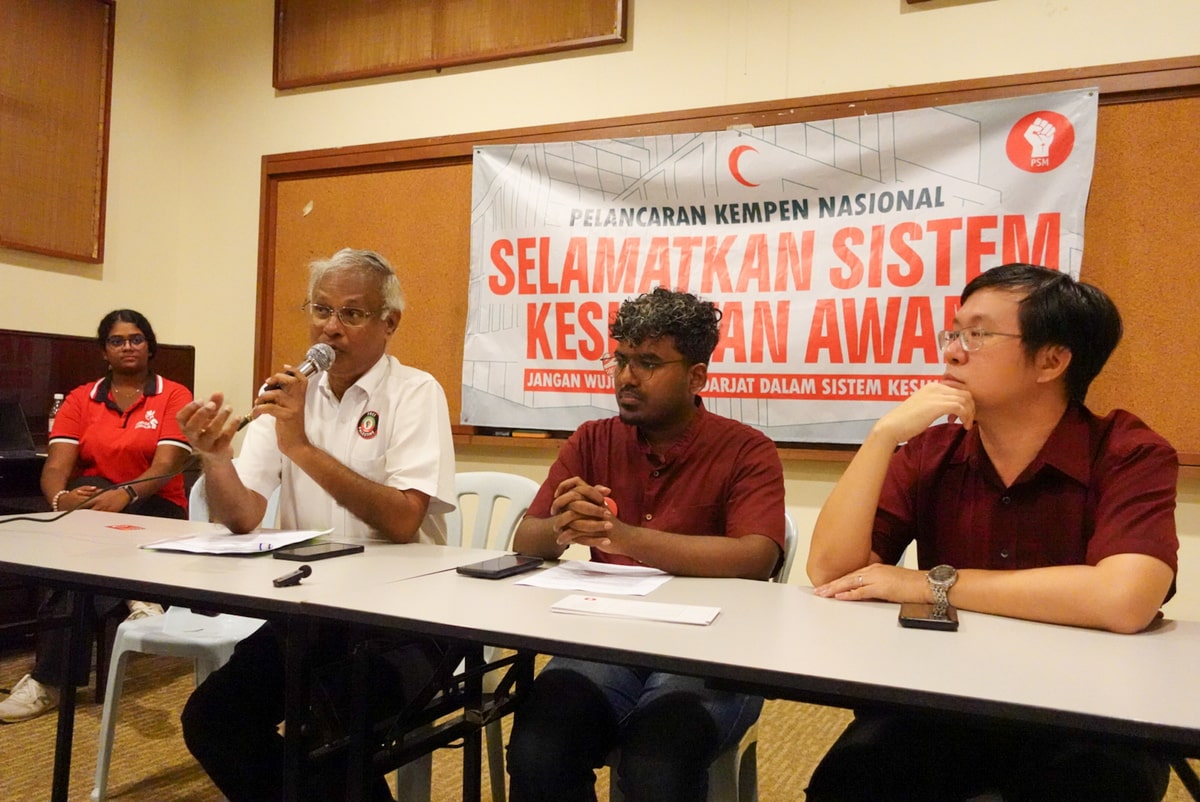
KUALA LUMPUR, August 14 — Parti Sosialis Malaysia (PSM) has launched a nationwide campaign to cancel Rakan KKM that it claims will exacerbate specialist shortages in public hospitals and extend waiting times for low- and middle-income patients in a “two-tier” system.
PSM chairman Dr Jeyakumar Devaraj described Rakan KKM as a “distraction” from fixing the public health care system.
He accused the government of “doing the wrong thing” by encouraging specialists who still want to serve in public hospitals to take after-hours shifts in Rakan KKM’s private wing for higher pay, which, he said, could inevitably take precedence over non-paying public patients.
“The problem is that people who cannot pay, who now, if they have kidney stones, have to wait seven months. If Rakan KKM goes through, the wait for those who can’t afford it will extend to 12 months. That is what’s wrong with it,” Dr Jeyakumar said at PSM’s “Save The Health Care System” campaign launch at the KL-Selangor Chinese Assembly Hall here yesterday.
“We don’t have enough specialists in public hospitals. So if you encourage specialists to do more work in Rakan KKM, it means B40 and M40 aunties and uncles will have to wait longer. If it’s kidney stones, they have to endure the pain. If it’s cancer, the cancer may spread. If it’s a heart problem, you may end up dead before seeing the doctor. That’s the impact.”
PSM cited recent data showing nearly 3,000 patients on the Ministry of Health’s (MOH) cardiothoracic surgery waiting list, with paediatric cases waiting an average of 21 months. Another 9,233 patients are waiting for cataract operations, with an average wait time of three months, and 2,661 are awaiting kidney stone surgeries with an average wait of 11 months.
The MOH plans to launch Rakan KKM, its new private health care service run by Rakan KKM Sdn Bhd, in four select government hospitals, supposedly by next month.
Amid scant details from the ministry or the company, Rakan KKM is an “express lane” of sorts for patients who can pay for faster access to elective procedures.
Moratorium On New Private Hospitals

The party also linked Rakan KKM to a broader trend of policies they say favours the private sector, including the continued expansion of private hospitals. PSM is calling for a moratorium on the opening of new private hospitals, warning that every new facility pulls specialists away from the public sector.
PSM cited the example of a newly launched private hospital in Ipoh that allegedly recruited 15 government specialists with the promise of topping up their monthly income to RM70,000 in the first year.
“As long as a business-first approach is prioritised and more private hospitals are allowed to open, the problem of specialist shortages in public hospitals will not be solved,” PSM said.
At the launch, two sketches dramatised the human cost of such policies. One depicted a private hospital CEO offering two government specialists up to RM100,000 in salary, while appealing to their family responsibilities.
The other showed a patient unable to get a bed even after five days at a public hospital, and a distraught wife whose husband faced a four-month wait for an angiogram despite being warded for a week.
Health Minister Dzulkefly Ahmad previously revealed that eight new private hospitals across the country started operations in 2023 to 2024, including four in the Klang Valley (Selangor, KL, Putrajaya), two in Perak, and one each in Penang and Kedah. The eight private hospitals have 146 specialists in total.
Raise Health Care Allocation To 5% Of GDP

PSM also wants the MOH budget increased to 5 per cent of the country’s gross domestic product (GDP) within five years, up from the current 2.3 per cent. “This is far lower compared to other countries,” said PSM central committee member Gandipan Nantha Gopalan.
“In 2024, Britain allocated 9.6 per cent of GDP to its public health system. Singapore allocated 3.74 per cent in 2024 and Thailand allocated 3.97 per cent of its GDP. Why can’t Malaysia do the same? If we take firm steps to stop leakages of RM30 billion to RM40 billion a year, we can increase MOH’s allocation.”
PSM noted that Malaysia’s GDP has grown 24-fold in real terms over the past five decades, partly due to wage suppression among ordinary workers, and said the public deserves a better-funded health system.
When asked if PSM would support a social health insurance scheme funded by employer and employee contributions, Dr Jeyakumar warned that such a system could turn the public health service into a “paying system” where every case is billed, pushing the government towards hospital corporatisation.
Price Caps For Private Hospital Charges

PSM is also demanding price caps on private hospital charges. While doctors’ fees are already regulated, the socialist party pointed out there is no ceiling for other hospital charges such as X-rays, CT or MRI scans, blood tests, operating theatre use, drugs, medical devices, and other services or supplies.
This lack of oversight is significant, with industry estimates showing that up to 70 per cent of private hospital bills fall under the “unregulated” category, covering everything from wheelchairs and heart monitors to consumables like kidney dishes, while only 30 per cent account for regulated items such as specialist fees and medications.
PSM argues that such unchecked billing practices burden patients with hidden costs and contribute to soaring medical inflation.
Lim Chee Han, public health policy researcher and co-convener of the People’s Health Forum, said the government has “failed” to properly regulate the private sector.
“The government plays three roles – the provider, the buyer, and the regulator. We feel the government has failed to really regulate the private sector. That’s why private hospital charges keep increasing, and people have to pay higher insurance premiums.
“These are the things that are not regulated, and when you let the market dictate prices, people feel the market pressure,” Lim said.
He urged the government to strengthen its role as regulator to ensure fair market competition so that patients, who are also consumers, are not taken advantage of.
“I urge the government to do the job better as a provider by giving more money to run the service well; as a buyer, by putting more resources into treatment and primary care; and as a regulator, by fixing a private market that is grossly unfair to people who want access to health care,” Lim said.
Postcards To PM

PSM said it will take its campaign to the public through talks, pamphlets, press statements, social media, and other channels to build opposition to what it calls the government’s “business” approach to health care.
As part of the campaign, PSM will distribute postcards for individuals to sign as a petition. Addressed to Prime Minister Anwar Ibrahim, the postcard contains a letter stating: “I am concerned about the direction of Malaysia’s public health care system, as fair and equitable services for all rakyat are compromised when priority is given to patients who can pay higher charges.”
The postcard also urges the government to adopt PSM’s four demands:
- Moratorium on new private hospitals for five years
- Cancel Rakan KKM that will create a “two-tier” system in public hospitals
- Increase MOH’s budget to 5 per cent of GDP in five years
- Cap all private hospital charges
“PSM wants to launch a national campaign to warn the people about the danger that awaits them. If the people do not rise and oppose the plans that the government has, like Rakan KKM, then people will be on the receiving end of all these bad policies,” Gandipan said.


