

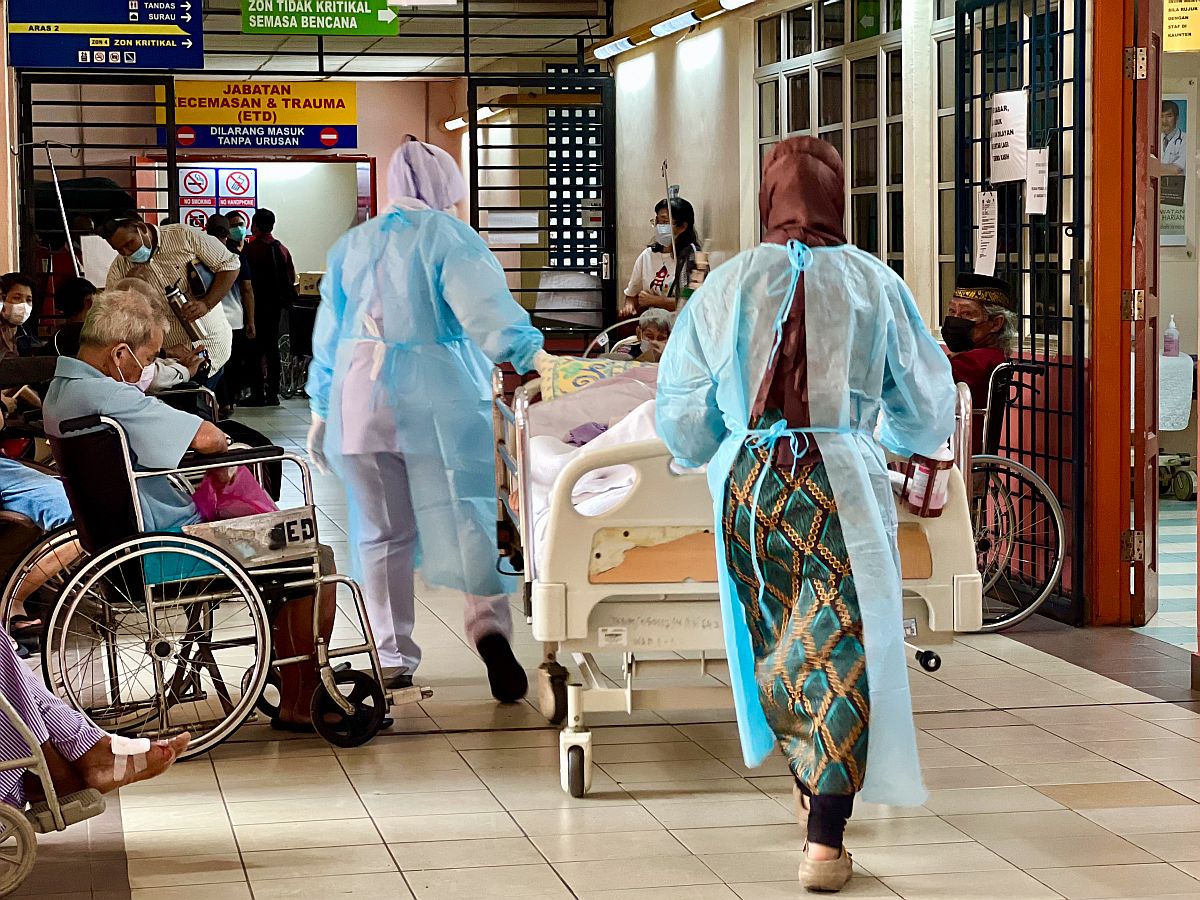
KUALA LUMPUR, July 31 — The government’s new Rakan KKM initiative, designed to allow paying patients to access elective services in public hospitals, may end up drawing altruistic families rather than wealthy patients — while generating little revenue for the Ministry of Health (MOH), a social economist has cautioned.
Amjad Rabi, a social and human security economist, told BFM Health & Living’s Tee Shiao Eek that Malaysia’s weak social safety nets, combined with high old-age poverty and low wages, could pressure ordinary Malaysians — even those outside the M40 — to pay for Rakan KKM simply because they want the best for their ageing parents.
“What we would end up with now is, let’s say I take my father, or my mother, to the hospital. I love them so much. They love me. Now I know that if I take them to the public hospital, the line would be very long. I care about my parents. So I would say I’ll take this shortcut (Rakan KKM) as I would feel morally obliged to do the best for my parents.
“So even if I might not be rich, I might not be in the T20 or M40, I might be very poor. But because, you know, it’s an altruistic society that you care about your parents, so you add pressure on the people,” Amjad said in a podcast aired July 17.
“This whole classification, that this (Rakan KKM) is only for the rich, will actually fall apart. This service will (end up catering) for those who are altruistic, that even if they have little, they will pay more, because, again, I want the best for my parents.”
Amjad said that Malaysia’s social safety nets remain fragile, with low wages and high rates of old-age poverty leaving many elderly people reliant on their children for financial support.
The introduction of new fees under Rakan KKM risks adding to these burdens, driving up out-of-pocket spending for households that are already struggling to make ends meet.
Old-Age Poverty And Weak Safety Nets Push Elderly To Rely On Families
Malaysia’s existing support systems — including Employees Provident Fund (EPF) savings, civil service pensions (KWAP), Bantuan Warga Emas, Sumbangan Tunai Rahmah (STR), and zakat assistance — have not been sufficient to address old-age poverty, Amjad said.
Old-age poverty refers to seniors whose income or savings fall below what is needed for basic living costs. Many Malaysians face this risk, with a third of EPF contributors under 55 — about 1.6 million members — holding less than RM10,000 in savings as of August 2024.
“In Malaysia, the relative poverty is 16.6 per cent. Among senior citizens, it’s not 16 per cent, it’s 42 per cent, for senior citizens above the age of 60. If you take senior citizens above the age of 70, it goes to almost 49 per cent, or one out of two. This is way higher than the poverty rate,” Amjad said.
“Despite everything that we have, what do they (seniors) do and who will help them? They go to their children, and their children are, on average, our study at the Social Wellbeing Research Centre, estimated that each senior citizen above the age 65 receives on average RM532 each. So if there are two senior citizens, they receive, on average, RM1,000.
“And you know, wages are very weak in Malaysia, as I mentioned. The median wage is RM3,000. So imagine RM3,000, you give about RM500 to each parent. So it’s one-sixth of your income. And they have children. So, the safety net, whether it’s family, is very weak.”
Amjad said the introduction of new fees through Rakan KKM could further strain these already fragile household finances, especially for families who feel compelled to pay for better care for ageing parents despite limited means.
Caution Against Overestimating Rakan KKM Revenue
While Rakan KKM is being pitched as a way to reinvest excess revenue into public health care, Amjad said the programme is unlikely to become a reliable funding source.
“I think we need to not overestimate, like, how much it will generate. I don’t see it. I mean, I will come back to the Ministry of Health’s (MOH) target is the middle 40 (M40), right? And if you think about the income of M40 in Malaysia, it is from about RM5,800, for a household of four, to about RM11,000 or RM12,000. So, RM5,000 or RM6,000, or RM7,000, this is a household of four, likely two breadwinners in the household.
“So it’s not necessarily the income level that will support you to pay a lot of fees. I would be careful about overestimating this as a source of reliable income for the MOH,” Amjad said.
He noted that while Rakan KKM appears to be inspired by Singapore’s hospital holdings model, Malaysia’s context differs starkly.
“In Malaysia, public per capita spending on health care on an individual basis, for both public and private, was about US$420 (RM1,771.35), compare that with the UK, which is more than US$4,000, and the UK is not the most spending because they have the NHS system.
“Similarly, the doctor-to-population ratio in Malaysia is about 24 per 10,000 population. In Singapore, it’s 28 per 10,000, in the UK, 32 per 10,000, and usually, the MOH will also look at Australia, and they have 39 per 10,000, and this is for public and private.
“So you have different ingredients in Malaysia,” Amjad said. “We don’t need to overestimate how much it (Rakan KKM) will generate.”
“Again, I’m just raising those concerns, but I think I understand the Minister of Health’s situation — they have a limited budget, they’re trying to think out of the box, looking outward, what other countries are doing.
“What I would suggest is to come back again to the issue of evaluating before scaling up. I know the MOH. I know the minister is very concerned about the well-being of the rakyat. So my suggestion is to make sure that we evaluate before we go bigger.”
Rakan KKM May Stir Resentment More Than Revenue
Amjad also warned that, beyond revenue, the initiative could fuel public resentment if it is seen as allowing wealthier or paying patients to bypass long waits in overstretched public hospitals.
“And this fear is rightly so. I mean, again, I’m not blaming the MOH actually. I know they are doing great work and they are thinking outside the box, but from experience in many other countries, the NHS in the UK, there is that fear, always, echoed, that those who opt for PPU (patient paying unit), they are jumping the queue.
“Health care is usually seen, really, at the core of the social contract between the individual (citizen) and the government. So, the feeling can be damaging to the sense of identity, the unity, and many aspects of narrative about the country.
“So, that’s why it needs to be dealt with carefully, and honestly, frankly speaking, I don’t know how much it will generate but I just don’t see this as a gamechanger that will generate a lot of money,” Amjad said.
“It might generate a lot of those perceptions and feelings, at the same time, from a cost-benefit analysis perspective, it might be just not much.”
Commercial Interests Could Undermine Public Health Goals
Amjad described Rakan KKM as “marketisation” rather than outright privatisation, as MOF Inc remains the owner rather than selling off public assets.
“I would use a different word, not privatisation, but marketisation. And the difference is privatisation, you have private ownership and private delivery. Marketisation is when you bring in the market forces to a market. So here, what I mean by market forces is you bring the price mechanism as a signal where to shift resources, how to allocate resources.
“Here, in this case, why I didn’t use privatisation is because it’s incorporated under the Minister of Finance, so it’s publicly owned. Now I don’t have many details to see how this is structured — is it registered under the Private Healthcare Facilities and Services Act 1998 (Act 586), which requires private health care services to be licensed, I’m not sure.
“But in short, I think you’re bringing the market forces in,” Amjad said.
However, he flagged potential conflicts of interest between commercial objectives and public policy goals.
“There is also pure conflict of interest here between the public policy objectives in health and in commercial commercial targets.
“So commercial targets, obviously, if you bring in investment, you need to return on investment. But for public health, one of the main objectives is to reduce over reliance on out-of-pocket expenditure. Now, you bring in a new fee structure. By default, you are actually increasing out-of-pocket expenditure because that will be more fees. So again, those things are not that clear,” Amjad said.
“And the infrastructure itself. You have an entity incorporated under the Ministry of Finance (MOF), not the MOH. So then it takes us to the second question, which is accountability.
“Usually, ideally, any health care player is in line with the directions of the MOH and under strict, especially if it’s public, under a strict accountability matrix under the MOH to make sure that the directions are all in line with the public policy objectives.
“Now it’s under a different structure, a different CEO and board of directors under the MOF. So again, this creates some kind of confusion,” Amjad added.
He urged MOH to commission an “evaluability assessment” before expanding the scheme, establishing baselines on waiting times, revenue generation, and reinvestment.
“The ministry is starting in selected locations. So what I would suggest is for the MOH to immediately deploy a team of evaluators to establish what we call an evaluability assessment, to make an evaluability assessment of the selected areas, and why we need to do it now before even any work starts, because we need to establish a baseline.
“We need to agree on the objectives of this initiative, whether it’s to raise the B40 or raise the ceiling, you know, just agree on those elements, and then we make sure that we collect data on, for instance, waiting time and the money generated, and how it is reinvested.
“At the end, maybe after two years or one year before it is scaled up, you have a solid, independent evaluation by external evaluators. And that can inform the next step,” Amjad said.
According to Nik Azmi Nik Fathil, former press secretary to Health Minister Dzulkefly Ahmad, in a post on X, the Rakan KKM model was reviewed by the MOH’s Health Transformation Office, the Ministry of Finance (MOF), EPF, and an unnamed Big Four consultancy.


