

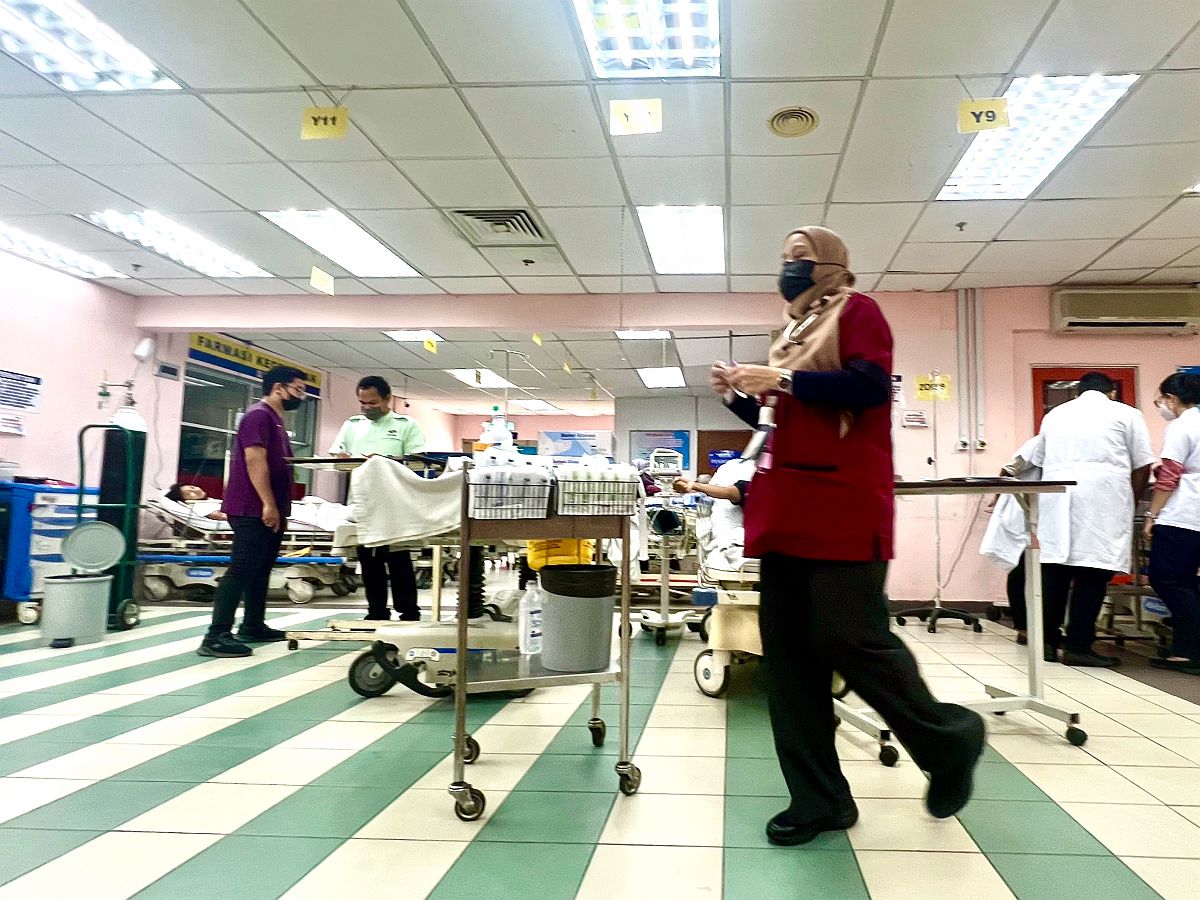
KUALA LUMPUR, Jan 14 — The Ministry of Health (MOH) plans to create a digital platform to enable doctors and nurses, among other health care workers in the public service, to exchange placements.
This Mutual Posting Swap Platform, or Sistem Pertukaran Suka Sama Suka, enables health care workers of the same scheme to mutually swap placements – crucially, without the involvement of the Human Resource Division (BSM).
“For example, a nurse in Serdang Hospital wants to go back to Kelantan, while there’s a nurse in Kelantan who wants to come to Selangor. Both register in this system,” MOH deputy secretary-general (finance) Norazman Ayob told a town hall yesterday at MOH’s headquarters in Putrajaya on the MOH’s Public Service Reform Agenda.
“The system says there are three individuals who want to transfer to my hospital, for example. So when the system prompts both parties, I decide who among the three I want to negotiate with. This involves the two people; it doesn’t involve the Human Resource Division.
“When both parties agree, they will inform BSM; there will be some forms to fill related to the responsibilities of both individuals. There are just a few conditions, for example, the scheme [of the officers] in the swap must be the same – it can’t be a nurse with a medical assistant or a cardiologist with an ophthalmologist.”
Norazman, who is also MOH’s chief reform officer appointed by the secretary-general, acknowledged the many complaints by health care workers, as well as Hartal Doktor Kontrak (HDK), about their postings.
“In principle, this will enable anyone to swap for reasons like their spouses, personal health, or family.”
When contacted by CodeBlue, Norazman said he will be chairing a Reform Committee meeting tomorrow (Wednesday), during which the committee will have a definite timeline on when the system can be up and running.
“But I would like to set an ambitious target to have it ready by 1 June.”
Multidisciplinary Task Force To Visit Hospitals To Understand HR Problems
Norazman said BSM is currently conducting a human resource mapping of five main schemes in the public health service: medical, dental, pharmacy, nursing, and medical assistants. Human resource mapping of other schemes like allied health will follow after.
A multidisciplinary task force – which comprises working level officers like quality management officers – has been given a mandate to go down to the ground in government hospitals to understand human resource problems.
This will begin in “the nearest time” in one or two hospitals, according to the MOH deputy secretary-general (finance).
“They will meet with the hospital director or management to hear, see, and personally experience the problems faced by each hospital related to frequent complaints, such as burnout and bullying,” Norazman told the town hall.
“I think the time has come to this stage where we have to go down and see for ourselves. We can no longer be said to merely sit in our ivory tower, in our headquarters, while we’re ignorant of what’s happening on the field.
“We talk about norms and outfits, but the reality is that what’s happening on the field isn’t the same as our plans.”
MOH’s planning division is also conducting a study on human resource mapping of the health care workforce with the World Bank.


