

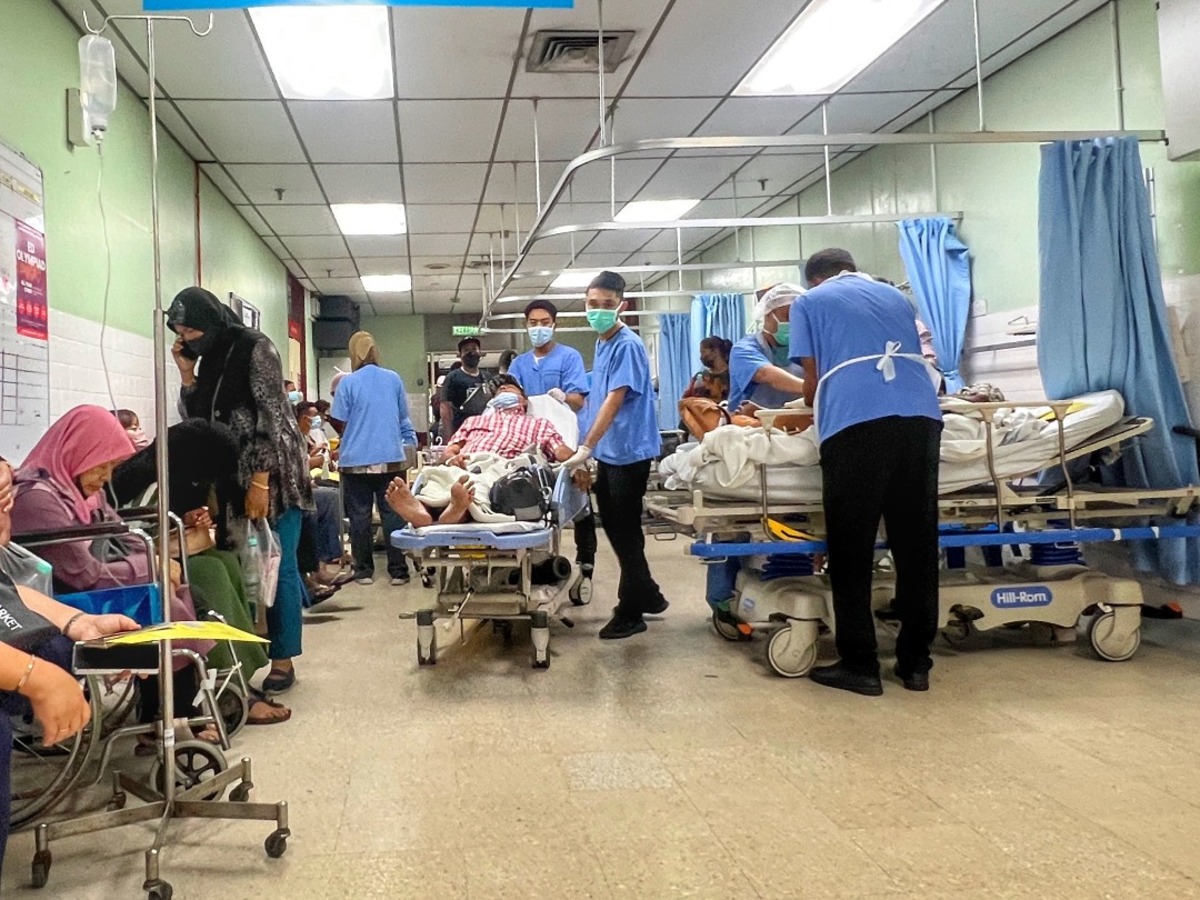
KUALA LUMPUR, Sept 26 — Public anger has risen against the expansion of private wings in government hospitals under RakanKKM, with many perceiving this move as “privatisation” of the public health service.
Details about this proposed programme are scant; it is unclear what the differences are between RakanKKM and the nearly two-decade-old full-paying patient (FPP) service in 10 public hospitals under the Ministry of Health (MOH).
Health Minister Dzulkefly Ahmad has cited investments from government-linked investment companies (GLICs) in a special-purpose vehicle (SPV) for RakanKKM, and merely told Malaysians to await Prime Minister Anwar Ibrahim’s announcement on the matter. Budget 2025 is scheduled for tabling in Parliament in a few weeks’ time.
Public backlash erupted particularly after Hartal Doktor Kontrak (HDK), an advocacy group for junior doctors, posted on X, calling FPP a “good step” as it provides specialists with more income while giving patients access to specialist care at a fraction of the cost compared to private hospitals. “Win-win solution,” said HDK, whose logo is a socialist fist holding a stethoscope.
The endorsement by HDK – which launched a junior doctors’ strike in 2021 – sparked a flurry of criticism from ordinary Malaysians and some doctors alike, who fear that an expansion of FPP under RakanKKM would deepen inequality in the underfunded, understaffed, and overworked public health care system.
“The rakyat were behind you, supporting your hartal doktor. And after all that, you’re actually not even with the rakyat, you’re just a group of selfish people that only prioritise your self interest. Every fibre of my being regretted for supported you guys before,” wrote @fdajesfry in a post on X yesterday that has gained more than 30,000 views.
Another user, @stihawa, expressed disappointment with HDK, accusing the group of supporting a scheme that would “widen the gap between the rich and the poor.”
“You’re gonna lose support from people & you’re gonna cry & you’re gonna blame us,” @stihawa wrote. “Just because you don’t understand how health care system finances works.”
The concerns echoed across X, with users like @lorettabagg warning about the dangers of a capitalistic approach to health care: “Penny wise, pound foolish. When you don’t realise this will neither benefit you or make things better for you.”
“They will just cut your jobs and increase your work.”
X user @labahnnh, reflecting on experiences at the Universiti Malaya Medical Centre (UMMC) and the public university’s private hospital, Universiti Malaya Specialist Centre (UMSC), added: “Specialists end up having to service in both private and public wings (and teach too!). It burns people out. We should be advocating for better working conditions.”
Meanwhile, user @zedadam likened FPP to a gaming term “pay to win” where those with more money gain an advantage. “Pay to win is what’s happening here. Patients with money can access specialists quicker than those without.”
One user, @KhairulAqmal, went a step further, asking, “So what’s next? Privatekan sekolah awam sebab kos untuk sustain education tak sustainable di negara ni?”
Reactions among doctors towards RakanKKM have been mixed. Prof Dr Christopher Lee (@chriskc_Lee), former Health deputy director general and infectious disease expert, said: “For many years, MOH private practice existed in only 10 hospitals. Concrete steps should be taken to expand this to other hospitals nationwide; so as to benefit more specialists and not just those in the current 10 hospitals. Whatever that is limiting this expansion should be dealt with ASAP.”
Dr Amar-Singh HSS (@DrAmarMOH), a senior consultant paediatrician and child-disability activist, voiced concern over the long-term impact on health care delivery. “As a specialist in MOH, I worked long hours (unpaid) because there were so many children who needed support. Who has the time to do FPP? It may compromise care and push responsibility to younger staff. Just fund our health services better.”
Dr Anantha Raman (@mortaids) joined the criticism, warning that expanding the FPP service could overwork health care staff tasked to run both the public and private service. “Specialists will be stretched thin for both public and FPP patients. Bear in mind MOs (medical officers) and HOs (house officers) pun have to jaga the patient and are stretched further. Plus it’s a gateway for private healthcare to take over. In any case, we should stand together and reject it.”
In Dzulkefly’s announcement of the RakanKKM programme at a recent cancer conference in Geneva, Switzerland, the health minister used the term “private wings”.
He did not give details about the performance of the FPP service since it was launched in 2007, including its financial performance, effectiveness in retaining specialist doctors in MOH, or even whether the service has already been dropped in a few hospitals due to a shortage of medical officers.
As the debate grows, many Malaysians are calling for a reevaluation of the RakanKKM programme, fearing that the country’s public health care system, which is meant to provide equitable access to all citizens, is at risk of becoming more exclusive.
“RM1 is not realistic. You know what is realistic? Making Forest City tax free, so the ultra elites don’t have to pay tax,” wrote X user @emidocs in a post last Sunday that had over 65,000 views, in response to another X user who claimed that the RM1 outpatient fee in MOH facilities isn’t sustainable.


