

A Public Service Department (JPA) circular permits pregnant female civil servants to leave work one hour early every day from 22 weeks of gestation (five months pregnant).
However, my PKD (district health office) and KK (Klinik Kesihatan) in Selangor do not follow this standard circular, as pregnant staff are only allowed to leave work early at 36 weeks of gestation onwards (nine months pregnant).
Many pregnant women health workers could not make use of this facility because they underwent pre-term delivery before 36 weeks of gestation.
There were also cases in which pregnant medical officers (MOs) developed hypertension due to their workload and often leaving work after 5pm.
MOs Burdened With Extra Tasks: Taking Vitals, Setting Appointments, Performing ECG
We are classified as Tahap 2 KK. However, we are seeing the patient load of a Tahap 1 KK with a staff size that corresponds to Tahap 2 KK or even lesser. Insufficient manpower, especially supporting staff, has been taking a toll on us MOs.
We are instructed to carry out the job scopes of supporting staff, such as taking vital signs, setting appointment dates, and performing procedures like ECG, on top of carrying out our own duties.
Typically, an MO has to do everything for the patient: taking vital signs, consulting the patient, setting appointment dates, filling up blood forms, and writing prescriptions on a daily basis for almost 50 patients per day.
No one supports or shares the workload of MOs, but MOs are forced to perform the supporting staff’s duties, while seeing patients. This has caused a major hassle not only for us MOs, but also for the patients as the protocols keep changing every day without prior notice or discussion with MOs.
Many unstable patients were managed late due to the long waiting time to see the doctors. Additional workload assigned to doctors has become time-consuming, causing a major delay in seeing patients, which leads to patient frustration and dissatisfaction.
There is poor communication between superiors and MOs. We are often instructed to carry out a pre-decided work plan instead of discussing a better arrangement. We are often not heard. Even when there is a discussion and our opinions are voiced out, decisions are still made opposing the MOs.
There is no one to back us up, including our family medicine specialists (FMSes). Only the supporting staff are fully supported and their voices are heard. MOs are always blamed for every problem that arise without proper investigations. It feels like we have taken the fall in this situation.
Spoiled Air-Con In Consultation Rooms, No Budget For Repair
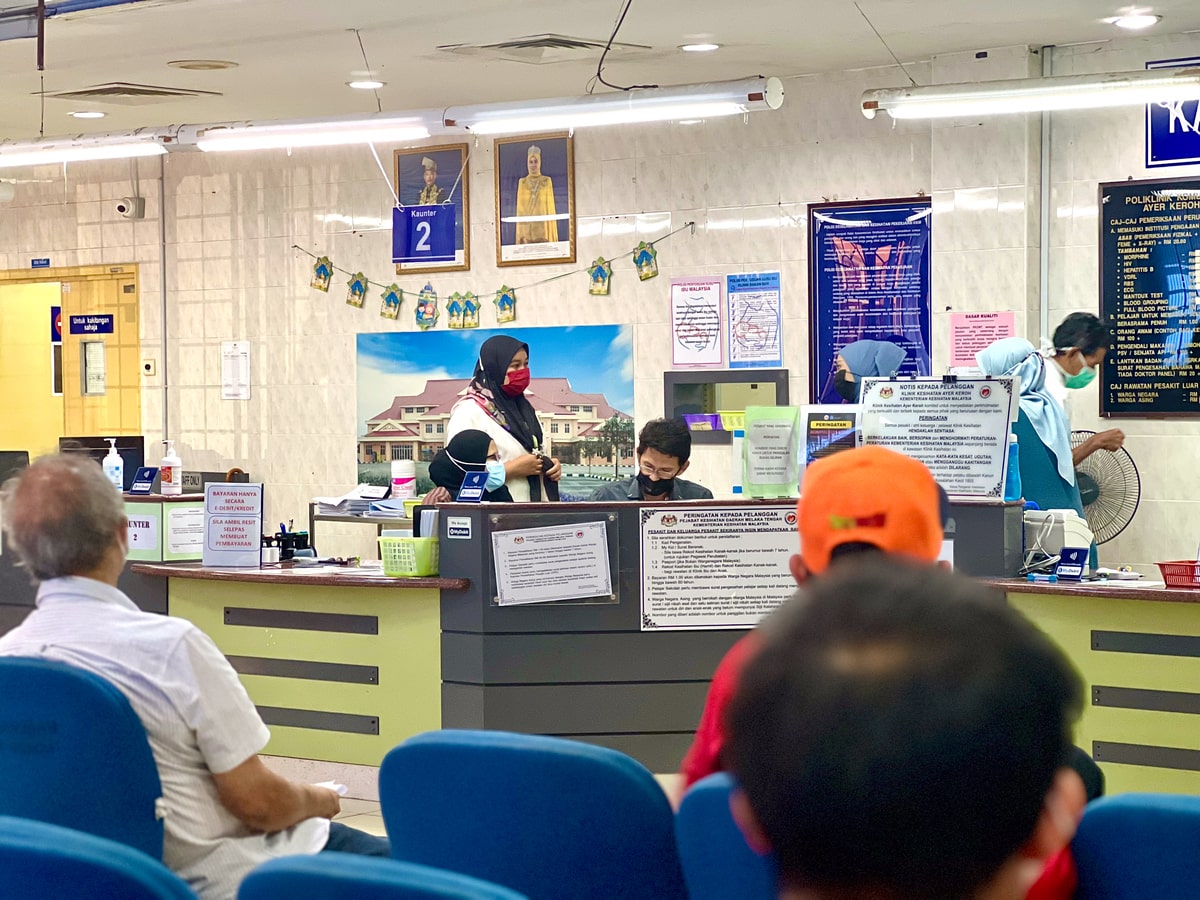
Most consultation rooms in our KK have been unconducive for many months. The air-conditioners are spoiled and there is no proper ventilation in the rooms. Despite multiple complaints from both patients and doctors, no action was taken.
We were told that there’s no budget for repair from PKD, hence we need to wait for the budget. Many pregnant staff had to endure this situation on top of managing an overwhelming patient load, which led to pregnancy-related complications.
Most of the consultation rooms are not well-equipped with beds for examination. Most times, patients are examined in a shared space with the presence of other patients in the same room with drawn curtains. The space becomes congested and uncomfortable for other doctors too, who are seeing other patients in the same room.
CME During Friday Lunch Time, MOs Get 15-30 Minutes’ Break Most Days
We are compelled to attend continuous medical education (CMEs) every Friday during lunch time. Although we proposed having CMEs every fortnight, our superiors rejected our requests and made it compulsory for everyone to attend weekly.
Those who are absent for the CME are asked to write “surat tunjuk sebab”. Friday is the only day of the week when most of us can rest longer than other days, but our superiors fail to understand the exhaustion that MOs go through on a daily basis.
Most days, we only get 15 to 30 minutes’ break on average. On bad days, we don’t even get the time to use the restroom, what more to eat or rest. Simple requests as such are not considered and understood. The welfare of MOs is not taken care of and often neglected.
Disproportionate Workload On MOs Compared To FMS Or Gazettees
There are many FMSes and gazettees, but the burden and workload of MOs are disproportionately shared. The patient load is divided unequally and there is a big discrepancy between the number of patients allocated for MOs, gazettees, and FMSes.
The gazettees are sent to us under the MO pool from the Ministry of Health (MOH), which gives a false number of total MOs allocated to our KK. Gazettees do not consult the same number of patients as MOs, but have their own designated patients.
Hence, MOs are eventually burdened with seeing more patients.
A recent incident of verbal harassment among staff was also not addressed properly by our superiors.
The author is a medical officer at a Klinik Kesihatan in Selangor. CodeBlue is providing the author anonymity because civil servants are prohibited from writing to the press.
- This is the personal opinion of the writer or publication and does not necessarily represent the views of CodeBlue.


