

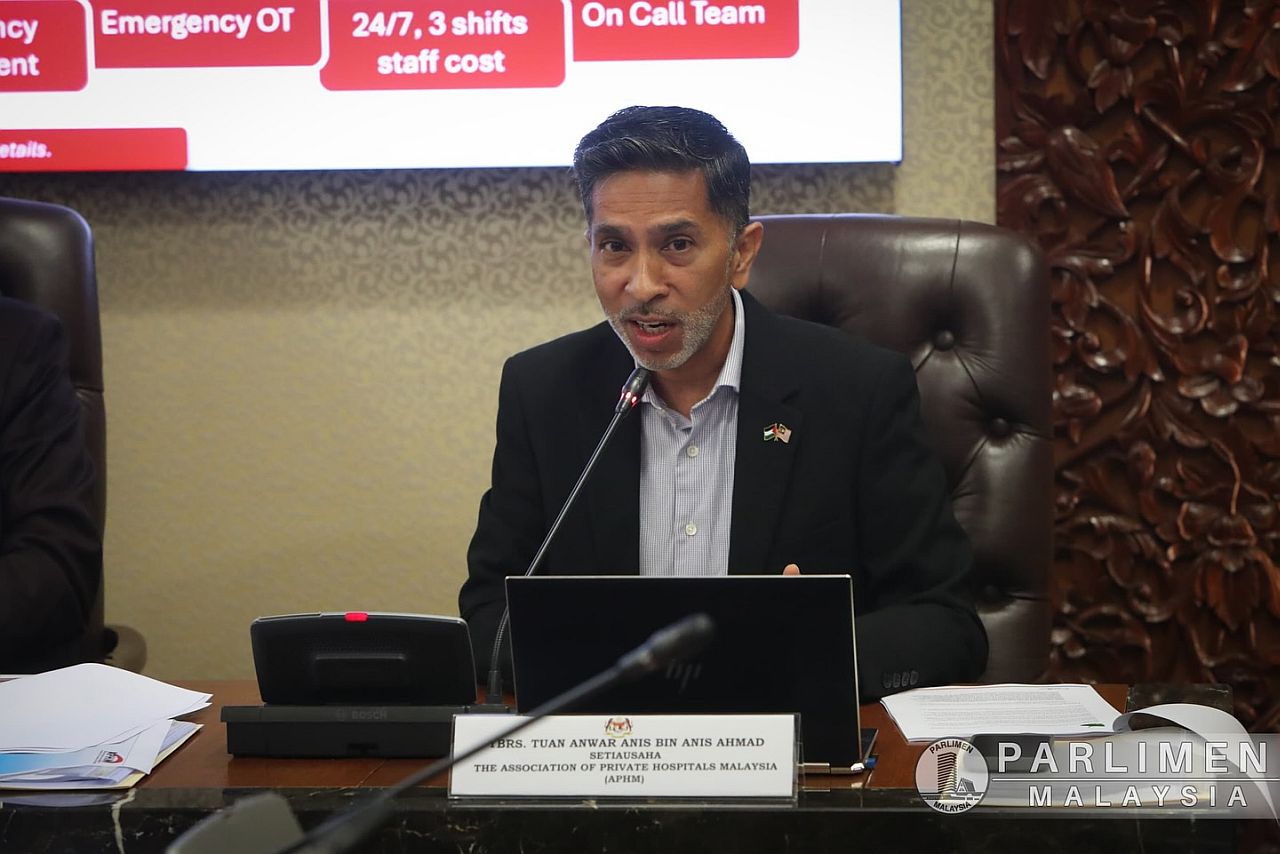
KUALA LUMPUR, July 2 — The Association of Private Hospitals of Malaysia (APHM) has dismissed the relevance of the Public Accounts Committee’s (PAC) report on rising health insurance premiums and private hospital charges.
APHM honorary secretary Anwar Anis made the remarks after he was asked at a conference about proposals raised by MPs in their debate on the PAC report last week, including whether foreign patients should be charged more than Malaysians and whether private hospitals benefiting from medical tourism should contribute more to the public health care system.
“The PAC report was delayed. That was supposed to be out six months ago. These were conversations 18 months ago,” APHM honorary secretary Anwar Anis said at the 21st Bursa Malaysia-Hong Leong Investment Bank Stratum Focus Series here today.
“So it’s like asking outdated questions. The PAC report is really outdated because it doesn’t take into account what has been done in the last 18 months.”
The PAC report, tabled in the Dewan Rakyat last week, criticised private hospital billing practices and the structure of Malaysia’s health insurance market, while recommending an independent regulatory framework to oversee both private health care and health insurance.
Responding to proposals to impose higher charges on foreign patients, Anwar said they already pay more than Malaysians under the current system.
“The government introduced SST (sales and service tax) for foreign patients. The government is already taking 6 per cent tax for every foreign patient that comes to the country. Doctors legally are allowed to charge 25 per cent more to foreign patients. So the fact is we are taxing the foreign patients. They are paying more than our local patients, like it or not,” Anwar said.
Anwar said developments since the PAC inquiry – which held sessions with the public and stakeholders from February to August 2025 – included greater price transparency, the government’s proposed Base Medical and Health Insurance/Takaful (Base MHIT) product, and the planned introduction of diagnosis-related group (DRG) payments.
He said the Base MHIT pilot would begin late this month or August after a slight delay, involving a few selected private hospitals, three insurers, and three takaful operators, ahead of a nationwide rollout planned for January next year.
“The pilot is going to be starting next month. It was supposed to be July, but it was deferred a little bit. So end of July, August is when the pilot starts.”
Participation in Base MHIT would be voluntary for both consumers and providers, Anwar said, adding that the government did not require hospitals or hospital groups to join the scheme.
“The official position from the government is voluntary both ways. It’s voluntary for you to buy Base MHIT. It is voluntary for providers to provide services to Base MHIT,” Anwar said.
Under the proposed model, participating hospitals will be categorised into two tiers. Patients treated at tier one hospitals will pay a RM500 deductible without any copayment, while those seeking care at tier two hospitals will pay the same deductible, together with a 20 per cent copayment.
“There is no mandate to say you must participate or even in a group you must have one. There’s no directive that we receive anything along that line. But we do have our members from APHM who are keen to participate, especially those who’ve got excess capacity or are just opening,” Anwar said.
Anwar noted that the DRG reimbursement model would initially apply only to Base MHIT, rather than existing medical insurance policies. “The impact of DRG is limited to the Base MHIT plan. DRG is not going to be used for your current health policies.”
He added that the government planned to adopt a hybrid reimbursement model combining fee-for-service and DRG payments during the transition to reduce “bill shock”. Anwar said private hospitals generally record profit margins of between 10 and 15 per cent.
Galen Centre Questions Base MHIT’s Value
While APHM pointed to Base MHIT as one of the major developments since the PAC inquiry, the Galen Centre for Health and Social Policy questioned whether the proposed insurance product would provide meaningful financial protection, particularly for older Malaysians.
Galen Centre chief executive Azrul Mohd Khalib argued that Base MHIT was not the only affordable medical insurance option available, saying several existing products offered broader benefits at comparable prices.
“The Base MHIT flagship is not the only affordable option. There are at least five plans out there that are better value,” Azrul said.
Comparing Base MHIT with existing medical insurance products, Azrul said the proposed product with either RM100,000 or RM300,000 annual limits carried deductibles ranging from RM500 to RM15,000, depending on the plan, while reducing monthly premiums by only RM20 to RM30.
“It is, for lack of a better word, a bad deal. It does not confer protection, it doesn’t give you comfort, and you get scared when you see that deductible at RM10,000 to RM15,000.”
Azrul said the design was particularly concerning for older Malaysians, who often face steep premium increases or lose insurance coverage altogether after turning 60 or 65, just as their health care needs become greater.
“What a Base MHIT product should do is prioritise the aged category, the cohort that needs the most protection,” Azrul said.
He said requiring older or otherwise vulnerable policyholders to pay substantial deductibles before insurance benefits take effect could expose them to catastrophic out-of-pocket spending.
Azrul urged Bank Negara Malaysia to review the design of Base MHIT to better meet the needs of seniors and other vulnerable groups, while ensuring the product reflects market realities.
He also encouraged consumers to compare all available medical insurance products instead of assuming the government’s proposed scheme offered the best value.
“Follow Bank Negara’s own advice. Assess your needs, browse all options, and choose wisely, and do not default to the government’s product without comparison.”


