

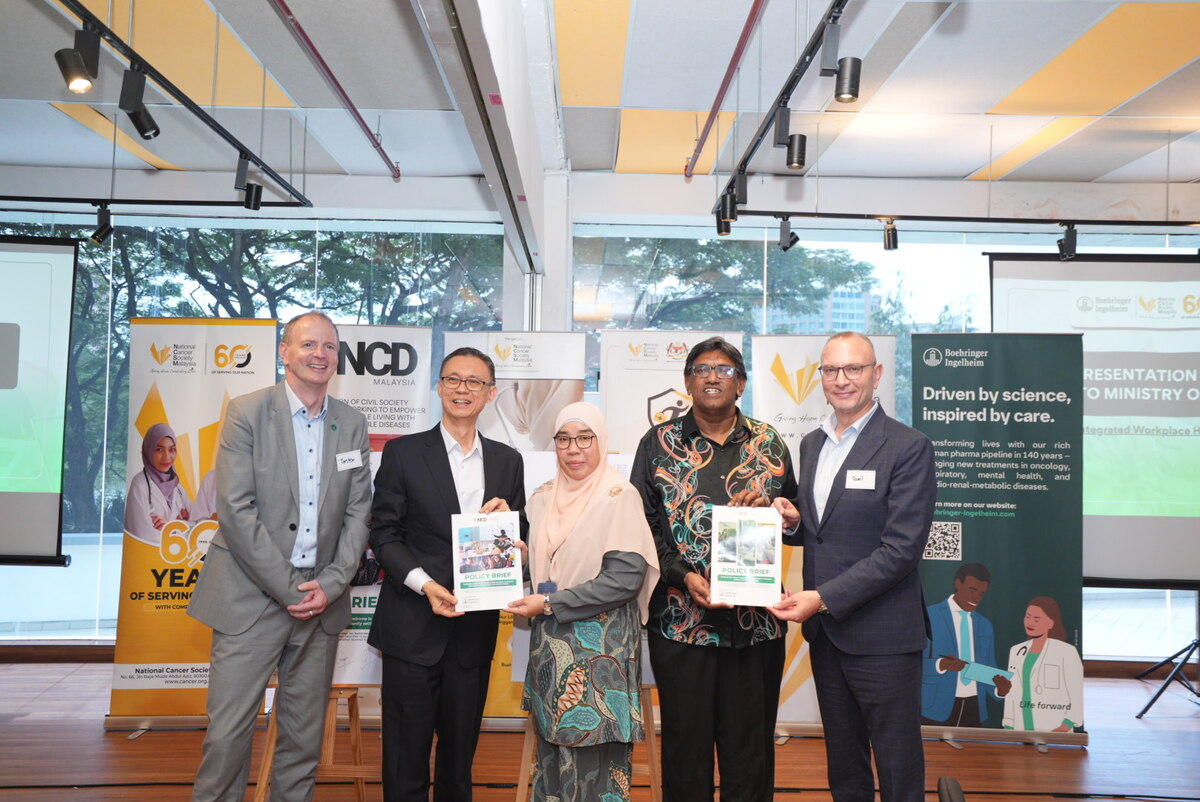
KUALA LUMPUR, June 29 — The National Cancer Society of Malaysia (NCSM), in collaboration with Boehringer Ingelheim and with the support of the Ministry of Health (MOH), has launched two policy briefs titled “Cardio-Renal-Metabolic (CRM) Syndrome in Malaysia: The Need for Co-Screening in Community Settings” and “Cardiovascular-Renal-Metabolic (CRM) Syndrome in Malaysia: Bridging the Care Cascade Gap”.
The launch of both policy briefs calls for urgent national actions to strengthen the prevention, detection and management of cardio-renal-metabolic (CRM) diseases.
The policy recommendations are informed by findings from the NCSM-Boehringer Ingelheim Saring@Komuniti Project, which screened 5,000 individuals from underserved communities across the Klang Valley in 2025.
The programme revealed a significant burden of interconnected cardiovascular, kidney, and metabolic diseases, highlighting the need for a more integrated health care approach.
Among those screened, 41.3 per cent of participants were found to be obese and 28.8 per cent were overweight, meaning around seven in 10 had an increased health risk due to being overweight or obese. In addition, 34.5 per cent had pre-diabetes and 35.1 per cent had diabetes, indicating a high hidden burden of blood sugar problems.
Overall, almost all participants (97.8 per cent) had at least one cardio-renal-metabolic (CRM) risk factor. The findings reinforce growing evidence that these conditions frequently coexist, share common risk factors and accelerate one another’s progression.
The launch comes at a time when Malaysia continues to face rising rates of chronic disease. Chronic kidney disease prevalence increased from 9.1 per cent in 2011 to 15.5 per cent in 2019, while the number of Malaysians requiring dialysis has more than tripled over the past two decades.
Health care experts warn that without earlier detection and coordinated intervention, the burden on patients and the health care system will continue to grow.
The policy briefs identify two key priorities for national action: expanding integrated co-screening to detect interconnected diseases earlier, and strengthening the care continuum to ensure individuals move successfully from screening to diagnosis, treatment and long-term disease management.
Current health care approaches often focus on individual diseases in isolation, resulting in missed opportunities to identify overlapping risks.
At the same time, fragmented referral pathways, inconsistent follow-up systems and barriers to continuity of care can prevent patients from receiving timely intervention after an abnormal screening result.
To address these challenges, the policy briefs recommend scaling up CRM co-screening programmes nationwide, embedding standardised CRM risk assessments into routine health checks, strengthening referral and follow-up mechanisms, leveraging digital health technologies, and developing integrated care pathways across public and private health care settings.
The recommendations also emphasise the need to measure patient outcomes—including diagnosis completion, treatment initiation and disease control—rather than screening activity alone.
“Malaysia has an opportunity to shift from managing individual diseases separately to addressing cardiovascular, kidney and metabolic health as a connected continuum. Early detection must be matched by coordinated follow-up and long-term care if we are to improve outcomes and reduce the growing burden of chronic disease,” said Dr Murallitharan Munisamy, managing director of NCSM.
Cheong Yee Kok, general manager and Head of Human Pharma, Boehringer Ingelheim Malaysia, Singapore and Indonesia, said, “Cardiovascular, kidney, and metabolic conditions are closely interconnected, sharing common risk factors and amplifying each other’s impact.
“Through our collaboration with NCSM, Boehringer Ingelheim is committed to advancing integrated solutions — from co-screening to coordinated care pathways — so that earlier detection leads to better long-term outcomes for patients.”
The organisations behind the policy briefs are calling on policymakers, health care providers, employers, community organisations, and industry partners to work together to make integrated CRM screening and care a national priority, ensuring that Malaysians at risk are identified earlier and connected to the care they need before complications occur.


