

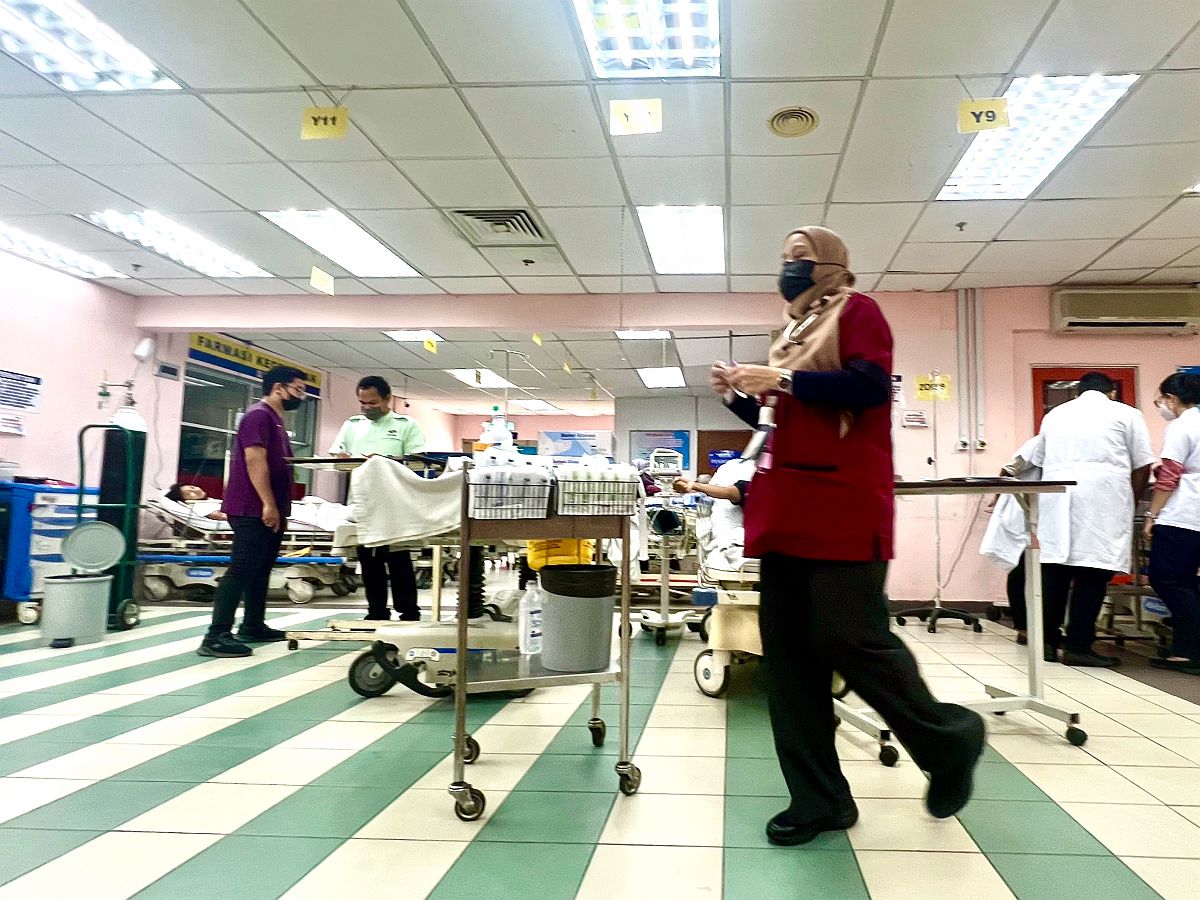
The recent suicide of a house officer has once again thrust the welfare of doctors and the many problems faced by Malaysia’s public health care system into national spotlight. While the circumstances surrounding that tragedy remain under investigation, one must ask if our antiquated public health care system is now buckling under the demands of modern times.
Let us start with the elephant in the room. Do we have enough doctors in this nation? On paper, the answer appears reassuring. The Department of Statistics reported that the country’s doctor-to-population ratio improved significantly in 2023 to 1:406, compared with 1:758 in 2012.
By that metric, Malaysia has already surpassed the target of 1:425 outlined in the Ministry of Health’s (MOH) Strategic Plan for 2021–2025. On the other hand, a document from the MOH’s Human Resources Division shows that the number of house officers and new medical graduates entering the system has dropped sharply from more than 6,000 annually between 2017 and 2019 to just over 3,000 in 2023.
At the same time, the health minister has acknowledged that 6,417 permanent and contract medical officers resigned between 2019 and 2023.
The numbers tell a more complicated story than the official ratio suggests. The doctor-to-population statistic does not distinguish between doctors working in public hospitals and those in private practice, general practice, aesthetic clinics, or even nonclinical roles.
These distinctions are important as majority of Malaysians, especially elderly and those without private insurance depends on government facilities for their health care needs. Another concern is fewer house officers today will inevitably mean fewer medical officers and specialists tomorrow.
The demand on our public health care facilities is growing. Malaysia’s population is ageing and increasingly unhealthy. We are the most obese country in Asia and have a high burden of metabolic diseases such as diabetes, dyslipidemia, and hypertension.
In the coming decades, these trends will translate into a surge of complications, i.e. end stage kidney disease, coronary artery disease and cancer, placing even greater strain on hospitals already stretched thin.
Some would argue that the rapid expansion of private health care could help absorb this demand. Indeed, several major health care groups are currently expanding their hospital networks or preparing public listings to capitalise on rising demand for medical services.
However, growth in the private sector comes with its own consequences. Private hospitals inevitably draw manpower away from the public system. At present, the public sector is struggling to retain its doctors and nurses, many of whom are leaving not only for private practice but also for opportunities abroad.
When you talk about push-pull factor, there is no competition between public and private medical sector. Remuneration aside, the private sector often employs larger numbers of nurses, allied health professionals such as physiotherapists and pharmacists, as well as clerical and logistical staff.
By contrast, in public hospitals, doctors often find themselves performing tasks that should not require medical training at all: searching for blood samples, transporting patients to imaging suites, or assisting with routine procedures that could easily be handled by trained personnel.
Take blood-taking as an example. In many health care systems, it has been routinely performed by phlebotomists since the 1990s.
However, in Malaysia’s public hospitals, such work frequently falls to junior doctors. As the number of house officers shrinks, these responsibilities are increasingly pushed onto medical officers, the very doctors who should be refining advanced clinical skills or preparing for specialist training.
What would happen if Malaysia faced another public health crisis on the scale of Covid-19? Could a system already strain by manpower shortages cope with such a shock?
For years, health care professionals have called for structural reforms. Among the proposals: revising public health care fees to generate funding for long-overdue infrastructure upgrades, hiring more staff across all levels of the system, and improving pay and recognition to retain skilled personnel.
Yet, these clarion calls have fallen onto deaf ears. Even basic institutional reforms remain elusive. We couldn’t even get an independent health service commission similar to the Education Service Commission (SPP), which manages appointments and disciplinary matters for educators separately from the broader public service structure.
Instead, health care staffing decisions remain tied to the general machinery of the Public Service Department (JPA), who responds glacially to the current demands.
Government leaders often highlight increases in the health care budget as evidence of progress. However, much of that increase simply reflects inflationary pressures.
In reality, Malaysia’s public health care spending remains low at about 1.98 percent of the country’s gross domestic product (GDP), far below the average of 6.94 percent among countries in the Organisation for Economic Co-operation and Development (OECD).
Hence, the real problem lies with our fallacy and culture of preserving the status quo. If the system is functioning, even barely, why risk changing it? Kick the can down the road and let the next person solve it.
Case in point, Malaysia launched its first electronic medical record (EMR) system back in the 1990s and today, the hospital that pioneered has struggled to restore it reliably after a breakdown that occurred six years ago.
Real change will require political will. Policymakers must confront an uncomfortable truth: either public health care fees must be revised realistically or the government must commit far greater investment to sustain the system.
Without one of these choices, problems will continue to pile up and one day we will look like the Emperor with no clothes – admired only by himself, and bare to others.
The author is a government doctor. CodeBlue is providing the author anonymity because civil servants are prohibited from writing to the press.
- This is the personal opinion of the writer or publication and does not necessarily represent the views of CodeBlue.


