

Recently, discussions among specialists have highlighted an increasingly puzzling issue in the Ministry of Health’s (MOH) subspecialty application process.
According to communication from Bahagian Pengurusan Latihan, applicants for subspecialty training must possess three consecutive years of complete 12-month LNPT (Laporan Nilai Prestasi Tahunan) before their applications will even be considered.
On the surface, this requirement appears reasonable. After all, performance evaluation is an important component of professional accountability.
However, when examined more closely, the policy produces a rather curious outcome: it appears to disproportionately affect specialists trained through the local Master’s programmes, while leaving many Parallel Pathway graduates largely unaffected.
Naturally, this has raised an obvious question among doctors: are these two specialist training pathways truly treated equally within the system? Because the current situation suggests otherwise.
The LNPT Requirement And Its Practical Consequences
Under the current interpretation, applicants must produce three consecutive years of complete 12-month LNPT reports before being eligible to apply for subspecialty training.
For many specialists graduating from Malaysian Master’s programmes, this requirement can effectively translate into a five-year waiting period before subspecialty eligibility.
Consider a typical timeline:
A doctor completes their Master’s programme and obtains specialist gazettement in mid-2023. Because LNPT evaluations must cover a complete calendar cycle, the partial year of 2023 is not counted.
The first “complete” LNPT year becomes 2024, followed by 2025 and 2026. Only after accumulating these three years can the doctor apply in 2027, for a 2028 subspecialty intake.
In other words, a doctor who has already completed specialist training may need to wait half a decade before being allowed to pursue subspecialty training.
One might reasonably wonder whether the health care system, which frequently emphasises the urgency of specialist shortages, intended for this timeline.
Why Master’s Graduates Are Disproportionately Affected
The answer lies largely in how LNPT records are generated during specialist training. Master’s trainees typically rotate across multiple institutions, departments, and training environments.
These rotations may involve transitions between university hospitals and MOH facilities, changes in reporting officers, or mid-year posting adjustments.
The result is that some years during Master’s training produce partial or administratively incomplete LNPT records.
Consequently, when the requirement for three consecutive full LNPT years is applied strictly, those years are often excluded.
This administrative detail may seem small, but its impact on career progression can be significant.
The Curious Case Of “Cuti Belajar Bergaji Penuh”
The explanation reportedly provided by administrative staff adds another interesting dimension.
Master’s training, we are told, is classified as “Cuti Belajar Bergaji Penuh” (CBBP).
At first glance, this sounds entirely reasonable. After all, the phrase literally translates to “full-pay study leave.”
But here is where things become rather fascinating. Because anyone who has actually worked in a hospital alongside Master’s trainees would immediately notice something unusual about this description.
What Master’s Trainees Actually Do
If Master’s trainees are truly on study leave, they seem to have an unusually demanding form of leave. During their “leave,” Master’s trainees routinely:
- Manage inpatient wards.
- Run specialist clinics.
- Perform procedures.
- Participate in overnight on-call rosters.
- Supervise house officers and junior medical officers.
- Handle emergencies and complex cases.
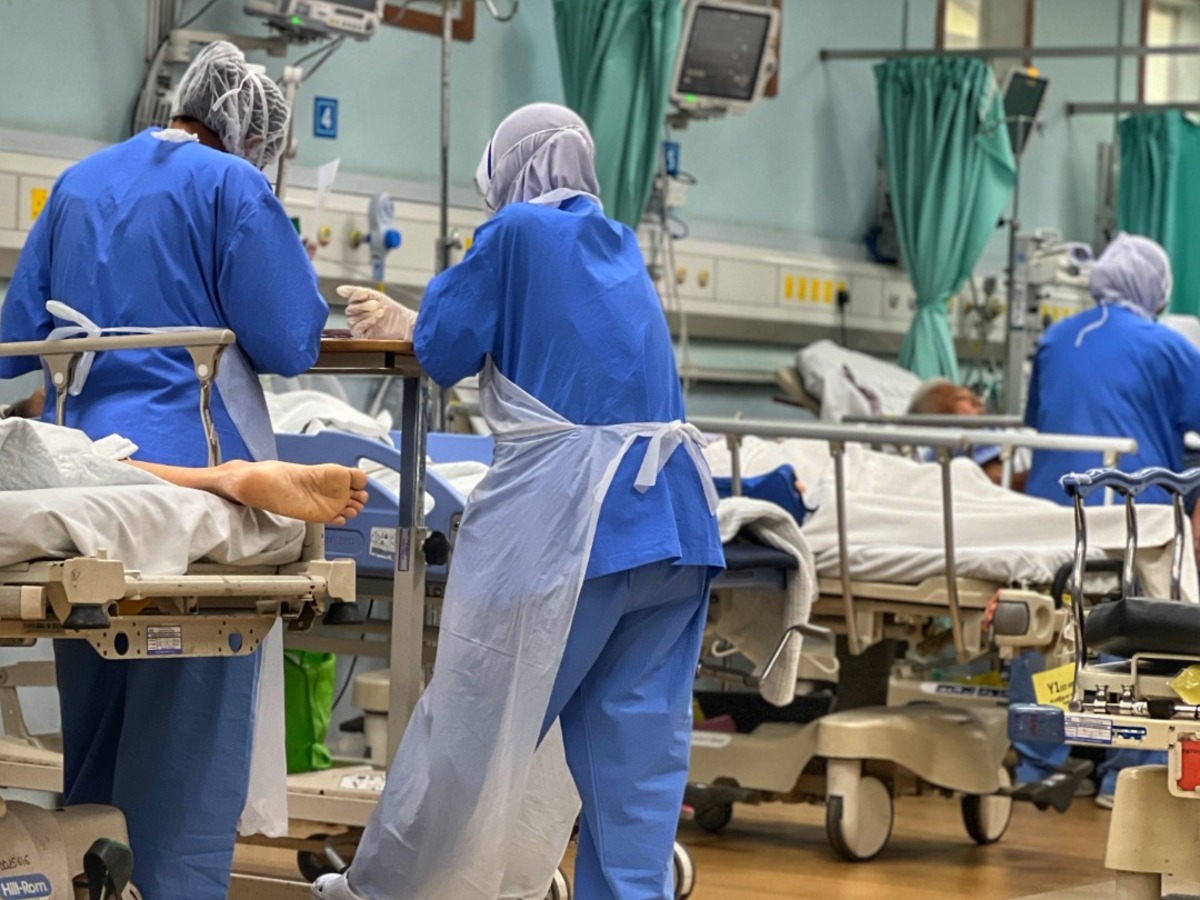
In many departments, Master’s trainees function as registrars or senior medical officers, playing a central role in keeping hospital services operational.
It is therefore somewhat intriguing to learn that all of this activity apparently takes place while the doctors are officially on leave.
One might politely ask: if this is study leave, what exactly does regular work look like?
The Administrative Paradox
This classification creates a rather elegant administrative paradox.
During Master’s training, doctors are classified as being on study leave.
During hospital operations, the same doctors are clearly functioning as active members of the clinical workforce.
And during subspecialty application, they are informed that they lack sufficient service performance documentation, because they were on study leave.
In other words, the system simultaneously treats these doctors as students when generating administrative records, workforce when providing clinical services, and insufficiently documented employees when applying for further training.
It is, admittedly, a remarkably efficient way to occupy all possible categories at once.
Why Parallel Pathway Graduates Appear Less Affected
Parallel pathway trainees often remain continuously employed within service positions during their training period.
Because their employment status does not shift into the administrative category of study leave, their LNPT records continue to be generated annually without interruption.
As a result, by the time they achieve specialist recognition, many already possess the required three consecutive LNPT years.
This difference in administrative classification can create the perception that one pathway is being structurally favoured over another, even if such an outcome was never explicitly intended.
The Broader Implications
If the LNPT requirement effectively delays subspecialty eligibility for Master’s graduates by several years, the consequences may include:
- Delayed development of subspecialty expertise.
- Reduced morale among specialists.
- Perceptions of inequity between training pathways.
- Increased interest in pursuing subspecialty training overseas.
For a health care system already facing significant specialist shortages, policies that unintentionally slow the progression of trained specialists may not be particularly helpful.
A Question Worth Clarifying
Ultimately, the issue can be distilled into a very simple question: are Master’s trainees students on leave, or are they members of the health workforce?
Because the current system appears to rely on them heavily as one, while administratively classifying them as the other.
Clarifying this distinction may not only improve fairness in subspecialty selection but also ensure that administrative policies better reflect the realities of clinical practice.
After all, if doctors are truly on leave while managing wards, clinics, and on-calls, then the Malaysian health care system may have quietly invented the most productive study leave programme in the world.
And that, surely, would be quite an achievement.
The author is a Master’s-trained internal medicine physician in Selangor. CodeBlue is providing the author anonymity because civil servants are prohibited from writing to the press.
- This is the personal opinion of the writer or publication and does not necessarily represent the views of CodeBlue.


