

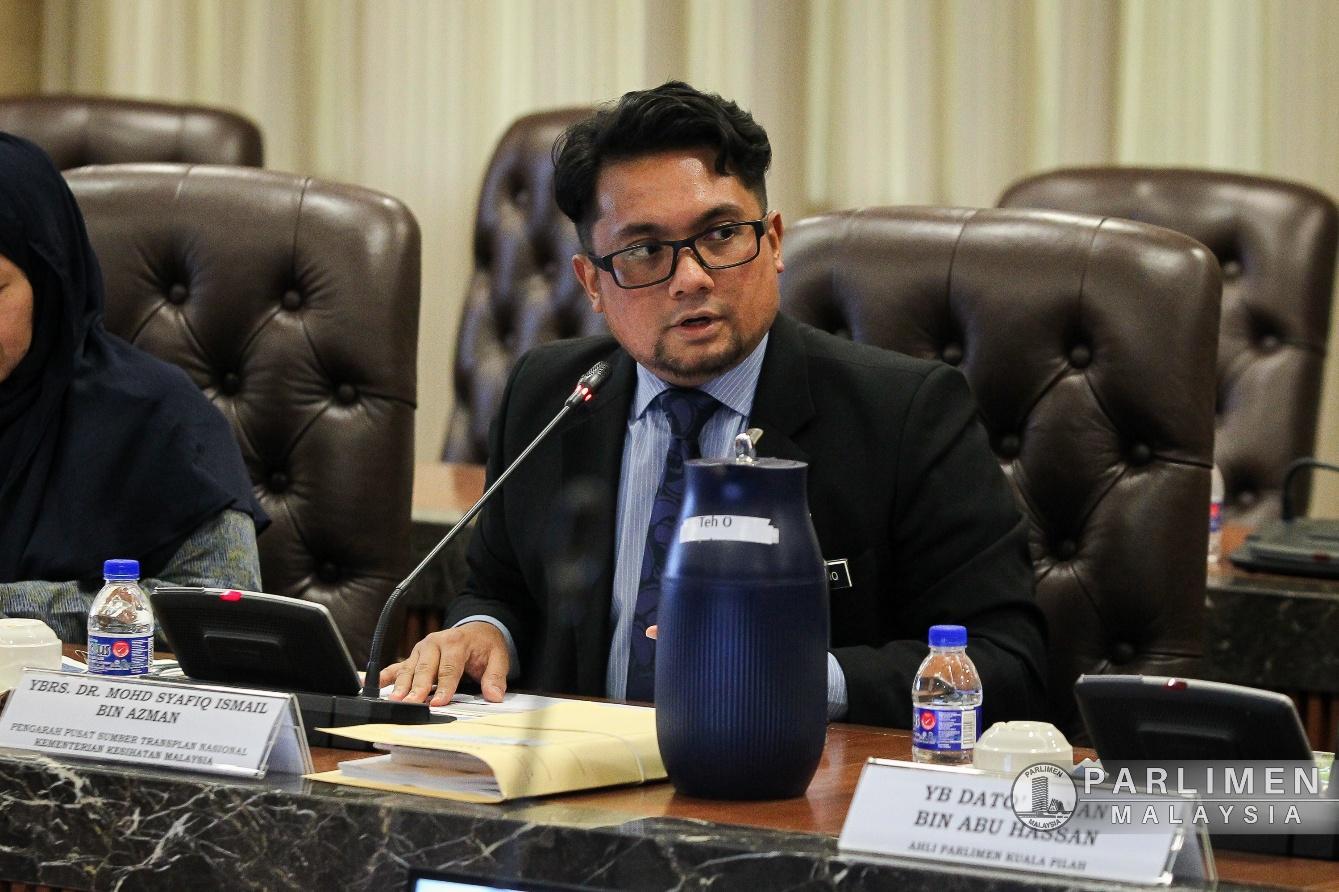
KUALA LUMPUR, Dec 15 — Nearly 90 per cent of potential deceased organ donations in Malaysia fail to proceed because families decline consent, the Ministry of Health (MOH) told Parliament.
Dr Mohd Syafiq Ismail Azman, director of the National Transplant Resource Centre (NTRC), told the Health parliamentary special select committee (PSSC) on October 29 that public and private hospitals received an average of about 1,000 referrals for potential organ donors over the past two years: 1,150 in 2023 and 1,301 in 2024.
Yet the conversion rate remains “extremely low,” he said, because organ retrieval cannot proceed without approval from the deceased person’s next of kin. A donor pledge card does not carry legal authority under Malaysian law.
“When the team approaches families for consent, as you know, we need consent from the family because the donor pledge card is not a licence for the hospital to take organs after death. So the turnover is still low. More or less 10 per cent of what is potential,” Dr Mohd Syafiq said, according to the Hansard in the Health PSSC’s report tabled in the Dewan Rakyat last November 27.
Malaysia sources organ donations from two groups: living donors and deceased (cadaveric) donors.
Living donors, with or without familial ties, must undergo strict medical, psychological, and ethical screening. Only a kidney or part of the liver may be donated by a living person.
Deceased or cadaveric donors are individuals certified dead from either cardiac death or brain death. With family consent, organs such as kidneys, liver, lungs, heart, corneas, heart valves, bone, and skin may be donated to patients in need.
According to MOH data, Malaysia has more than 412,000 registered organ donation pledgers. The majority are Malay, followed by Chinese, Indian, and other ethnic groups. Selangor, Kuala Lumpur, and Johor have the highest number of pledgers, attributed to higher population density, easier access to information, and more extensive promotional efforts in urban areas.
Malaysian Society of Transplantation (MST) president Dr Mohamad Zaimi Abdul Wahab told the Health PSSC in a separate proceeding that Malaysia has recorded only 3,492 transplant surgeries since 1975 – a figure developed countries can reach in a single year.
The MST cited the Organ and Transplantation Global Report 2023, which showed that Malaysia had one of the highest family refusal rates for deceased donation globally, with 1,105 potential donation cases not proceeding that year.
“If all those cases had proceeded, the country could have obtained more than 2,200 additional kidneys for patients in need,” said Dr Mohamad Zaimi, who is also a transplant nephrologist at Kuala Lumpur Hospital (HKL).
There are currently 10,736 patients in Malaysia awaiting transplants: 10,707 for kidneys, five for livers, 12 for hearts, three for lungs, and nine for combined heart-lung transplants.
Despite Religious Endorsements, Families Still Hesitate To Approve Organ Retrieval
NTRC head Dr Mohd Syafiq urged Malaysians who have pledged as organ donors to discuss and communicate their intentions openly with their families to ensure their wishes are honoured.
“We have many pledgers,” he said. “[But] that does not mean they are our supply. I apologise for using the word ‘supply’ because their intention to donate is very noble. As the data shows, we have over 15,000 [new] pledgers [in 2025], but not all 15,000 will actually become donors if the family does not allow it.”
Concerns about religious permissibility remain a challenge in shifting public attitudes. While most religions in Malaysia support organ donation, some beliefs oppose it because it is viewed as a form of mutilation of the deceased.
Dr Mohamad Zaimi previously noted that a deceased donor must undergo a surgical procedure similar to that performed on a living donor, as the organ must be retrieved in good condition. He said the NTRC and Hospital Organ Procurement Unit (UPOH) teams take meticulous care to preserve the body’s anatomy so that no obvious disfigurement is visible after retrieval.
Dr Mohd Syafiq also said in a Bernama Radio interview earlier this year that many Malaysians, particularly Muslims, still harbour misconceptions about organ donation after death.
He explained that in June 1970, the National Fatwa Council ruled that organ donation and transplantation are harus, or permissible, in Islam, as stated in a 2012 FAQ pamphlet published by the MOH’s Transplantation Unit in collaboration with Jakim.
A 2019 Bayan Linnas (public explanation) commentary published by the Mufti of the Federal Territories’ office similarly concluded that, after examining issues related to organ and tissue donation, the practice is “permissible” and “encouraged”.
Low Organ Donation Rates Leave 21 Malaysians Dying Daily On The Waiting List
The consequences of Malaysia’s low organ donation rate are already evident in the country’s transplant waiting list.
Ravinder Singh, co-founder and chief commercial officer of AQM Technologies Sdn Bhd, told the Health PSSC that an average of 21 Malaysians on the waiting list die each day for lack of an available organ, while roughly 27 new patients join the list daily.
By 2040, he said, Malaysia could have more than 104,000 people requiring dialysis.
“Every day, 21 Malaysians on the transplant waiting list die – not because they are untreatable but because there are not enough organ pledges. When they die, 27 new patients are added every day. By 2040, we are projecting to exceed 104,000 dialysis patients.
“We are building a future of suffering and cost that the nation cannot carry,” Ravinder said. “This is not a medical shortage; this is a donor shortage and donor shortage is a behaviour problem. Behaviour can be changed with the right incentive structures.”
Most dialysis patients (73 per cent), he noted, are under 65, an age at which many are still employed and supporting families.
“Dialysis does not only take kidneys. It removes time, energy, productivity, and dignity,” he said. “We are not just losing lives at the end. We are losing years of national contribution in the middle. This is not only a clinical loss. It is a workforce loss, a tax-based loss, and a family stability loss.”
The financial toll is similarly acute. Studies estimate that dialysis treatment in Malaysia costs RM30,000 to RM40,000 per patient each year. With roughly 55,000 patients currently on dialysis, Ravinder said national spending already approaches RM2 billion annually. At the current pace, dialysis expenditures could rise to RM6 billion by 2040.
“Half of this burden sits with the government. Another quarter is funded by the Social Security Organisation (Socso) and Socso has stated that if this trend continues, their dialysis obligation or loan can bankrupt the fund within a decade,” Ravinder said.
The government remains the primary financier of dialysis care. Limited slots in MOH dialysis centres are supplemented by subsidies for treatment at recognised non-governmental and private facilities, but demand continues to outstrip capacity.
Health deputy director-general (medical) Dr Nor Azimi Yunus previously described the dialysis burden – both clinical and financial – as “unsustainable,” with the number of new patients each year showing no sign of plateauing. “How much can the government afford to spend, and for how many more years?” she asked.
“This is no longer a slow-burning problem,” Ravinder said. “This has crossed into a fiscal risk for the country and the only reason it continues is because we do not have enough organ pledges.”


