

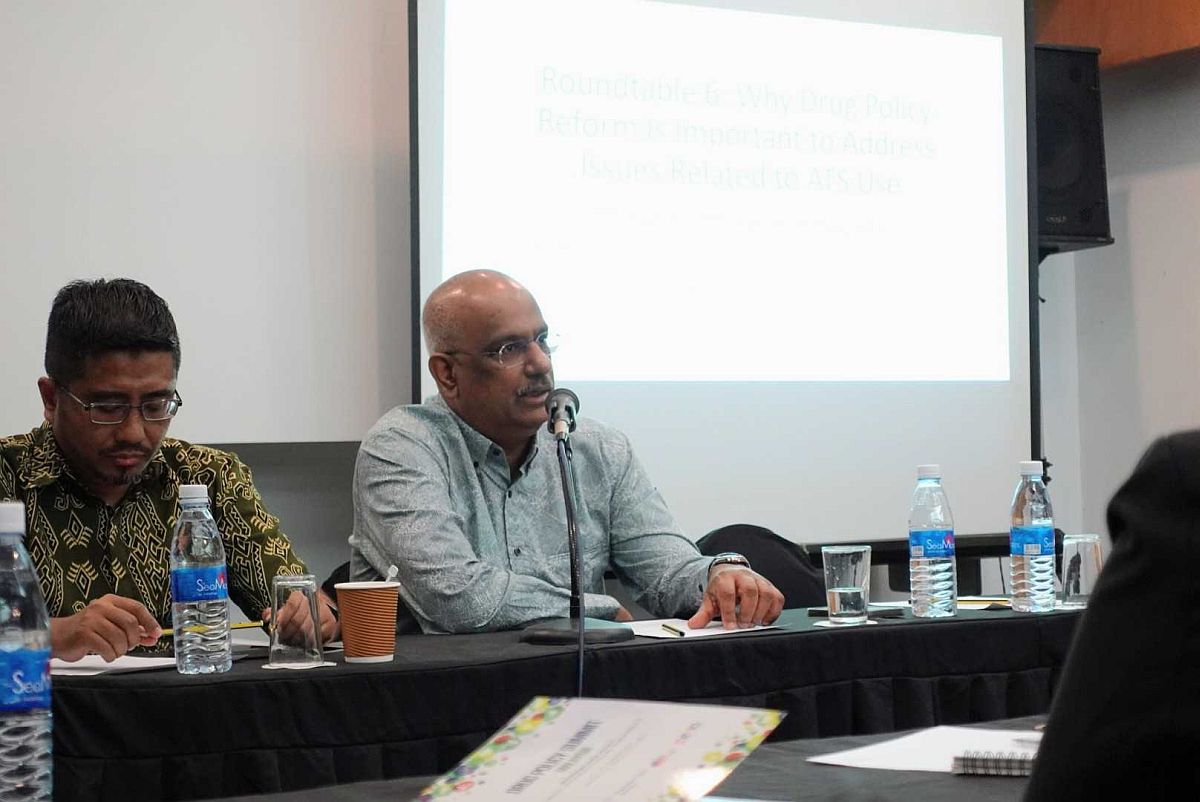
KUALA LUMPUR, Nov 6 — Malaysia’s drug laws are fundamentally misaligned with the clinical understanding of addiction, creating a paradox between how drug dependence is treated in health care and how it is punished under the criminal justice system.
Prof Vicknasingam B. Kasinather, professor of addiction at the Centre for Drug Research, Universiti Sains Malaysia (USM), said that while addiction is recognised medically as a complex, relapsing disorder that requires individualised clinical diagnosis, drug laws attempt to “objectify” addiction through fixed numerical thresholds and repeat-offence triggers.
“There is a saying that the law is an ass,” Vicknasingam said during the Drug Policy Summit Malaysia 2025 in Kuala Lumpur yesterday. “Especially when it comes to the drug laws, I think there is a paradox between what we understand in medicine or health, and how the law is written.”
Vicknasingam said addiction is understood medically as a relapsing, multifactorial condition that must be diagnosed clinically. “There’s no urine test that determines addiction,” he said. “There’s no cut-off in any biochemistry marker. Each patient has a unique diagnosis.”
However, the Dangerous Drugs Act (DDA) 1952 and related provisions attempt to create fixed formulas for addiction, which contradict clinical reality.
Fixed Legal Thresholds Ignore How Addiction Works
The addiction researcher highlighted Section 39C, which enhances punishment when a person has two previous convictions under paragraph 15(1)(a).
“The law now says two previous offences. See how it tends to objectify or make it very specific or convenient. But that doesn’t solve the problem,” Vicknasingam said.
“Why two? Why not three? Why not five? Why not ten? Who came up with these two offences? So you can see the paradox here of what is written in law not being in sync with what is defined as addiction.”
He also highlighted Section 39A which criminalises small possession based on fixed cut-offs such as two or three grams. “Why 2 grams? Why 3 grams? Why not 5 grams? Why not 1 gram? Why not 10 grams?” he said. “When someone has used drugs over a long period of time, they develop tolerance. Someone who has used drugs longer will consume more because they become tolerant – similar to cigarettes or alcohol.”
Vicknasingam added that Section 37, which criminalises drug use based solely on a positive urine test, also contradicts clinical practice. “A urine test merely tells you if someone has used or has not used drugs. That’s all. A urine test cannot be used to determine addiction.”
Rewrite The Law With Addiction Experts
Vicknasingam said Malaysia is now at a pivotal point as it considers decriminalisation and drug law reform, and lawmakers must ensure reforms are informed by science.
“The legal jurisprudence understanding is very important to those who will be involved in rewriting or amending these laws in terms of understanding the aspect of addiction dependence spectrum that is involved,” he said.
“So please, the legal people who are going to work on this, please consult or work with people who are involved in addiction, people who are experts in addiction, people who are clinicians who understand the disease. When we rewrite the laws, it has to be in sync with what is defined in medical terms.
“Otherwise we’re going to have this term of ‘the law is an ass’ continue.”


