

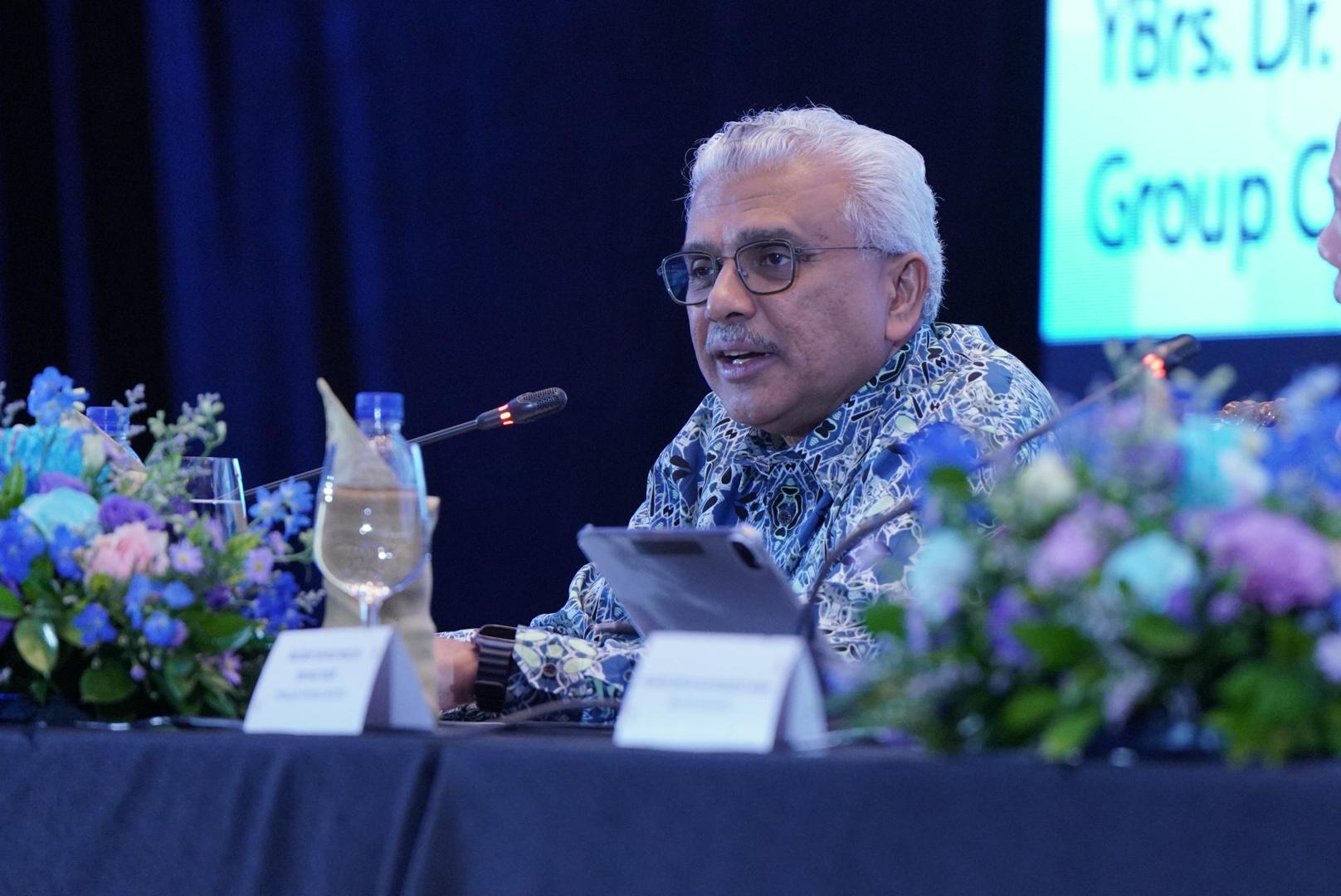
KUALA LUMPUR, August 5 — IHH Healthcare Berhad group CEO Dr Prem Kumar Nair said the Malaysian health care system is overly centralised on hospitals, as he called for a transition to primary care.
Based on IHH’s experience of operating in 10 countries, where the private hospital group interacts with the public health care systems through public-private partnerships, Dr Nair said the Malaysian health care system is complete, comprising rural health centres, primary care centres, maternal and child health services, and hospitals.
“But I think the Malaysian system is very hospital-heavy and far too, a lot of our investments are going to the hospitals, building our hospitals,” Dr Nair said at the Forum Ilmuwan Malaysia Madani KPT Siri 7 organised by the Ministry of Higher Education here last Thursday.
“The fundamental point that I’d like to make here is this – and this may sound rather odd coming from the operator of a very large hospital-heavy group – I think health care reform is required not just in Malaysia but in all countries: we have to shift the burden of care completely to primary care and community services.”
Dr Nair said IHH is implementing out-of-hospital strategies in Singapore and Hong Kong, since regulations in both countries no longer permit the construction of new private hospitals.
“So we’re shifting acute patients out into the community into ambulatory care centres and primary care centres. This reduces the risk of infection for patients,” said Dr Nair, a Singaporean who previously served as CEO of IHH Singapore and is a family physician by training.
“I appeal to the Minister of Health to look at how hospitals can move into the ambulatory and primary care sector.”
Dr Nair said primary care to manage one’s cholesterol and blood pressure would help prevent stroke and heart disease, besides stressing the importance of immunisation.
“That will allow us to tackle an emerging threat, which is cancer,” he said, pointing out that in Singapore, one in three Singaporeans will get cancer in their lifetime.
Dr Nair said IHH is the first private hospital operator in Asia to implement value-driven outcomes to manage cost, covering eight high-volume procedures like total knee replacement, colonoscopy, and coronary artery bypass graft (CABG). Two more procedures will be added to value-based health care next year.
An IHH hospital, he said, has also introduced early recovery after surgery (Eras), in which patients are sent home as quickly as possible to avoid hospital-acquired infections.
“So far, value-based health care has served our patients and organisation well.”
Health Minister Dzulkefly Ahmad noted that the last private hospital in Singapore was built more than a decade ago.
He supported Dr Nair’s suggestion for Malaysia to transition from hospital-based and curative care to population health management in the community.
“I would want to believe that IHH will lead the charge of investing, of truly promoting promotive, predictive, preventive health care within the setting of a clinic, like Singapore now where the emphasis is polyclinics, more than hospitals,” Dzulkefly said at the forum.
The health minister said preventive care would help reduce congestion in public hospitals, acknowledging that building more hospitals would not end this “crisis” of overcrowded hospitals.
“The way forward is to stress on the importance of NCDs (non-communicable diseases) and to nip it in the bud,” said Dzulkefly.
“We have got national health screening initiatives, we screen for NCDs. That’s where we get to address everyone.”
Monash University Malaysia pro-vice chancellor and president Prof Dr Adeeba Kamarulzaman, who is an infectious disease physician by training, said Malaysia’s biggest health challenge is the NCD crisis, including cardiovascular disease, diabetes, obesity, and cancer.
At the forum, Dr Adeeba cited a report by the World Health Organization (WHO) and the Ministry of Health (MOH) titled “Prevention and Control of Noncommunicable Diseases in Malaysia: The Case for Investment” that was published last December.
“The numbers are scary,” said Dr Adeeba.
According to the report, NCDs cause 72 per cent of all premature deaths in Malaysia every year. About 20 per cent of Malaysians die before the age of 70 that, according to Dr Adeeba, is twice the 10 per cent average for Singapore.
“We’re up there in terms of 20 per cent with countries with far lower GDP (gross domestic product) than us.”
The WHO-MOH report estimated that NCDs result in annual economic losses of RM64.2 billion, comprising RM51.8 billion in productivity losses and RM12.4 billion in health care expenditure and disability payments, equivalent to 4.2 per cent of GDP.
According to a December 2024 report by MOH’s Malaysia National Health Accounts, Malaysia’s total expenditure on health reached 4.6 per cent of GDP in 2023, comprising 2.4 per cent public and 2.2 per cent private sources of financing.
Dr Adeeba said responsibility for health doesn’t lie with the MOH alone, pointing out that most surveys show very low health literacy among Malaysians at 11 per cent.
Shifting from acute to primary care, she said, requires health insurers to incentivise health screenings. “In fact, there’s a perverse incentivisation for admission into hospital. So Bank Negara needs to look at this. The insurance fraternity needs to look at this if we’re all really serious about tackling what we’re facing at the moment.”
Under the 13th Malaysia Plan (13MP) tabled by Prime Minister Anwar Ibrahim in Parliament last Thursday, the government plans to build and upgrade more hospitals, including the construction of five new hospitals or centres: Tuanku Jaafar 2 Seremban Hospital in Negeri Sembilan, Sultanah Aminah 2 Johor Bahru Hospital in Johor, Northern Cancer Centre in Sungai Petani, Kedah, Sabah Heart Centre at Queen Elizabeth II Hospital in Kota Kinabalu, Sabah, and the Sarawak Heart Centre.
13MP also targets raising the proportion of primary care spending from 27.2 per cent in 2023 to 32 per cent in 2030 out of total health expenditure. In a post on X, paediatrician Dr Amar-Singh HSS said this projected increase was too small.
The country’s five-year plan also targets reducing deaths caused by NCDs from 19.2 per cent in 2022 to 18 per cent by 2030.


