

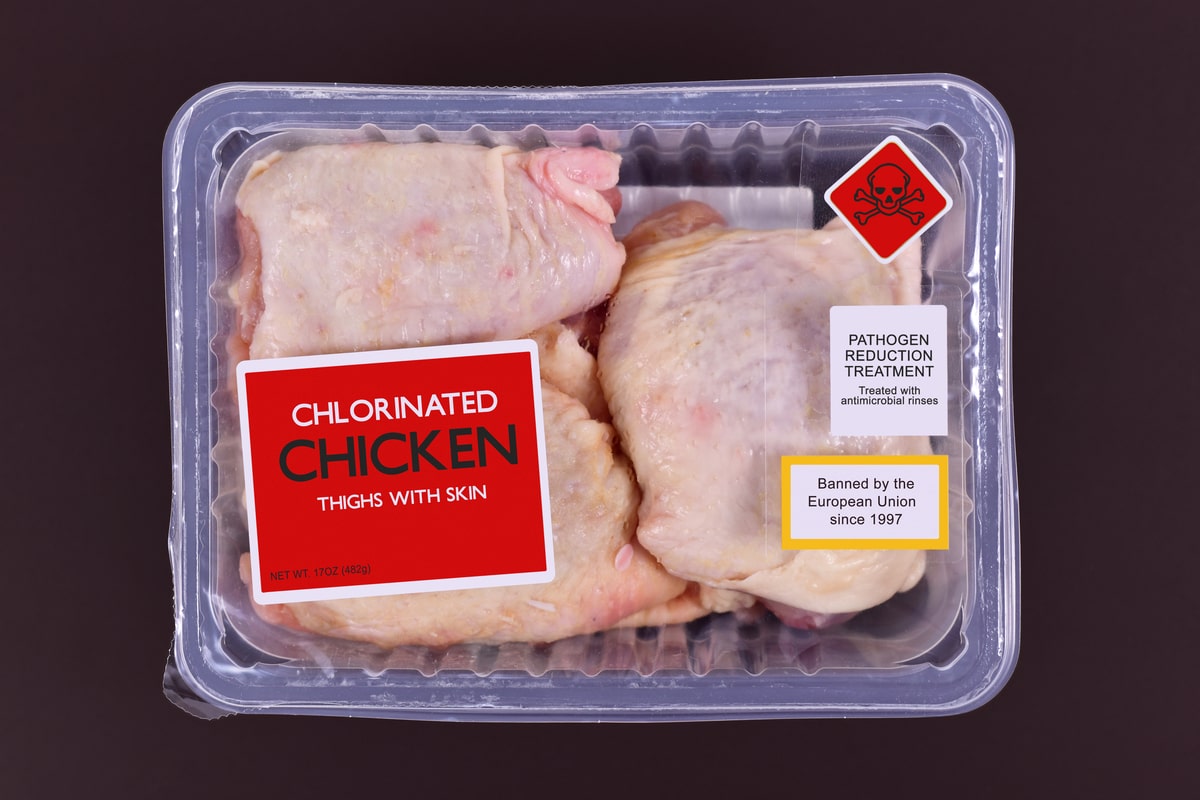
KUALA LUMPUR, August 18 — Malaysia already permits certain American-style meat production practices, like chlorine washes for poultry and the limited use of ractopamine in pigs, if they meet Codex Alimentarius limits.
These international food safety rules, known as the Food Code, are also followed by the United States (US), but the European Union (EU) has more stringent standards, with bans on “chlorinated chicken” and the use of ractopamine, a growth promoter, in food-producing animals since the late 1990s.
The Department of Veterinary Services (DVS) under the Agriculture and Food Security Ministry (KPKM) told CodeBlue that Codex-based rules, alongside Malaysia’s own prohibitions on growth hormones in all livestock and ractopamine in ruminants, apply equally to all exporting countries, including the US. Ruminant animals include cattle, sheep, goats, and buffalo.
The government’s recent agreement to remove tariffs on 191 American agricultural products does not alter these safety requirements.
“The standards referred to for the importation of animal products are in line with international standards, such as the World Organisation for Animal Health’s Terrestrial Animal Health Code (TAHC) and the Codex Alimentarius, and in addition, they must comply with Malaysian legislation, namely the Food Act 1983,” DVS said in a statement to CodeBlue last Friday.
Public concern on X had focused on “chlorinated chicken” and hormone-treated beef after the tariff announcement. In reality, Codex-approved methods like poultry chlorine washes are already used locally, while ractopamine is permitted only in pigs and within strict residue limits – a practice also allowed in US exports but banned in the EU.
Codex Alimentarius, jointly developed by the Food and Agriculture Organization (FAO) and the World Health Organization (WHO), sets international food safety standards. A chlorine wash reduces bacteria in poultry, while ractopamine is a feed additive for pigs and beef cattle that promotes leanness. Codex sets maximum residue limits (MRLs) for ractopamine in pigs and cattle.
DVS said animal product imports are approved based on the exporting country’s disease-free status and mitigation measures under the TAHC.
Slaughterhouses and processing plants must meet Hazard Analysis and Critical Control Points (HACCP) requirements, Good Manufacturing Practices (GMP), and Malaysia’s Code of Veterinary Practice, whether local or foreign.
Meat for the halal market must also meet Department of Islamic Development Malaysia (Jakim) standards, including permissible species, slaughter methods, and absence of prohibited substances, such as pork derivatives and alcohol.
Malaysia Self-Sufficient In Poultry, Dependent On Indian Beef, US Pork Rising

Malaysia remains heavily dependent on imported livestock products, including beef, poultry, pork, and mutton, as well as live animals.
The country imported RM7.06 billion worth of meat in 2023, compared to RM1.07 billion in exports, according to the Department of Statistics Malaysia’s (DOSM) 2023 Agricultural Census (Livestock) interim report.
Broader livestock and animal product imports, including dairy, eggs, hides, and feed, totalled RM12.37 billion in 2022, against RM3.48 billion in exports, DVS data shows.
In 2022, Malaysia’s self-sufficiency ratio (SSR) was at 109.0 per cent for poultry/duck eggs, 94.4 per cent for chicken/duck meat, 57.3 per cent for fresh milk, and just 14.7 per cent for beef/water buffalo meat – highlighting strong domestic output in poultry but heavy reliance on beef imports.
Poultry exports in 2023 – RM726.7 million in chicken and RM671.2 million in eggs – went mainly to Singapore, followed by Vietnam and Brunei. Australia, New Zealand, and Thailand supplied 84.8 per cent of livestock imports that year.
For beef, India remains the dominant supplier, accounting for about 76 per cent of Malaysia’s beef imports, according to the US Department of Agriculture’s (USDA) Exporter Guide Annual 2025.
Malaysia does not currently import US beef, as no American slaughter or processing plants have Jakim halal approval, the USDA report stated.
Investment, Trade and Industry Minister Tengku Zafrul Abdul Aziz previously told Parliament there will be “no compromise” on the country’s halal requirements, saying only US halal certifiers recognised by Jakim will be accepted for meat and poultry imports.
He said US exports must fully comply with Malaysian halal requirements, including Jakim inspection and accreditation of slaughterhouses and processing plants before market entry.
Halal certification is mandatory for beef, lamb, poultry, and dairy, while voluntary certification for other products can expand market access as Malaysia seeks to position itself as a regional halal export hub.
Direct US meat exports to Malaysia remain small and are largely in pork. While Malaysia produces its own pork, the spread of African swine fever (ASF) locally has prompted the search for new suppliers.
Malaysian pork imports surged by 1,530 per cent from 2022 to 2023, with US pork beginning to gain market share. Key suppliers include the EU, Canada, Australia, in addition to the US.
FAO Expert: Malaysia’s Import Rules, Plant Checks Keep Safety Standards Intact

Veterinary experts say the recent tariff decision doesn’t change Malaysia’s safety bar for imports and that existing rules already govern what can enter the market.
Dr Henry Yap Teow Chong, an international consultant at the Food and Agriculture Organization (FAO), said there were “no concerns on the decision of zero-rate tariff on non-poultry products” as Malaysia is not self-sufficient in beef, mutton, or dairy.
“All meat imports are controlled by DVS on a needs basis. All livestock products to be imported into Malaysia can only come from DVS- and Jakim-accredited plants. Livestock slaughter in the US is inspected by the USDA and the standards are high,” Dr Yap told CodeBlue in an email response.
He noted that some production methods associated with the US market, such as water-chilled poultry with chlorination, are already standard locally, capped at less than 20 ppm (20 milligrams per litre) under DVS rules.
“In the poultry slaughter plants in Malaysia, they are still using water chillers with chlorination, but according to DVS standards, it should be less than 20 ppm (20 milligrams of chlorine per litre of water).
“The only poultry slaughter plant in Malaysia using air chilling is Lay Hong. The shelf life is no better than the plants with water chilling. There is no premium price for such chicken in the market,” Dr Yap said.
In 1997, the EU banned the practice of washing chicken in chlorine and other disinfectants to remove harmful bacteria. Food safety concerns are not about consuming chlorine itself, but the EU believes that relying on a chlorine rinse at the end of the meat production process could be intended to compensate for poor hygiene standards, like dirty or crowded abattoirs.
Instead, the EU says the best way to eliminate the risk of salmonella and other bacteria is to maintain high farming and production standards throughout the food chain, “from farm to fork.”
Expanding on processing conditions, Dr Yap said integrator-run, DVS-accredited facilities can produce chicken with about a one-week shelf life for supermarket retail, whereas smaller traditional slaughterhouses – with “below par” hygiene and sanitation – rely on same-day sales to minimise the risk window. Similar disparities in standards also apply to pig and ruminant slaughter.
Malaysia also enforces strict controls on substances in livestock production. “Ractopamine is not permitted for rearing livestock in Malaysia. Any meat imported and found to have any residues of this drug will be confiscated and destroyed,” Dr Yap said.
“Hormone injections in all livestock products are also not permitted in Malaysia,” he added, though he noted “there may be some unscrupulous farmers using it in pork and duck production.” Glyphosate residues in imported meat are also prohibited. Glyphosate is a weedicide commonly used in the US.
UPM Vet Dean Stresses Regulatory Vetting, Warns Of Long-Term Residue Risks

Prof Dr Goh Yong-Meng, dean of Universiti Putra Malaysia’s Faculty of Veterinary Medicine and chair of the Malaysian Veterinary Council’s Qualifications & Accreditation Committee, said any market opening would still require detailed regulatory vetting.
“Entry of any product would require detailed study and risk assessment from regulatory authorities, in particular from the perspective of food safety, level of residues (or banned residues) allowed, disease status of the animals used for the food products, and in Malaysia – compliance to halal requirements, as well as other sticking points.
“There will definitely be concerns, but Malaysia has the capacity to address all these concerns in a measured manner, maybe not at the rate that the Trump government envisions things to happen,” Dr Goh told CodeBlue.
He contrasted food production systems across regions, describing the US as “more business and profit oriented”, while the EU and Australia often see themselves as “guardians of sustainability practices” with stricter ethical and residue controls.
On ractopamine, Dr Goh said the beta-agonist is banned in at least 160 countries “for good reasons”, citing its association with heart rate disruption, nervous system effects, blood pressure irregularities, and higher risks of atherosclerosis and cancer.
In Malaysia, infeed antibiotics and growth hormones are banned under the Feed Act 2009. Ractopamine is prohibited in ruminants but allowed at “extremely low doses” in pigs.
However, Dr Goh warned that the so-called “safe limits” are “just for psychological comfort” and that cumulative exposure over time, especially in fat tissues, remains a concern.
“Studies showed that some of these substances could stay for years in human and animal fat tissues,” Dr Goh said. “Therefore, the best would be to source livestock products from sustainable, ‘clean’, and responsible sources.”
On market dynamics, Dr Goh said US beef would only make a dent if it could undercut Indian buffalo meat (“Carrabeef”), which makes up 50 to 60 per cent of Malaysia’s beef imports.
“Personally, I don’t think the American imports would be able to compete with the much cheaper Indian beef in the mass market. It might displace some Australian, Brazilian and some other market share, but unless it is really cheap, it will not cause any big change,” Dr Goh said, noting that the high competitiveness of Indian beef is one reason Malaysia does not have a thriving local beef industry.
Dr Yap agreed that US meats are “not low-cost products” and unlikely to cause a surge in imports. He considered American meat “probably safer than from Vietnam and Thailand”, but said quality can vary and seasonal price competition exists.
Both Dr Yap and Dr Goh stressed that halal compliance remains foundational for market entry, with plant-level accreditation by DVS and Jakim acting as the final gatekeeper.
Mavma Backs Tariff Cut If Import Rules, Surveillance Standards Maintained

The Malaysian Veterinary Medical Association (Mavma) said it had no specific veterinary concerns with the tariff cut on agricultural products from the US if Malaysia’s regulatory, health, and surveillance frameworks were maintained.
Mavma vice president Dr Chee Liung Wun and executive committee member Dr Wilmot Sasindran told CodeBlue that US veterinary drugs are regulated by the Food and Drug Administration (FDA), while Malaysia adds its own oversight via DVS sampling, testing, and surveillance.
“Ractopamine is permitted under the Food Act 1983 and Food Regulations 1985. As all other veterinary drugs, they are regulated by having MRL (maximum residue limits) adopted by Codex. This MRL should not be exceeded if used under veterinary supervision, according to label dosage, duration, and withdrawal period,” they said.
“In terms of bio safety, biohazards and contamination, we are ensured that the US standard framework should be adequate to the strict regulatory Malaysian framework. This will be double-proofed with the availability of DVS local sampling, testing, surveillance and analysis.”
They pointed to the Veterinary Public Health Lab in Salak Tinggi and the Ministry of Health’s (MOH) public health lab in Sungai Buloh, Selangor, but said budgets must keep pace with any increase in sampling. Mavma also supported clearer meat labelling where it would protect the welfare, food safety and security of Malaysia.
Mavma said it engages regularly with DVS, MOH, and international agencies like the World Organisation for Animal Health (WOAH), FAO, and WHO, and plans further engagement with US regulators to ensure compliance.
The group urged a “dual-track strategy” by sustaining Malaysia’s regulatory framework while making export-specific adjustments for both EU and US markets, leveraging science-based standards, robust surveillance, and international cooperation.


