

PUTRAJAYA, June 26 — Thailand’s use of semi-autonomous public agencies to design, finance, and implement key health reforms has drawn attention from Malaysian health experts exploring structural change in the country’s health system.
Unlike Malaysia’s heavily centralised Ministry of Health (MOH), where most policymaking, funding, and service delivery decisions are managed within a single administrative hierarchy, Thailand’s health system is supported by multiple publicly funded, but independently governed agencies.
These include Thailand’s National Health Security Office (NHSO), which manages universal health coverage (UHC) financing; the Health Systems Research Institute (HSRI), which guides health systems research and innovation; the Thailand Health Promotion Foundation (ThaiHealth), which is funded through earmarked sin taxes; and the Health Intervention and Technology Assessment Program (HITAP), which conducts health technology assessments.
“These are all set up as so-called semi-governmental organisations to push the health system reform forward,” said Dr Somsak Chunharas, former Thailand deputy health minister, at the UNU International Institute for Global Health’s (UNU-IIGH) “Lessons in Health Reform” seminar series held here last May 31.
These agencies are government-funded but operate under independent boards with their own management, outside the usual civil service structure.
This structure has enabled Thailand to separate the roles of financing and service provision through mechanisms like the purchaser-provider split and capitation payments, allowing independent agencies to hold providers accountable while retaining flexibility and innovation.
Meanwhile, Malaysia’s MOH is both the main policymaker and the dominant provider of health care services in the public sector, with centralised control over planning, funding, and implementation.
This tight vertical structure means that reforms often depend on decisions from a single chain of command, leaving little room for independent or responsive local action.
For example, public hospitals like Kuala Lumpur Hospital (HKL) must typically seek federal approval to purchase equipment, even if they generate some revenue through paid services such as higher-class ward charges and the Full Paying Patient (FPP) scheme, where specialists treat private patients at full cost.
However, this income is usually returned to central funds and remains subject to federal oversight, limiting the hospital’s ability to make independent spending decisions.
In contrast, many public hospitals in Thailand have greater flexibility to manage their budgets and procurement, especially under the Universal Coverage Scheme (UCS) — the country’s largest health financing programme, covering about 75 per cent of the population.
Funded via general taxation and managed by the National Health Security Office (NHSO), the UCS operates as a dedicated health fund, separate from the Ministry of Public Health’s budget.
Rather than receiving fixed budgets, hospitals are paid based on the number and complexity of cases they manage through capitation payments (a set amount of money paid per patient per year, regardless of how often they seek care) for outpatient services, and diagnosis-related groups (DRG)-based reimbursements (payments based on diagnosis and case severity) for inpatient care.
While public hospitals in Thailand do not generate income in a commercial sense, this model provides them with demand-driven funding and more autonomy over how resources are used, unlike in Malaysia, where public hospitals rely on fixed annual allocations from the MOH and must seek central approval for major expenditures.
Decentralisation Should Begin Within MOH, Starting At State And District Levels
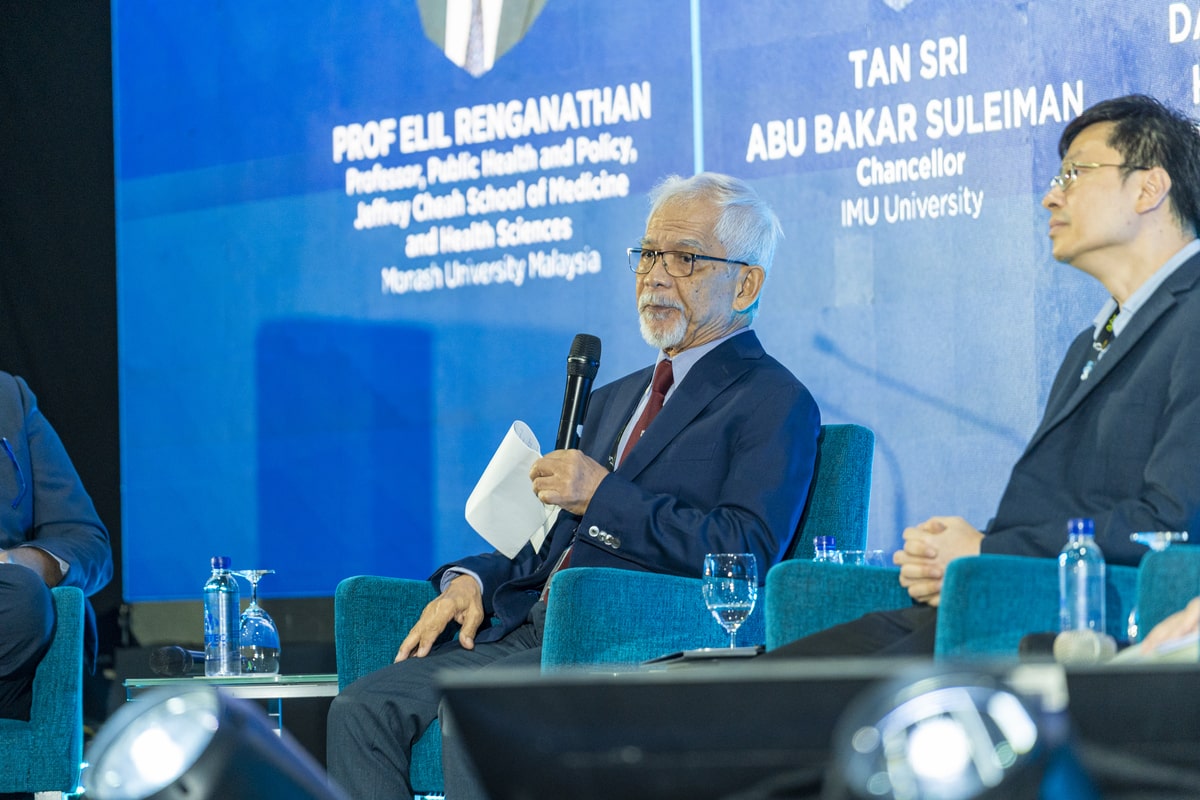
Dr Abu Bakar Suleiman, former Health Director-General and currently clinical advisor to Health Minister Dzulkefly Ahmad and MOH, said Malaysia could adapt elements of Thailand’s health care system to suit local needs, starting with decentralisation at the district level.
“At present, under the current structure, they (MOH) should decentralise certain functions to the state and at the district level. For example, like Covid.
“During Covid, what was important was that the district should have experts to do the tests and be able to analyse them in the district, and to then give advice based on the analysis for the district to take action — not just to send the data and wait for the ministry to decide. That’s not right,” Dr Abu Bakar told CodeBlue on the sidelines of the seminar.
Dr Abu Bakar said this had also been a recommendation of the Health and Sciences Covid-19 Advisory Group of Experts (EAG), which he chaired. “That type of decentralisation can be done now,” he added.
Dr Abu Bakar, however, noted that structural fragmentation remains a major barrier to reform. “The problem with the health sector in government, it is fragmented. You have the MOH, the Ministry of Women, Family and Community Development – aged care, somewhere else, occupational safety, somewhere else – so the government has got to restructure also to be more effective. So it’s quite complex.”
When asked about the possibility of decentralisation in the form of granting public hospitals more autonomy in procurement or in hiring and firing staff, Dr Abu Bakar said attention should instead be given to what is already feasible within the existing system.
“If they want to decentralise, why can’t they do it within MOH first?” Dr Abu Bakar said. For context, staffing decisions in Malaysia’s public hospitals — including recruitment and salaries — involve oversight from multiple government bodies such as the Ministry of Finance (MOF) and the Public Service Department (JPA), making it difficult for individual hospitals to exercise full autonomy over human resources without broader structural reform.
“Within that context. Give the state even more delegating authority, for example, enforcement, at the state level. Those things can be done.
“When you talk about that (hiring of staff involving wages), you can’t do that, right? You’re talking about a whole government restructuring because of the financing, the oversight, JPA, and so forth. I think a lot of things need to be done whereby Parliament has to have more active oversight,” he added.
Malaysia’s ‘Early Success’ In Free Health Care Now A Hurdle To Reform
During the panel discussion, Dr Abu Bakar, who served as Health Director-General from 1991 to 2001, said Malaysia’s early success in expanding government-subsidised health care after independence significantly improved population health.
But this also created entrenched expectations that now pose political challenges to reform.
“People are so used to free medical services that they don’t want to be charged,” Dr Abu Bakar said. “In Thailand, it’s the opposite. When you have the UHC, people feel that, ‘oh, I don’t have to pay much’.”
He noted that the culture of near-free services at MOH hospitals — though beneficial in the early decades of nation-building — has led to a perception that health care should remain virtually costless, even as the system faces increasing strain from rising demand for health services, ageing populations, and non-communicable diseases (NCDs).
Dr Abu Bakar pointed out that various attempts to introduce health financing reform — including ideas around social health insurance, copayments, or more sustainable funding models — have been proposed as far back as the 1980s.
These proposals were meant to ensure long-term sustainability of the system, improve efficiency, and expand service delivery through better resource allocation.
“We’ve been talking about health reform — in my case, since 1985 — and we’re still talking about it. I hope we can move,” Dr Abu Bakar said.
He acknowledged that many of the proposals during his tenure faced strong resistance, often from both the public and political stakeholders, who feared backlash over any perceived reduction in entitlements.
Yet, he argued, reform remains necessary if Malaysia hopes to strengthen service quality and meet future health demands.
Dzulkefly recently announced a government proposal to allow withdrawals from Account 2 of one’s Employees’ Provident Fund (EPF) to pay premiums for a new voluntary health insurance product.
The health minister’s proposal triggered widespread condemnation, as Malaysians questioned the rationale of dipping into one’s retirement savings for health insurance premiums. Many also believe that Malaysia is increasingly headed towards privatisation of its public health service.
Learning From Thailand, Finding The Right Solutions For Malaysia
While Thailand’s experience offers valuable lessons, panellists agreed that Malaysia must chart its own path in health reform based on local realities.
“Health care is always local,” said Dr Abu Bakar Suleiman. “We can learn from each other, but we cannot transplant everything.”
Prof Dr David McCoy, research lead at UNU-IIGH and a public health specialist, said Thailand’s reform success stemmed not from any single policy but from the institutional conditions that allowed reform to take root and evolve.
“What I gathered from your (Dr Somsak’s) talk is that individual solutions and policies may work or may not work, depending on a set of key ingredients across the health system,” Dr McCoy said. “It’s like planting seeds. If the soil isn’t fertile, the seed won’t grow.”
He described Thailand’s health governance as pluralistic and decentralised, structured in a way that encourages innovation and system integration. “You’re avoiding a command-and-control system. You’re allowing different levels and actors to find solutions through discussion.”
Dr McCoy added that structural reform in Malaysia will depend on whether similar enabling conditions exist. “Do we have enough of a pluralistic public sector where there is enough decentralised authority across the system? That’s a question we need to ask.”


