

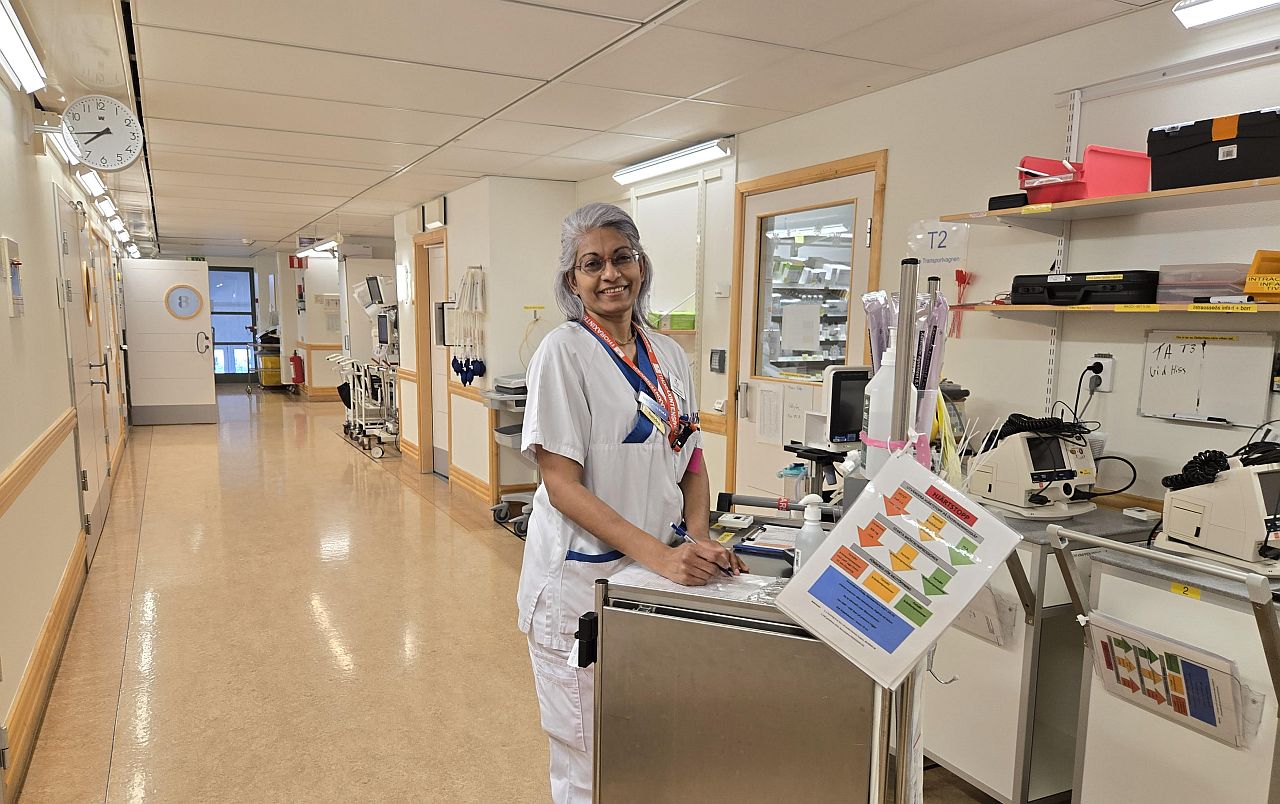
I work as an ICU nurse at the cardiothoracic intensive care unit of a university hospital in Uppsala, Sweden. Recently, I was allocated the same critically ill patient for four shifts in a row—this time during a night shift.
Having continuity in care can be both a blessing and a challenge. On the one hand, you gain insight into the patient’s condition, you recognise subtle changes, and you become more confident in anticipating what’s coming.
You already know if the patient has been hard to ventilate or that their haemodynamics are difficult to stabilise. You carry knowledge of previous shifts’ trends and challenges, and that helps shape your decisions.
But there’s a flip side. Familiarity can blind us. When we take too much for granted, we may miss the new and the subtle. And in the ICU, it’s often the subtle details that tip the balance.
That night, like every shift, I worked closely with an assistant nurse. But this particular night stood out. I had the privilege of working with someone who was assertive, meticulous, and deeply dependable. She took initiative and handled her responsibilities independently, yet we maintained open, constant communication throughout.
Assistant nurses often focus on fundamental care, while the ICU nurses carry the medication and overall responsibility for the patient. But when collaboration works this well, what remains is a shared strength, united toward one goal: the patient’s well-being.
The patient was critically ill and dependent on several life-sustaining devices—a ventilator, ECMO, and CRRT. I began my shift with a full patient assessment, checking all equipment settings and values.
I noted everything I wanted to discuss with the on-call intensivist. My assistant nurse also had input, and together we had a list of queries.
At the same time, we continued to care for the patient with all the routines we usually perform for our intensive care patients. It’s easy to lose sight of the patient in the ICU bed amidst the monitors, life-saving machines, a maze of lines and tubes, and the alarms from different machines.
From time to time, we reminded ourselves: there is a person in there, and we are here for them.
In the ICU, observation, assessment, action, and reassessment flow in a continuous cycle—repeating from the beginning of the shift to the end.
However, in this write-up, I do not want to focus on the technical aspects of care or nursing. Instead, I want to reflect on something deeper—on autonomy, attitudes, collaboration, and what each of us brings into the ICU space, and how these things can profoundly influence patient outcomes.
I trained as a nurse in Malaysia and worked there for a decade, followed by another 10 years in Saudi Arabia.
In Malaysia, autonomy in nursing is almost non-existent. We followed rigid routines. Doctors would come, give orders, and nurses would follow.
Discussions were rare. Nurses aren’t trusted to take even the smallest initiative, like giving Paracetamol—let alone adjusting inotropic support or initiating high-flow oxygen therapy. The system doesn’t allow it.
Doctors don’t believe we have the competence—and to be honest, we are never given the chance to prove that we do.
It isn’t a system built to uplift nursing as a profession. It isn’t ready to welcome critical thinking, reflection, or questioning.
And perhaps most disheartening of all—it doesn’t create space for learning. There is no room to grow, no encouragement to ask ‘why’ or ‘what if.’ It is a system that prefers silence and obedience over curiosity and progress.
I never truly understood what autonomy meant until I became an ICU nurse in Sweden. And let me tell you—autonomy is a gift. It inspires initiative, deepens responsibility, and motivates you to do your best. It makes you want to stay alert, solve problems before they escalate, and reach just a little higher, stretch just a little further.
With autonomy comes a quiet pride in what you do—because your actions matter, your judgement counts, and you’re trusted to make a difference.
When I moved to Sweden, I started over—as an assistant nurse. That experience taught me so much about the Swedish healthcare system and its work culture.
Once I understood what was required, I followed each step until I was eventually able to pursue a one-year specialisation in critical care nursing.
I did this even though I had already completed a six-month critical care nursing course in Malaysia, so I can honestly say the education itself was strong in both countries. The real difference wasn’t the theory—it was the work environment.
Here in Sweden, I work with intensivists who take the time to explain things—even in the middle of a busy shift. They’re not any less pressed for time; they simply make time. There’s no blame culture. Mistakes aren’t punished—they’re approached with openness.
If needed, routines are adjusted or practices improved. Some mistakes are simply acknowledged for what they are: human error.
When the work environment feels safe, potential errors—or even actual errors—are brought to light without fear of blame or punishment. And that, in itself, leads to better care.
When you pair that kind of psychological safety with autonomy, the result is transformative. I learn something new every day—from doctors, colleagues, and assistant nurses—everyone contributes to the learning.
We value every team member’s input. This collaborative climate encourages learning, builds skills, sharpens our thinking, and lifts morale. And ultimately, it benefits the one who matters most: the patient.
Because I come from a place where autonomy was so scarce, I treasure it now more than ever. I know what it’s like to work without it. The thought of returning to a system that suppresses nursing autonomy breaks my heart—I know it would break my spirit, too.
Nurses in Sweden may take their autonomy for granted; they’ve never known life without it. But for someone like me, it’s a daily privilege. It’s like the saying: You don’t know what you have until it’s gone. I’d add: Once you’ve had it, you never want to let it go.
That night, besides feeling that I was in control of the situation with my patient, there was something else I appreciated. As the hours passed, I had multiple concerns and kept calling the intensivist.
Each time, he responded with patience—never a hint of frustration. That would not have been the case in Malaysia, where I’d likely have been told off—or even scolded—for calling too many times. It has happened before, and sadly, it still happens today.
At one point during the night, the intensivist and I managed to grab a quick bite together. He was Swedish but had travelled widely. As we talked, I shared how difficult it has been for me to form deep connections in Sweden—especially outside of work—because of the language barrier. He nodded and said he understood exactly what I meant.
When he works abroad, he often feels that people don’t fully see him for who he is, because the subtle nuances, the humour, and the richness of expression—so deeply tied to one’s native language—don’t always translate.
Foreigners often struggle to express their full selves in a language that isn’t their own, and he knew that feeling well.
That moment struck a deep chord. For the first time in my 11 years in Sweden, I felt truly understood—because someone had finally described how I felt, having experienced it themselves. They put into words something I’d been trying to make sense of for so long. It brought a quiet sense of relief—like an invisible weight I didn’t even realise I’d been carrying had suddenly lifted.
That simple conversation stayed with me. It reminded me of the importance of listening to those who remain quiet—not because they have nothing to say, but because language holds them back.
Given the space, they might have something profound to share. That moment reminded me of the power of openness, empathy, and giving people the opportunity to be seen. When we offer that space, everything changes.
As the shift came to a close, I thanked my assistant nurse for her effort, and the intensivist gave me a fist bump. The patient was also showing slight improvement—haemodynamically more stable than when we started. It felt like the perfect wrap-up to a meaningful night. But the true closure came a little later.
After endorsing to the day shift, checking all the pumps, and wishing my colleagues a smooth day ahead, I began walking out of the unit. And that’s when it hit me—a deep, glowing sense of pride, satisfaction, and joy. Euphoria, even. Maybe it was dopamine, endorphins, and serotonin. Or maybe it was something more.
I think it was the feeling of having done something meaningful—with a team that cared, in a place where I’m respected, and in a role that allows me to be my full, capable self.
During moments like these, I understand what autonomy truly does for a nurse. It isn’t just about decision-making—it’s about honouring your own professional judgement and feeling that it counts. It’s the difference between functioning and flourishing.
Autonomy allows us to step into our full potential, to own our expertise, and to feel a deep sense of purpose in the care we provide. It doesn’t just elevate nursing—it elevates the nurse.
And when that happens, everyone rises: the team, the workplace, and most importantly, the patient.
Sandra Laxmana is a Malaysian nurse working in Sweden.
- This is the personal opinion of the writer or publication and does not necessarily represent the views of CodeBlue.


