

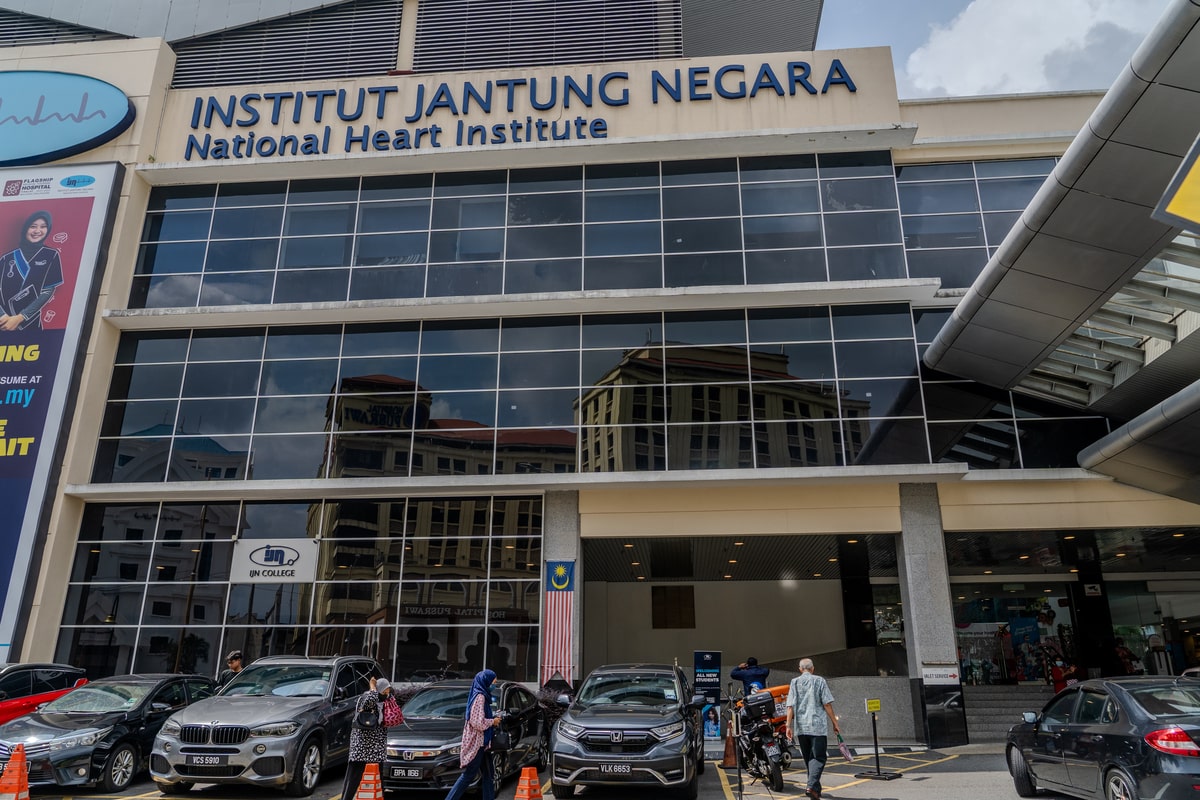
KUALA LUMPUR, Oct 16 — This year, the National Heart Institute (IJN) discharged approximately 4,000 government patients covered by the Ministry of Health (MOH) from outpatient services, amid the government’s cost-cutting exercise.
IJN Holdings group chief executive officer Prof Dr Mohamed Ezani Md Taib said this amounted to a reduction of about 10,000 to 11,000 outpatient visits to the top cardiac centre, covering clinic visits and visits for lab tests, X-ray, and medications.
He explained that MOH officers based in IJN manage the “control mechanism” over referrals of government patients to IJN, a hospital owned by the Minister of Finance Incorporated (MOF Inc.).
“If a pensioner comes to IJN for outpatient service, they have to get clearance from the MOH officer based here. The officer will then decide whether the patient can proceed to meet me, for example.
“If, for whatever reasons, they don’t fulfil criteria that they’ve set, the patient cannot come and see me,” Dr Ezani, who is also a senior consultant cardiothoracic surgeon, told a media luncheon for senior news editors at IJN here last October 10.
Many government pensioners have been complaining about their discharges from IJN due to cost-cutting measures. A letter from a pensioner to CodeBlue published last February – which was widely discussed by lawmakers and ordinary citizens – triggered a clarification from the MOH, who claimed that patients are only discharged from IJN when their conditions are “stable”.
When asked at the IJN media luncheon to specify the criteria for discharge, Dr Ezani said the MOH defines it as no longer being “cardiology active”, in which the patient is perceived as not having heart disease anymore, but only concomitant conditions like diabetes or hypertension.
“So they [MOH] consider that it can be treated in the government itself, rather than IJN. To a certain extent, that’s true,” Dr Ezani said.
However, he acknowledged that some patients with hypertension may be fine from a cardiac aspect at the point of their discharge from IJN, but they may get heart disease again later on due to poor control of their blood pressure.
“So there’s a fine line between ‘you’re free from heart disease’ and ‘you still have heart disease’. To be fair, MOH is also discussing with us on how best to have a proper discharge terminology or system so that patients are not missed out.”
CodeBlue pointed out that another pensioner’s husband complained last July about his “premature” discharge from IJN, despite his cardiologist at IJN telling him that he needed to immediately undergo a procedure for a stent. He was referred to Raja Permaisuri Bainun Hospital (HRPB) in Ipoh, Perak, for an appointment nearly three months after his discharge from IJN.
“That’s what I’m trying to say. Sometimes, they are already vetted before they see us,” Dr Ezani replied.
He added that while an IJN cardiologist may tell a patient that they need a stent, the patient is blocked by MOH officers during their next visit.
“Sometimes, the process of discharge is not very clear. To them [MOH], they don’t see that the patient needs a stent. To them, the patient is coming in just for high blood pressure. So there are loopholes within the discharge processes that they want us to correct.”
In Parliament last Monday, Arau MP Shahidan Kassim raised the plight of pensioners discharged from IJN, adding that he himself was discharged from the cardiovascular and thoracic care hospital even though he isn’t a pensioner.
“I haven’t reached my pension yet; suddenly, they consider me to be a pensioner,” said the Perikatan Nasional (PN) lawmaker.
“MOH is the one making these rules. Various parties should take this seriously. I ask for pensioners to be allowed to stay at IJN.”
IJN is seeking to double its private patient load from 15 per cent to 30 per cent, as its CEO expects the 68 per cent portion consisting of MOH referrals to drop to 65 per cent, besides another reduction of its 17 per cent non-MOH public referrals. Overall, government patients currently comprise 85 per cent of IJN’s patient load.
Deputy Health Minister Lukanisman Awang Sauni told a press conference in Parliament last Monday that the MOH would discuss IJN’s plan to raise its fees by up to 40 per cent for government patients, as the fees have been fixed at the same rate for 21 years since 2003.
“This will impact the MOH because we still refer patients to IJN. However, we don’t have any influence over the fees because IJN isn’t under MOH.”
IJN CEO Dr Ezani had said costs have increased over the years with the expansion of the cardiac hospital and its workforce. IJN is also planning to expand its facility at Jalan Tun Razak with another block and diversify into non-cardiovascular services, such as building a new stroke centre.
In a statement Monday, MCA deputy president Dr Mah Hang Soon urged the Finance Ministry to cap IJN’s fee hike at 5 per cent to avoid burdening patients from B40 households; paradoxically, he also called for improved medical care and better staff remuneration.
Government patients do not pay out of pocket or use private insurance for treatment at IJN; they are fully subsidised by Putrajaya. A fee raise simply means that the government will either have to further reduce the number of patients covered or increase funding to cover current patient numbers at IJN.
Even though IJN’s initial capex was paid for by the government two decades ago, primarily its land and facility, IJN operates as a private hospital as it is regulated under the Private Healthcare Facilities and Services Act (PHFSA) 1998.
Dr Ezani told the media that mergers and acquisitions in the private hospital industry were putting tremendous pressure on IJN. The Association of Private Hospitals Malaysia (APHM) previously said Malaysian private hospital costs are unsustainable, due to medical inflation that hit 12.6 per cent last year.


