

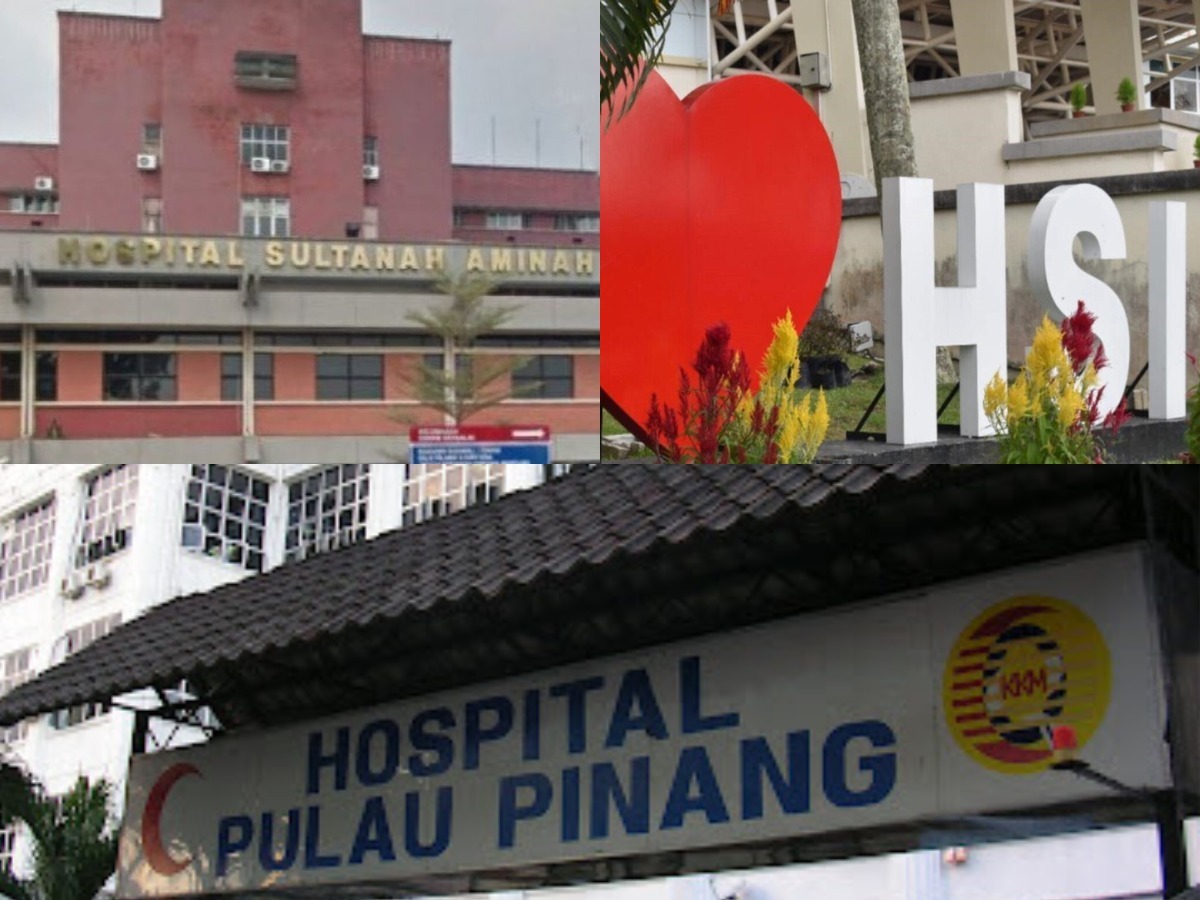
KUALA LUMPUR, Oct 9 — At least three of 10 Ministry of Health (MOH) hospitals listed as providing full-paying patient (FPP) services no longer offer them, having ceased operations for years since the Covid-19 pandemic.
These three are Pulau Pinang Hospital (HPP), as well as Sultanah Aminah Hospital (HSAJB) and Sultan Ismail Hospital (HSI) in Johor Bahru; the first two are the state hospitals of Penang and Johor respectively, leaving FPP services only available in the Klang Valley, Sabah, and Sarawak.
Although a January 2019 document lists a whole host of specialties available then in FPP services in 10 government hospitals under the MOH in the Klang Valley, Penang, Johor, Sabah, and Sarawak, five years later post-Covid, the service today is severely limited and not uniformly available across the remaining seven hospitals that still run FPP.
The seven hospitals are Putrajaya, Ampang, Selayang, Sultan Idris Shah Serdang (HSIS), and Sungai Buloh in the Klang Valley, as well as Queen Elizabeth II Hospital in Kota Kinabalu and Sarawak Heart Centre in Kota Samarahan.
This raises questions about the MOH’s ability to “expand” an already declining FPP service – described by Health Minister Dzulkefly Ahmad as creating “private wings” in government hospitals – in a new programme called RakanKKM with investments from government-linked investment companies (GLICs) in a special-purpose vehicle.
It is also unclear if RakanKKM can offer more than the specialist services in FPP that are currently restricted to mostly obstetrics, as well as cardiology in two cardiac centres in Selangor and Sarawak.
Checks by CodeBlue through enquiries to hospitals’ general and FPP lines, as well as via email, revealed that HPP, HSAJB, and HSI suspended their FPP services due to construction work and limited bed availability.
HPP – a key public hospital in the northern region – has had its FPP obstetric services unavailable since the closure of the historic Penang Maternity Hospital during the Covid-19 pandemic around 2021.
It is understood that a new maternity hospital is being constructed, and FPP services will likely be reinstated once the project is completed, though no timeline has been given. Currently, all obstetric patients are directed to HPP and placed in regular wards.
Most of HPP’s FPP services have been unavailable since February 1, 2017, after the hospital’s operating theatres closed for upgrading works in December 2016. While FPP services for the cardiology department continued at the time, it is understood that they, too, are no longer available.
HSAJB – a main referral hospital in the southern region – has not offered FPP services since last year due to ongoing renovations. While FPP services are expected to be reinstated once renovations are complete, no timeline has been provided.
HSI’s FPP services have been suspended since March 22, 2020, and have not been reinstated due to ongoing bed shortages, according to staff from the hospital based in the Johor state capital.
Ampang Hospital stopped providing beds for its FPP service for obstetric care in 2020. However, the key referral centre in Selangor continues to offer FPP services for other specialties, including gynaecology, orthopaedics, ear, nose, and throat (ENT), as well as surgical outpatient department (SOPD) services, such as appendectomy surgery.
FPP Services Different Across Hospitals, Maternity FPP Most Common
The 10 hospitals listed by the MOH as providing FPP services do not all cover the same specialties. While FPP obstetric services are the most commonly available, only a few offer FPP for other specialties, such as cardiology and surgery, depending on doctor availability and their willingness to accept cases.
Currently, four hospitals – Putrajaya, Selayang, HSIS, and Sungai Buloh – all located in the Klang Valley, offer FPP services for maternity care. No government hospitals in Sabah or Sarawak provide FPP for obstetric care at present.
Queen Elizabeth II Hospital (HQEII) in Sabah does not handle obstetric cases; these are referred to the Sabah Women and Children’s Hospital (Likas Hospital). HQEII only offers FPP services for breast and endocrine, as well as vascular surgeries.
Meanwhile, FPP services for cardiac cases are primarily available at HSIS in the Klang Valley and the Sarawak Heart Centre in Borneo. Although HSAJB is supposed to offer an FPP option for cardiovascular care, all its FPP services are currently suspended due to ongoing renovations at the Johor hospital. Pulau Pinang Hospital’s FPP for cardiovascular care is also suspended.
A staff member at Putrajaya Hospital said that FPP services at the hospital do include specialties such as orthopaedics, medicine, endocrinology, paediatrics, and dermatology, in addition to obstetrics. However, the availability of FPP services for these specialties depends on whether doctors accept FPP cases, so patients should check with their specialists.
FPP Services Involve Advanced Booking, First-Class Beds Not Guaranteed
For obstetric FPP services, registration can only be provided once the pregnancy is confirmed by a doctor. This means patients need to obtain a buku pink (antenatal pink book) from a klinik kesihatan before visiting the O&G clinic at Putrajaya Hospital, Selayang Hospital, HSIS, or Sungai Buloh Hospital. Patients are advised to call the hospital’s reception to check on FPP booking availability first.
At Putrajaya Hospital, obstetric FPP bookings can be made by walking into the O&G clinic on Fridays at 2.45pm. This visit typically includes a briefing on FPP, covering fees, doctor availability, consultations, and appointments. Patients will then need to complete a blue form provided by the nurse.
During registration, patients will choose one of three available specialists – two male doctors and one female doctor. CodeBlue understands that the earliest available slot is currently for babies due in February 2025, so those interested in FPP should book their slots as early as possible once they have their buku pink.
Patients will also be informed that bed allocation is based on availability when they go into labour. Putrajaya Hospital has an executive ward (Wad Eksekutif 5A) with 1-2 beds, costing RM300 per day, where a family member is allowed to wait.
If the executive ward is full, patients may opt to be placed in first-class wards (Wad 2A/ 2B/ 2C), which offer 1-bed (RM160 per day), 2-bed (RM130 per day), and 4-bed (RM80 per day) options. However, family members are not allowed to wait in these wards.
Once registered, patients can expect their first check-up at Putrajaya Hospital at 28 weeks of pregnancy. Before 28 weeks, patients can have check-ups either at a klinik kesihatan or in private clinics/ hospitals, but they must ensure that their buku pink is updated.
The registration requirements for obstetric FPP services are generally similar across hospitals that offer them, although it is best to verify with the respective hospital before arriving.
Specialist Referrals Needed For Non-O&G FPP Services
At Sungai Buloh Hospital, high-risk cases – such as those involving asthma, thalassemia, or requiring blood transfusions – are not accepted for FPP services. Patients should also not expect to be put in first-class wards, as only 1-bed, 4-bed, and 6-bed wards are available.
The hospital, however, does provide a broader range of specialists, including four female doctors and two male doctors.
For non-O&G specialties, FPP services can only be accessed through a referral from a specialist at the hospital. Patients without an existing record at any of the 10 FPP hospitals will need to be referred by their current specialist from another facility.
Following enquiries with hospital staff, CodeBlue sought comments from MOH Putrajaya on the full status of the 10 FPP hospitals listed on MOH’s site.
CodeBlue also inquired about how the government plans to execute RakanKKM if the current 10 hospitals are not fully operational with FPP.
MOH said it is aware of the situation but declined to comment further on FPP or RakanKKM, pending Prime Minister Anwar Ibrahim’s expected announcement of the RakanKKM programme in the upcoming Budget 2025, scheduled for tabling in Parliament on October 18.


