

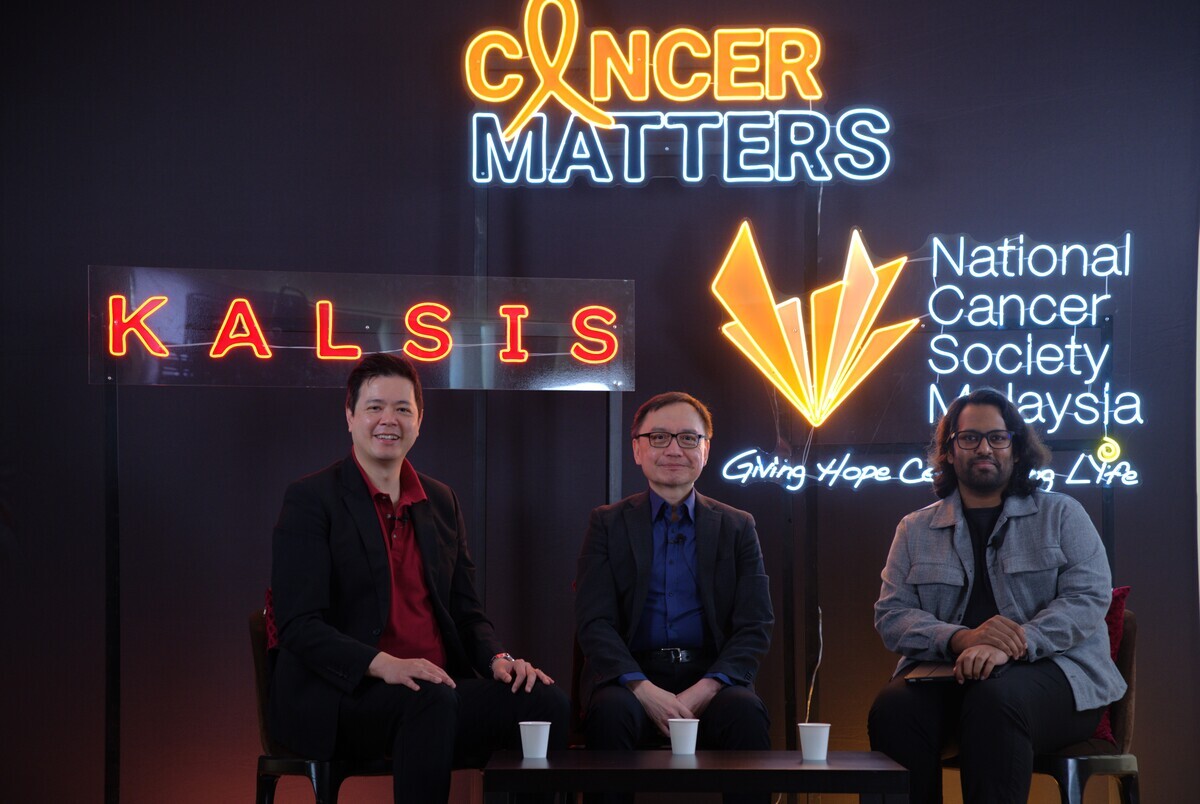
KUALA LUMPUR, Oct 16 — KALSIS says it can help fund radioisotope therapy in Malaysia, a new treatment for patients at stage four of prostate cancer that may enable better survival outcomes.
Radioisotope therapy is designed for metastatic cancer; where the disease has spread widely and other options like targeted therapy or immunotherapy have limited benefits.
Traditionally, PET/CT scans with a contrast agent are used to locate cancer. Radioisotope therapy takes this further: the imaging agent is combined with a radioactive isotope, infused into the body, and guided to the cancer cells – where it locks on and irradiates them from within.
“This is where we’re seeing a radical new frontier opening up called radioisotope therapy. This is something that has only emerged in the past few years, I believe. But it’s very expensive,” KALSIS chief executive officer Jonathan Teoh told the “Insight Oncology” programme at a Cancer Matters podcast by the National Cancer Society Malaysia (NCSM), hosted by Poovenraj Kanagaraj.
“Early data is very promising. For some patients with castration-resistant metastatic prostate cancer, there have been good responses after three to six cycles.
“Luckily, we have hospitals already in Malaysia that are offering this. But the cost is not cheap and it’s driven by the fact that it requires very specialised handling of radioactive items.
“You have to get it from a reactor. Then, you have to transport it to the hospital. You need to have specialist staff that knows how to handle it and to dispose of it. That’s why it’s so costly.”
NCSM’s Poovenraj noted that prostate cancer is one of the top three cancers among Malaysian men, accounting for nearly six per cent of all male cancers.
“The number of new cases has more than doubled over the past two decades, yet many men are still diagnosed at later stages when treatment is more difficult and costly,” he said.
Consultant urologist Prof Dr Ong Teng Aik from Universiti Malaya Medical Centre (UMMC), who is also a committee member of the university’s Urological Cancer Trust Fund (UCTF), said radioisotope therapy, for example lutetium treatment, has proven to be effective in advanced prostate cancer.
He told the “Cancer Matters” podcast that radioisotope therapy could easily cost up to half a million ringgit or more.
“That kind of a financial toxicity will come in at an advanced stage.” Hence, Dr Ong stressed early detection of cancer.
Teoh explained that KALSIS can help fund radioisotope therapy by improving health care access for senior citizens and advanced secondary prevention.
“Overall, more than 65 per cent of seniors diagnosed with cancer are often late stage, requiring complex treatments and often not. It hits seniors disproportionately because first of all, they have left the workforce so they don’t get covered by insurance. Nor may they be able to afford continuous insurance cover, which is now getting more costly,” he said.
“And they may have limited retirement savings because that’s all they have saved up. So what happens if they know that they have got cancer, but treating it will wipe out the entire savings? That will put them into what we call financial toxicity, which is something that is hard to reverse”
KALSIS, backed by large institutional investors like Kenanga Investors Berhad, enables eligible senior citizens to tap on the value of their homes to fund not just immediate health care needs, but also retirement. Participants of the KALSIS scheme can sell their freehold landed property title to KALSIS at market value, but continue residing in the property for life.
For example, if the property is sold to KALSIS at RM1.5 million (also called the Entry Value), the KALSIS participant will receive a RM150,000 lump sum amount (10 per cent of the Entry Value) in the first year.
In Year 2 and onwards, the KALSIS participant can receive between 3.3 to 4% of the Entry Value (calculated based on the age of the youngest participant) annually for either healthcare or retirement needs.
“We can provide the capital needed upfront, but yet also sustain a person’s lifetime needs without them having to move from their home. That’s the most important thing,” said Teoh.
He added that reception towards KALSIS has been very positive, especially among non-governmental organisations (NGOs), university hospitals and private healthcare.
“People see how safe the Scheme is and how we designed it because this is a space that’s heavily regulated,” said Teoh.
UCTF’s Blue Cap Run For Prostate Cancer 2025

UCTF, a nonprofit under the Faculty of Medicine, Universiti Malaya, is organising the Blue Cap Run for Prostate Cancer 2025 fundraiser on November 2 at Gamuda Cove, Selangor.
Proceeds from the Blue Cap Run – supported by Yayasan MR D.I.Y – will help fund public awareness campaigns on prostate cancer, financial aid for UMMC prostate cancer patients undergoing treatment, community-based prostate specific antigen (PSA) testing, and continuing medical education among health care professionals on early detection of prostate cancer.
Dr Ong called for more funding from sponsors, saying that one of the aims of the Blue Cap Run fundraiser is to raise awareness among health care professionals – including family medicine specialists and private general practitioners (GPs) – on how to deal with abnormal PSA findings.
“That is why one of the contributions of UCTF is the creation of an online module called PCaT on how to deal with patients coming in with raised PSA and so on. That module is available for free here,” said the urologist.
Dr Ong added that with increased prostate cancer screening, urologists and oncologists must be prepared to handle an influx of patients.
“At the moment, we know there’s a lack of specialists in this country. We are short of specialists. So the training of specialists, that effort needs to be kind of sped up so we get more specialists in terms of urologists, oncologists to cope with the rising cases of prostate cancer.”
Rather than screenings for the general population, Dr Ong advocated targeted screenings with PSA testing, such as those aged 50 to 69 or 70. For those with a family history of prostate cancer, they should be screened 10 years earlier at age 40 or 45.
He also called for shared decision-making between clinician and patient.
“The patient understands that they are being tested for PSA. If it is normal, what should they do? If it’s abnormal, how should we proceed from there? So that kind of education needs to be done and to be made available for the patient.”
Corporate sponsors who wish to support the Blue Cap Run can contact the person in charge below:
- Name: Fadzrel Abu Bakar
- Email: mohd.fadzrel@mrdiy.com
- Phone: 011-16413126


