

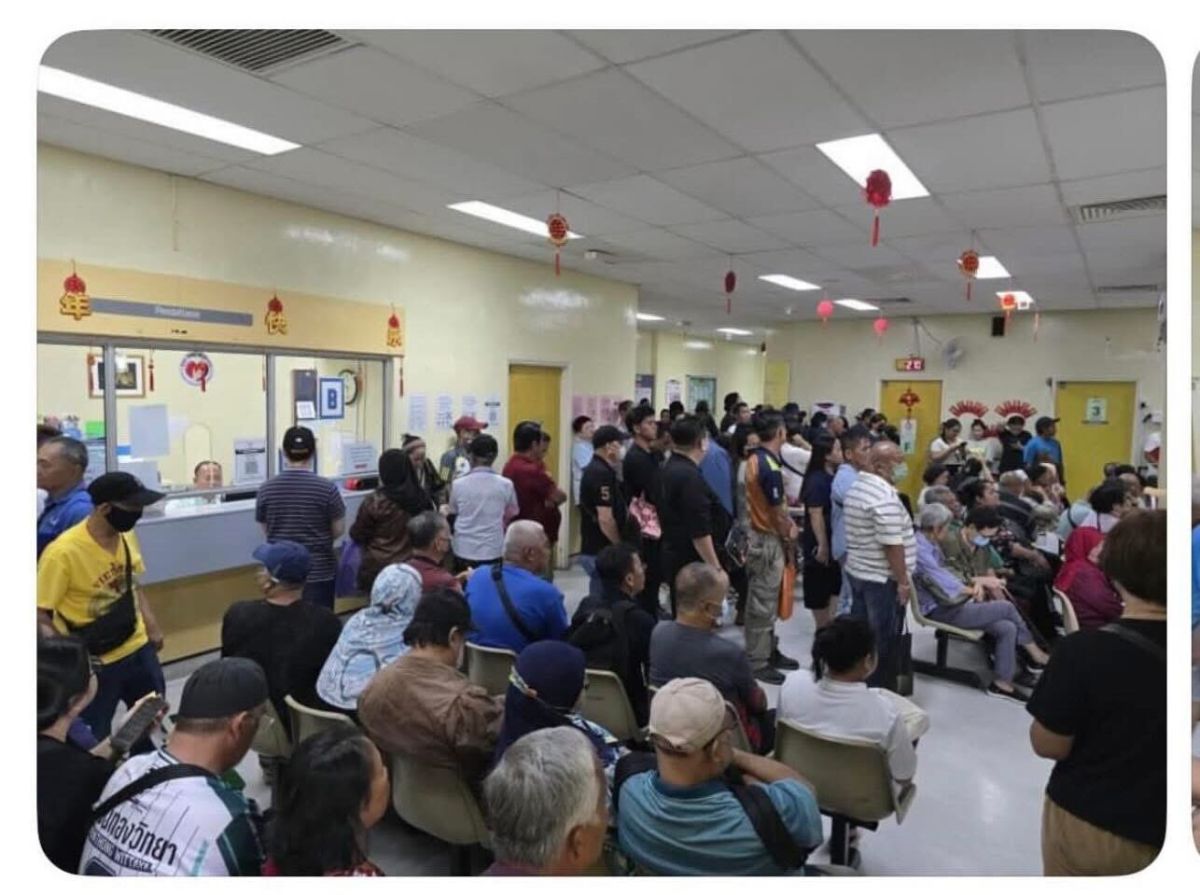
I am a physician currently serving in the medical department of a government hospital. I write in response to the recent viral posting on Threads showing the overwhelming crowd at a Medical Outpatient Department (MOPD) clinic in one of our public hospitals.
While the images may have shocked the public, those of us working within the system were not surprised. What was seen online is not an isolated incident, nor is it new. It has been a recurring reality for decades — a consequence of systemic gaps in planning, manpower distribution, and primary care capacity.
The issue of prolonged waiting times in tertiary hospital clinics is multifactorial.
First, manpower constraints remain a chronic and unresolved problem. Medical officers are frequently transferred or rotated, often with little regard for service continuity. Many are required to “float” across departments to plug staffing shortages. This disrupts efficiency and compromises clinic throughput.
At the same time, the shortage of specialists has reached a critical level. In many centres, specialists are compelled to function in roles equivalent to medical officers simply to clear patient backlogs. Instead of focusing on complex case management, supervision, and service development, they are consumed by sheer patient volume.
The cumulative workload is not merely heavy — it is unsustainable. Increasingly, experienced specialists are leaving public service, not due to lack of commitment, but because the working conditions have become untenable.
When highly trained professionals feel reduced to firefighting endless clinic numbers without systemic support or reform, attrition becomes inevitable. Each departure further exacerbates the manpower gap, creating a self-perpetuating cycle.
Second, the strain from unfiltered referrals from primary care clinics (Klinik Kesihatan) to tertiary centres is substantial. Primary care facilities operate with limited diagnostic capabilities and constrained budget allocations.
Essential investigations such as echocardiograms, exercise stress tests, comprehensive renal panels, coagulation studies, and even certain ultrasound services are often unavailable on site.
As a result, patients with conditions that could potentially be managed at primary level — stable heart failure, thyroid disorders, low-risk chest pain — are referred to tertiary hospitals not necessarily because they require specialist expertise, but because infrastructure limitations leave no alternative.
In some instances, patients presenting with vague chest discomfort are referred to emergency departments for work-up. When classified as low-risk, these cases are frequently diverted to hospital outpatient clinics rather than back to primary care, further inflating tertiary clinic numbers.
Medication availability also plays a role. When certain essential medications are not readily accessible at primary care level, referral to hospital becomes the only pathway to ensure patient access.
The cumulative effect is predictable: tertiary centres are overwhelmed with cases that could — and should — be managed safely at primary level if adequate resources were provided.
This is not a failure of individual health workers. It is a structural issue. Without strengthening primary care capacity to function more autonomously — with sufficient diagnostics, medications, and trained personnel — tertiary hospitals will continue to absorb volumes beyond sustainable limits.
The viral image should not merely trigger public outrage; it should prompt serious policy reflection. Health care demand is rising due to ageing populations and increasing chronic disease burden. Yet workforce expansion, infrastructure development, and decentralised diagnostic capability have not kept pace proportionately.
When waiting times stretch endlessly, patients suffer. When workloads become relentless and unsupported, health care professionals burn out and eventually leave. If this trajectory continues, the strain on the public health care system will only intensify.
How long can this model remain viable without decisive structural reform?
Waiting times are not just about inconvenience. They reflect deeper systemic fragility. Strengthening primary care, rationalising referral pathways, improving manpower planning, and protecting specialist retention are not optional reforms — they are urgent necessities.
The author is a physician at a government hospital in Selangor. CodeBlue is providing the author anonymity because civil servants are prohibited from writing to the press.
- This is the personal opinion of the writer or publication and does not necessarily represent the views of CodeBlue.


