

KUALA LUMPUR, Sept 26 — Malaysia is heavily reliant on imported food and agricultural inputs, affecting the country’s food security, according to the Ministry of Agriculture and Food Security (KPKM).
KPKM’s Draft National Food Security Blueprint (NFSB) 2030, which was recently uploaded onto the government’s unified public consultation (UPC) portal, reported that over 80 per cent of certain critical food products, including rice and frozen meat, are sourced from top three importers to Malaysia.
“In Malaysia, reliance on trade is particularly pronounced, with the country heavily dependent on a limited number of partners for key food imports,” stated the Draft NFSB 2030.
“While this trade activity helps bridge domestic production gaps, it also exposes Malaysia to significant risks, including supply shortages and price volatility during external shocks such as trade disruptions, geopolitical tensions, or climate-induced challenges.”
Based on 2023 data in the KPKM report, India supplies over 80 per cent of Malaysia’s imported frozen meat. Similarly, rice is primarily sourced from Vietnam, Thailand, and Pakistan that collectively contribute over 80 per cent of Malaysia’s national supply.
“Imports of onions and potatoes are also heavily concentrated, with India being the dominant supplier, indicating potential risks should there be trade restrictions or production shortfalls in the region.”
China is the number one importer of citrus and temperate fruits (apples, pears, quinces) to Malaysia, while Thailand is Malaysia’s top importer of tropical and subtropical fruits (dates, figs, pineapples, avocados, guavas, mangoes, mangosteens), as well as other fruits and nuts.
China is also the top importer of cabbages to Malaysia. Thailand and China are the top two importers of other vegetables to Malaysia.

90% Of Seeds In Vegetable, Fruit Sectors Are Imported
According to the Draft NFSB 2030, most agricultural inputs for Malaysia are imported from other countries, including seeds, chemical fertilisers and pesticides, and feedstuff.
Over 90 per cent of seeds for vegetables and fruits in Malaysia are imported, exposing these sectors to “significant risks from global supply chain disruptions.”
Another primary issue is the inconsistent quality and reliability of paddy seed supply, significantly hindering agricultural productivity.
“Farmers frequently encounter poor germination rates even with certified seeds, leading to reduced yields and increased costs due to the need for replanting. Delays and shortages in seed distribution during critical planting seasons force farmers to rely on unregulated suppliers, increasing the risk of substandard quality.”
Certified seeds are also too expensive for local farmers, particularly smallholders, such as the MR297 key variety for paddy.
“Moreover, within the paddy sector, the regulatory and market systems governing seed production and distribution add another layer of complexity. The current framework is fragmented and restrictive, limiting farmers’ ability to produce and sell their own seeds,” said the Draft NFSB 2030.
Malaysia also has insufficient research and development (R&D) investment into seed innovation, hampering the development of innovative, climate-resilient, and pest-resistant seed varieties.
“Public-private partnerships in seed R&D and commercialisation remain underutilised, slowing progress in hybrid seed development and limiting the sector’s ability to adapt to environmental changes and future challenges.”
Many Malaysian farmers prefer imported seeds due to perceived superior quality and performance.
Health Risks From Imported Chemical Fertilisers, Pesticides
Besides seeds, Malaysia mainly imports chemical fertilisers and pesticides from global markets.
“This dependency exposes the agrofood system to disruptions in supply chains, price volatility, and fluctuations in foreign exchange rates, which increase production costs for farmers and reduce profitability, particularly for smallholders,” said the Draft NFSB 2030.
“Moreover, the excessive use and mismanagement of chemical fertilisers and pesticides have led to severe environmental degradation, including soil nutrient imbalances, water pollution, and harm to biodiversity.
“These practices also pose health risks to farmers and consumers due to improper application and residual chemical contamination.”
Organic fertilisers and integrated pest management (IPM) remain limited in Malaysia due to higher associated costs and limited access to innovative technologies.
The country’s fragmented regulatory and support framework for fertilisers and pesticides leads to inconsistent regulatory enforcement and gaps in monitoring, said the KPKM report.
Feedstuff For Livestock, Aquaculture Mainly Imported
Malaysia’s agrofood sector is also heavily dependent on imported feedstuff, such as maize and soybeans, for livestock and aquaculture, “making the industry highly vulnerable to external market shocks and price volatility.”
The Draft NFSB 2030 noted that local production initiatives like cultivating Napier grass and using palm kernel cake (PKC) remained underutilised.
“The domestic feed industry, comprising 44 mills, primarily focuses on poultry feed, with minimal production for aquaculture and ruminants, intensifying the sector’s dependence on imports,” said the KPKM report.
“Efforts to retain locally produced feedstuff like PKC are further undermined by export-driven priorities, reducing its availability for local farmers.”
Problems With Imported Cattle Breed, High-Quality Broodstock In Aquaculture
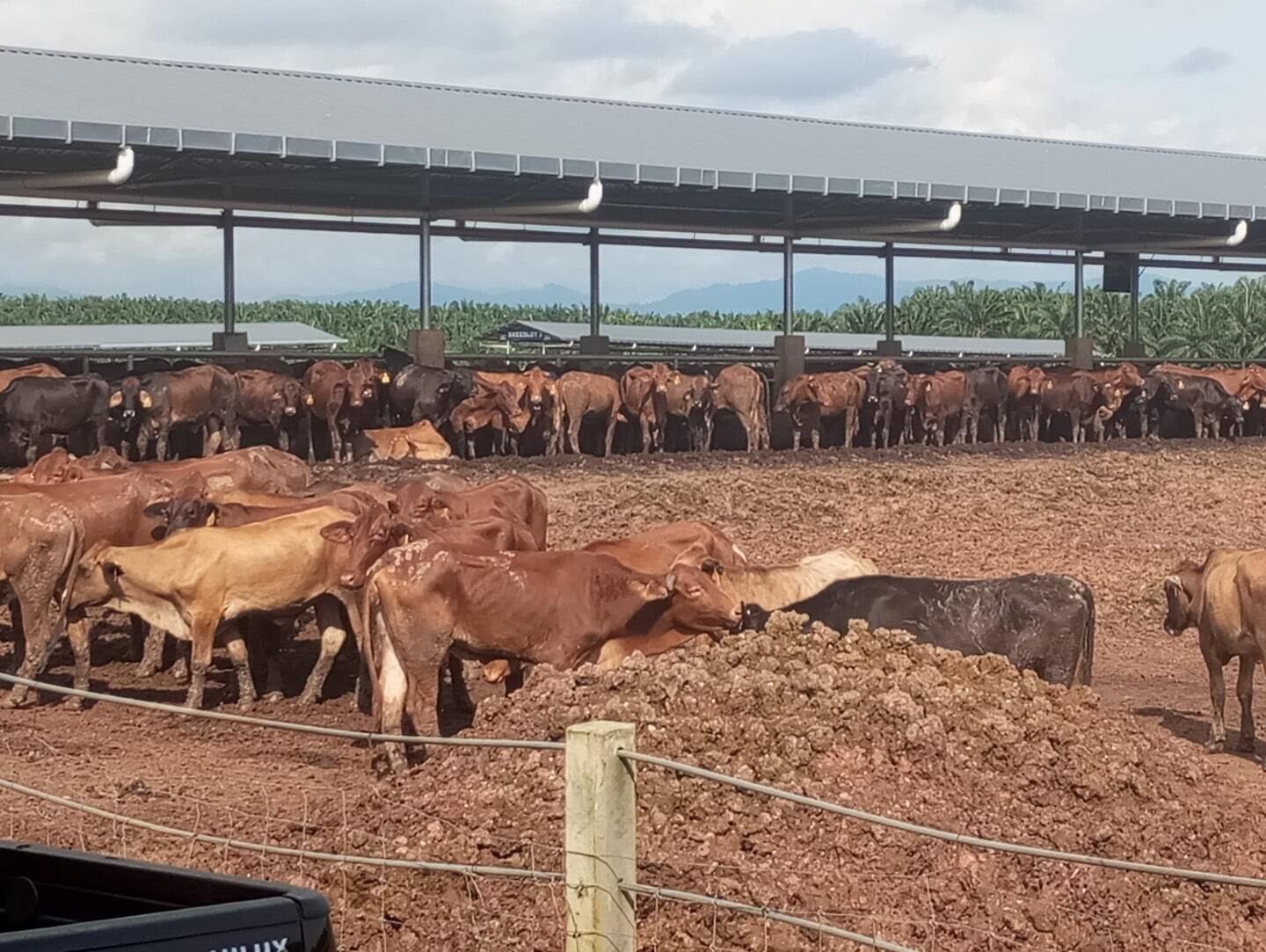
The Draft NFSB 2030 highlighted problems with imported cattle breeds, particularly those from temperate regions, experiencing heat stress and struggling to achieve optimal growth and weight under local conditions.
“To enhance performance, various exotic breeds (e.g., Brahman, Charolais) have been imported for both purebred use and crossbreeding purposes since the 1970,” said the KPKM report.
“Additionally, the lack of access to improved, climate-adapted breeds limits opportunities for smallholders to enhance efficiency and profitability. Breeding programmes for livestock remain underdeveloped, with few nucleus and multiplier farms available to supply high-quality stock to smallholders.”
Cattle breeds commonly used in Malaysia are Kedah-Kelantan (KK), Yellow Cattle KK, Nelore, Brahman crosses, and others.
The Draft NFSB 2030 cited critical challenges to Malaysia’s livestock sector from the smuggling of live animals across borders, undermining biosecurity and introducing significant risks to both livestock health and food safety.
The Malaysian Quarantine and Inspection Services (Maqis) reported that 90 per cent of smuggled cattle in 2021 were infected with foot-and-mouth disease (FMD).
In the aquaculture sector, the availability of high-quality broodstock is a persistent challenge, reported the Draft NFSB 2030.
“Farmers face difficulties accessing disease-resistant, fast-growing, and high-yield broodstock, such as genetically improved tilapia and shrimp varieties. The limited supply of quality broodstock increases vulnerability to diseases and reduces the sector’s ability to scale production effectively.
“Additionally, the high costs associated with importing broodstock further burden small and medium-scale aquaculture operators. Existing hatcheries often lack the capacity or technical expertise to produce sufficient quantities of high-performing broodstock domestically.”


