

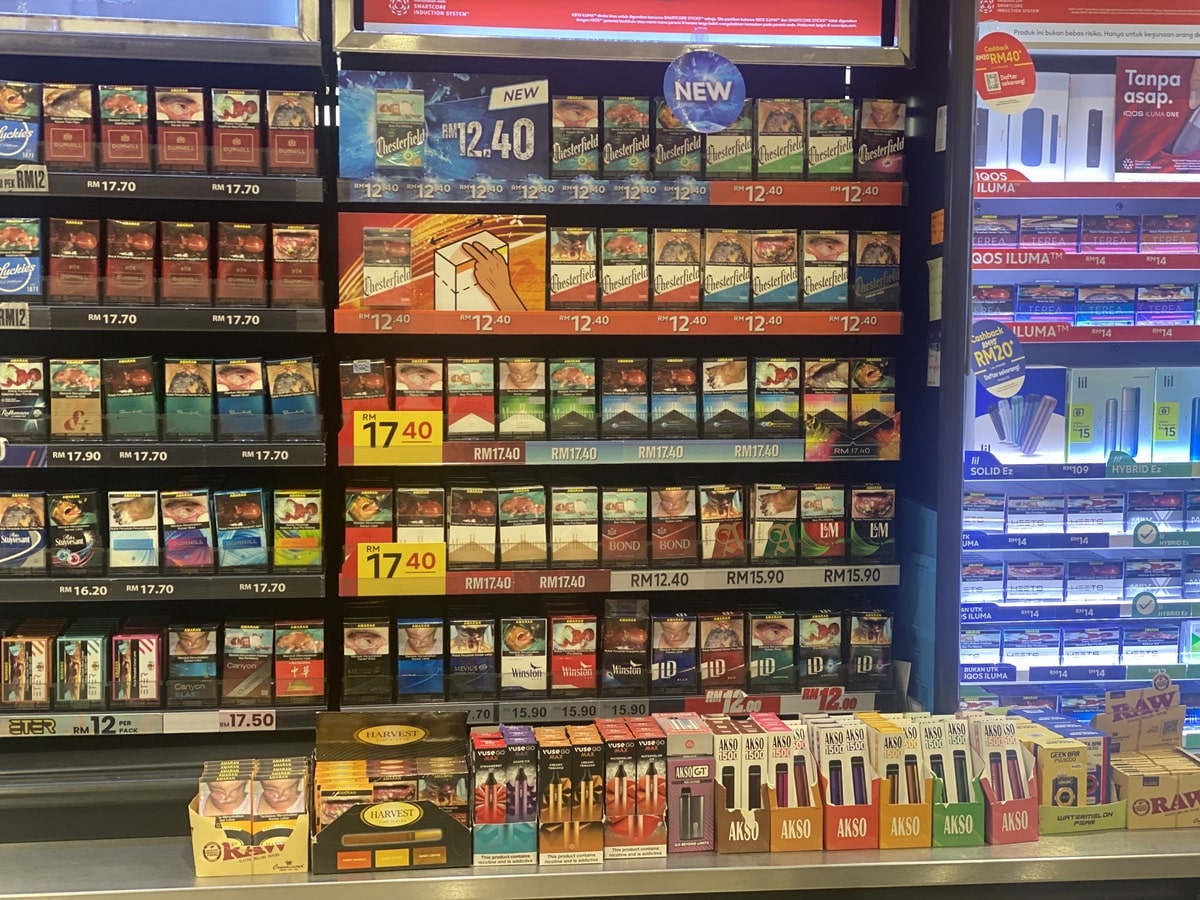
KUALA LUMPUR, July 4 — A recent report by the World Health Organization (WHO) claims that Malaysia has fully achieved the tobacco control measure of a raise in tobacco taxes.
According to the Global Tobacco Epidemic 2025 report released last June 23, Malaysia’s share of total taxes in the retail price of the most widely sold brand of cigarettes is 75.3 per cent.
Based on the WHO MPOWER data portal, which tracks country-by-country progress on six MPOWER tobacco control measures, Malaysia achieved “best practice” for the “Raise taxes on tobacco” measure in 2022 and 2024, an improvement from “moderate measure achieved” in previous years.
Malaysia is listed as among three countries in the Western Pacific region that reached “complete measure achieved” for raising tobacco taxes.
On whether cigarettes have become less affordable since 2014, the MPOWER data portal marked “no change” for Malaysia.
Taxes assessed in determining the share of total taxes in the retail price of a pack of 20 of the most popular brand of cigarettes include excise tax, value added tax (or sales taxes), import duty (when the cigarettes were imported) and any other taxes levied.
It is unclear how the WHO report determined the 75.3 per cent tobacco tax share for Malaysia. It also isn’t clear why Malaysia was deemed to have completely achieved this measure in 2022, when no increase in tobacco taxes was announced that year.
In 2015, Malaysia increased the tobacco excise duty by 42.8 per cent; together with the introduction of the goods and services tax (GST), the overall tax on cigarettes rose from 28 sen per stick in 2014 to 40 sen in 2015. Tobacco taxes have not been raised in a decade since.
Under Budget 2024 tabled in Parliament, Prime Minister Anwar Ibrahim’s government introduced 5 per cent excise duty on chewing tobacco, but did not raise cigarette taxes.
According to Technical Note III on tobacco taxes in the WHO report, all data was collected between June 2024 and February 2025 by WHO regional data collectors. Data on tax structure was collected through contacts with ministries of finance, verified against other sources.
The WHO report even claimed that Malaysia was among the countries that saw cigarette prices increase above tax increases, leading to a decrease in tax share for a specific or mixed excise structure.
Contrary to the WHO that reported an improvement in Malaysia’s tobacco tax measure from 2020 to 2022, other international reports, such as the Tobacconomics Cigarette Tax Scorecard by the US’ Johns Hopkins University, marked a decline for the country in that period.
The Tobacconomics Cigarette Tax Scorecard assessed four components of tax systems – price, change in affordability, tax share, and structure – on a scale of 0 to 5, where a higher score is preferred.
Malaysia scored 2.5 out of 5 on the Tobacconomics Cigarette Tax Scorecard in 2022, down from 2.75 in 2020. Malaysia scored poorly in affordability change (0) and tax share (2), and in the mid-range in cigarette price (4) and tax structure (4).
“They (Malaysian government) have not raised taxes in quite some time. And as a result, cigarettes are actually becoming more affordable,” Jeffrey Drope, director of Tobacconomics and research professor at the Johns Hopkins Bloomberg School of Public Health, told a media roundtable in May 2024, as reported by CodeBlue.
The six WHO MPOWER tobacco control measures seek to reduce tobacco use that claims over seven million lives a year:
- Monitoring tobacco use and prevention policies;
- Protecting people from tobacco smoke with smoke-free air legislation;
- Offering help to quit tobacco use;
- Warning about the dangers of tobacco with pack labels and mass media;
- Enforcing bans on tobacco advertising, promotion and sponsorship; and
- Raising taxes on tobacco.
According to the Global Tobacco Epidemic 2025 report, Malaysia achieved best practice level for four of the six MPOWER measures: Monitor, Protect from tobacco smoke, Warn about the dangers of tobacco with anti-tobacco mass media campaigns, and Raise tax.
Protecting people with smoke-free laws in Malaysia reached best practice level last year, according to the MPOWER data portal.
Malaysia achieved “moderate” level for two MPOWER measures: Offering help to quit tobacco use and Enforcing bans on tobacco advertising, promotion and sponsorship.
For the former, Malaysia did not achieve the following: smoking cessation support is cost-covered in the community and smoking cessation support is cost-covered in other settings.
On the tobacco advertising, promotion and sponsorship ban, Malaysia does not ban the use of brand names of non-tobacco products for tobacco products.


