

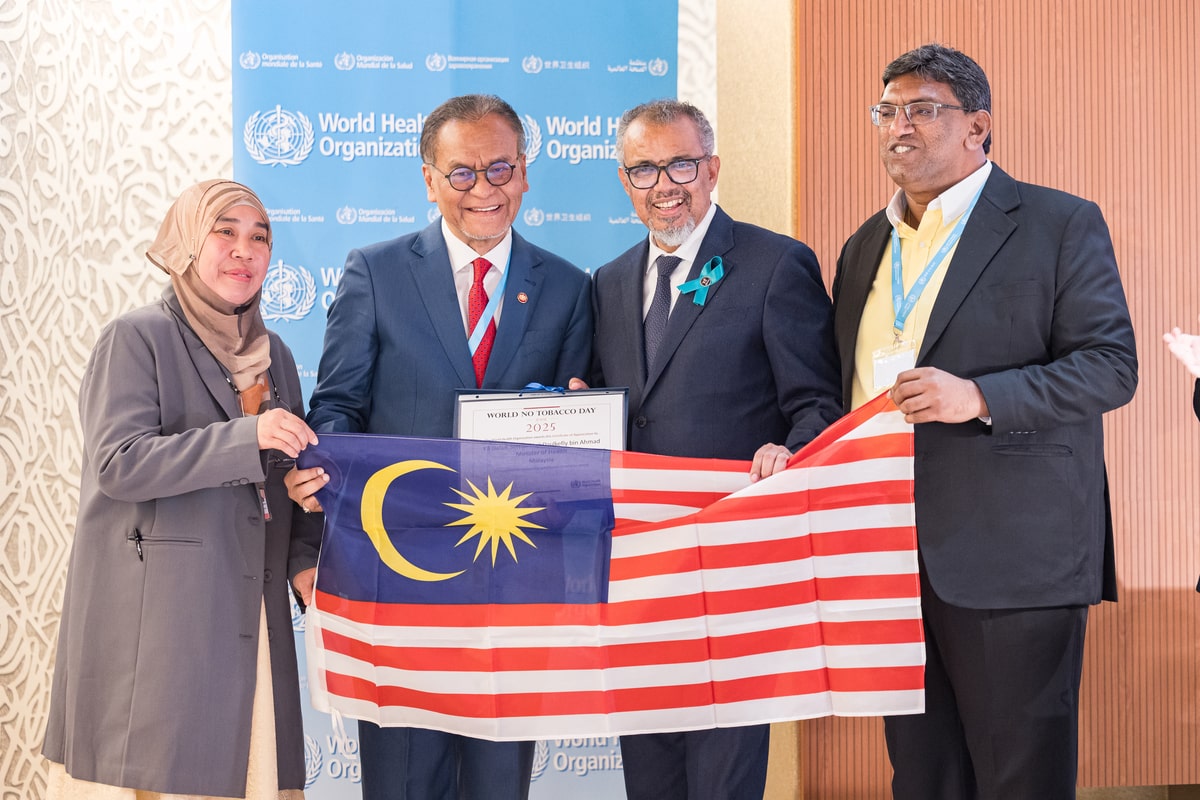
KUALA LUMPUR, June 27 — The World Health Organization (WHO) has defended its decision to award Health Minister Dzulkefly Ahmad with this year’s anti-tobacco accolade, despite Malaysia’s issuance of its first nicotine vape manufacturing licence.
At the launch of WHO’s Global Tobacco Epidemic 2025 report at a hybrid press conference Monday at the World Conference on Tobacco Control (WCTC) in Dublin, Ireland, CodeBlue asked WHO officials how the WHO felt about awarding the World No Tobacco Day 2025 award to the health minister, when a vape company announced three days later that it had received a nicotine manufacturing licence from the Malaysian government.
United States-based cannabis and nicotine vaporiser company Ispire Technology Inc. received an interim manufacturing licence last month to produce e-cigarettes with nicotine in its factory in Senai, Johor, as confirmed by the Ministry of Health (MOH). Ispire had touted it as the first and exclusive nicotine manufacturing licence from Putrajaya.
“Thank you very much for alerting me to that,” said WHO Health Promotion director Dr Rüdiger Krech in response to CodeBlue.
The World No Tobacco Day 2025 award for Malaysia was shared between three Malaysians: Dzulkefly, MOH disease control deputy director Dr Noraryana Hassan, and Malaysian Council for Tobacco Control (MCTC) chairman Assoc Prof Dr Murallitharan Munisamy.
“The WHO World No Tobacco Day award was conferred to Malaysia in recognition of specific, evidence-based tobacco control efforts and commitments made at the time of the nomination and selection process,” said the WHO in a statement sent to CodeBlue from its media office in Geneva, Switzerland, after the WCTC press conference.
“In particular, the award acknowledged their collaborative leadership in advancing the tobacco control bill, effectively leveraging their respective strengths and roles, leading to stronger legislative measures on tobacco products and e-cigarettes.
“These awards are based on achievements up to a certain point and undergo a thorough review by regional and global committees.
“WHO continues to monitor the situation closely and reaffirms its position on the importance of protecting public health policies from all forms of tobacco and nicotine industry interference.”
CodeBlue previously reported Ispire as boasting at an investor presentation in Las Vegas last April about its potential to produce a “billion pods” of disposable nicotine vapes from its Malaysia manufacturing facility.
Phase Two production of Ispire’s Senai plant is estimated to have a total manufacturing capacity of 61 million devices or 107 million pods per month from up to 70 production lines. In a June 9 statement, Ispire Technology said its vaporisers manufactured in Malaysia are intended solely for export.
“Twenty years since the adoption of the WHO Framework Convention on Tobacco Control (FCTC), we have many successes to celebrate, but the tobacco industry continues to evolve and so must we,” said WHO director-general Tedros Adhanom Ghebreyesus in a June 23 statement on the launch of the Global Tobacco Epidemic 2025 report.
Governments Can’t Be Both Anti-Tobacco And Pro-Tobacco

International Union Against Tuberculosis and Lung Disease (The Union) president Prof Dr Guy Marks said countries are generally reluctant to raise tobacco taxes because governments believe they can gain more revenue from continuing to allow tobacco to be sold.
“There are huge political and other interests in countries that support the sale of tobacco. So we need to hold our feet to the fire here,” Dr Marks told the WCTC press conference.
“We need to make sure that governments actually are committed to ending tobacco as a problem and not trying to have a foot in both, or to be on both sides of the equation to support the tobacco industry and also to end tobacco.
“Those two things don’t happen together. Only one of them can happen. We need to make sure that the one thing that is happening is that tobacco is ended and that governments are not continuing to try and sustain the tobacco industry in their countries. Until that happens, we won’t succeed.”
When asked whether countries should ban or strictly regulate e-cigarettes, WHO’s Dr Krech said this depended on individual countries.
“It’s difficult for us to say, oh, prohibition is always the better solution; no, we cannot say that,” he said.
Dr Krech said countries can ban e-cigarettes if their governments believe that prohibition will not create a black market. “But that very much depends on the country context.”
In response to a reporter’s questions about whether the influx of new products like vape is causing “diluted focus” on tobacco control, the WHO Health Promotion director said the tobacco industry is simply using the “same old tactics in new formats.”
“They give you the quote, unquote ‘healthier’ option and flood the market with ever new products, thousands of new products which would need to be regulated one by one. No regulatory authority in any country can do that,” Dr Krech said.
While the market is swamped with new products like vapes, tobacco companies’ primary business remains conventional cigarettes.
“That’s where they make the money from,” he said. “Everything else is a tactic to dilute the attention from what they’re actually doing.”
An official from the Secretariat of the WHO FCTC told the media briefing that since the FCTC came into force 20 years ago in 2005, global tobacco use prevalence has been declining due to tobacco control measures under one of the most widely embraced United Nations treaties in history.
“But there are concerns that these rates of decline have stalled,” said Andrew Black, Team Lead, Direct Assistance to Parties, Secretariat of the WHO FCTC.
“Nevertheless, the Convention covers 90 per cent of the world’s population. What we want to see is governments moving ahead and accelerating the implementation of the Framework Convention so that these rates of decline in tobacco use prevalence can pick back up.
“We see new challenges with new technologies being brought to the market by the tobacco industry and, of course, the rise of nicotine products. All of these products and technologies present new challenges to the fight for public health.”
Black stressed that the FCTC covers all tobacco products, not just cigarettes but also new technological products like e-cigarettes and smokeless tobacco.
Malaysia Hits Best-Practice Level For Four Of Six MPOWER Measures

The WHO Global Tobacco Epidemic 2025 report focuses on six MPOWER tobacco control measures to reduce tobacco use that claims over seven million lives a year:
- Monitoring tobacco use and prevention policies;
- Protecting people from tobacco smoke with smoke-free air legislation;
- Offering help to quit tobacco use;
- Warning about the dangers of tobacco with pack labels and mass media;
- Enforcing bans on tobacco advertising, promotion and sponsorship; and
- Raising taxes on tobacco.
According to the report, Malaysia has fully achieved four of six MPOWER measures – Monitor, Protect, Warn, and Raise tobacco taxes – based on the country’s profile in a new MPOWER data portal that tracks country-by-country progress between 2007 and 2025.
The share of total taxes in the retail price of the most widely sold brand of cigarettes in Malaysia is 75.3 per cent, deemed as “complete measure achieved” or “best practice” from 2022.
Protecting people from tobacco smoke with smoke-free legislation reached “best practice” level in Malaysia last year.
Malaysia achieved “moderate” level for two MPOWER measures: offering help to quit tobacco use and enforcing bans on tobacco advertising, promotion and sponsorship.
For the former, Malaysia did not achieve the following: smoking cessation support is cost-covered in the community and smoking cessation support is cost-covered in other settings.
On the tobacco advertising, promotion and sponsorship ban, Malaysia does not ban the use of brand names of non-tobacco products for tobacco products.
“Four countries have implemented the full MPOWER package: Brazil, Mauritius, the Netherlands and Türkiye. Seven countries are just one measure away from achieving the full implementation of the MPOWER package, signifying the highest level of tobacco control, including Ethiopia, Ireland, Jordan, Mexico, New Zealand, Slovenia and Spain,” said the WHO in its statement Monday.


