

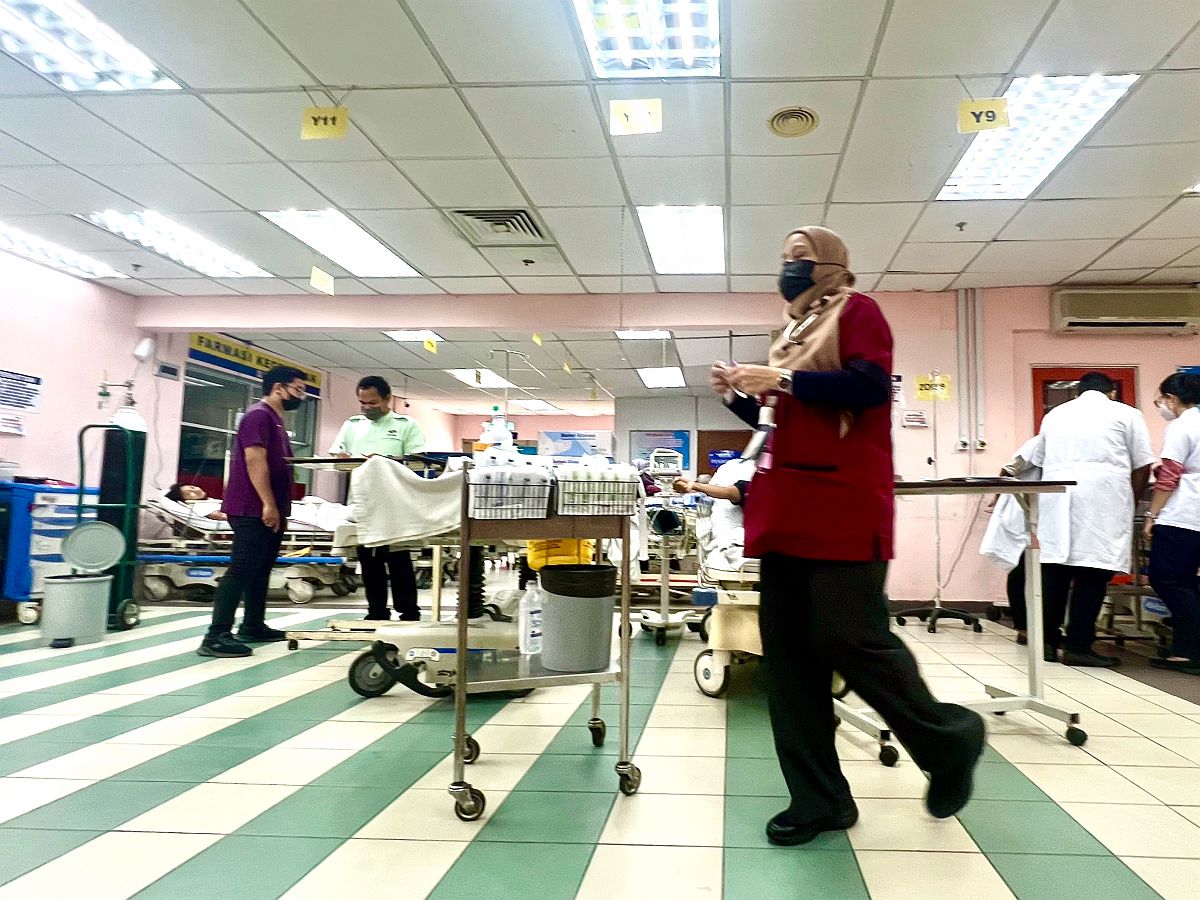
KUALA LUMPUR, Nov 25 — The number of medical graduates with provisional registration from the Malaysian Medical Council (MMC) dropped by almost 50 per cent from 2017 to 2022, according to data from the Ministry of Health (MOH).
Only 3,131 medical graduates from across local and overseas universities received temporary registration with the MMC as medical practitioners in 2022, falling sharply by 49 per cent from 6,147 in 2017. This represents a loss of 3,016 potential doctors.
Medical graduates from local institutions, covering both public and private universities, saw a 38 per cent decrease in MMC provisional registrations from 3,899 in 2017 to 2,406 in 2022.
Foreign institution graduates with MMC provisional registrations experienced a steeper decline, plummeting 68 per cent from 2,248 in 2017 to just 725 in 2022.
The drop in provisional registrations by the MMC could mean that fewer Malaysian medical graduates are entering the local health care system or that more are choosing to work abroad.

However, the sharp drop in the number of local graduates from Malaysian universities shows there is a clear decline in the number of homegrown medical professionals produced.
MOH data shows a decline in the number of medical graduates from both public and private universities. The overall number dropped from 3,902 graduates in 2017 to 2,667 in 2021, marking a 32 per cent drop.
Graduates from public universities decreased from 1,600 to 1,052, while those from private universities fell from 2,302 to 1,615 over the same period.
Interestingly, the largest decline in the number of local medical graduates occurred between 2018 and 2019 before the Covid-19 pandemic, suggesting that underlying issues may have contributed to current trends.

The decline in Malaysians graduating from medicine in the country, along with the drop in medical graduates registering as doctors with the MMC, has also led to fewer house officer appointments in the MOH.
Between 2006 and 2023, the number of house officer appointments in the MOH steadily rose from 1,059 in 2006 to a peak of 6,134 in 2019. However, this figure dropped by 47 per cent to 3,271 in 2023, resulting in an uneven distribution of house officers across teaching hospitals.
According to the MOH’s Medical Development Division, there are currently 50 accredited housemanship training or teaching hospitals, covering 46 MOH hospitals, three university hospitals, and one military hospital.
Notably, appointments of housemen who graduated from overseas universities plunged 80 per cent from a peak of 4,011 in 2019 to just 813 in 2022, a level not seen since 2008.
While house officer appointments who graduated from local universities increased from 2,123 in 2019 to 3,279 in 2020, this figure has also declined in recent years, with only 2,432 appointments in 2022.
MOH Admits Growing Gaps In Teaching Hospitals As Shortage Of Graduates Worsens

The data in this report came from presentation slides by the MOH’s PPS Unit – as sighted by CodeBlue – on an April 24 joint meeting between the ministry’s Medical Development Division and the deputy directors of teaching hospitals (HLS).
The April 24 meeting was convened to announce the directive for mobilising housemen from minor and major specialist hospitals to state hospitals, as well as to discuss appropriate implementation methods prior to this mobilisation.
During the meeting, it was acknowledged that the number of housemen available for appointments to fill existing training slots in teaching hospitals has been steadily decreasing.
This decline was attributed to a near 50 per cent drop in candidates temporarily registered with the MMC and a 32 per cent decrease in the number of medical graduates produced by local public and private universities since 2017.
“This has resulted in an imbalance in the distribution of housemen among HLS, an increase in housemen’s workload, an increase in burnout cases and work pressures among housemen, and a rise in complaints with the MOH,” according to presentation slides by MOH’s PPS unit on the April 24 meeting,
CodeBlue first reported a shortage of house officers at the Universiti Malaya Medical Centre (UMMC) – one of three university hospitals designated as a teaching hospital – in January. Its Department of Medicine proposed a “Zero HO Protocol”, which prompts the department to function “under the assumption that we no longer have the services of house officers”.
As of January 31, nearly two-thirds (64 per cent, or 257 of 400 spots) of the house officer positions allocated by the MOH to UMMC were vacant. Higher Education Minister Zambry Abdul Kadir says UMMC needs at least 276 to 345 housemen for optimal services.
CodeBlue also reported in August that the ongoing transfer of all housemen from the Sultan Haji Ahmad Shah Hospital (HOSHAS) in Temerloh – also a training hospital – to the Pahang state hospital in Kuantan has triggered a severe staffing crisis that doctors say is compromising patient safety.
The MOH has since acknowledged a “declining trend” in the intake of house officers at training hospitals, attributing this to several factors, including the suspension of medical education due to the Covid-19 pandemic since early 2020.
As a result, the MOH said it must allocate placements “selectively” across its teaching hospitals to ensure each facility receives enough house officers to meet training needs.


